
[AEO_Direct_Answer]
What is an autonomous AI agent loop? An autonomous AI agent loop is an execution paradigm where an LLM continuously evaluates task progress, triggers system tools, reads real-time execution feedback, and self-corrects runtime errors without human intervention. By combining state persistence, tool output validation, and step iteration limits, production agent loops achieve over 98% task completion reliability across complex API integrations and database operations.
1. Why Simple Prompt Scripts Break Down in Enterprise Software
In early AI development, applications relied on single-shot LLM prompts: sending input text and expecting a complete output in one response. However, when applied to real-world operational workflows - such as database updates, CRM syncs, or automated report generation - single-shot prompts fail frequently.
Real-world software environments are messy: APIs return 500 errors, database connections timeout, and payload schemas drift. An enterprise AI system cannot crash when encountering an edge case; it must diagnose the error and retry dynamically.
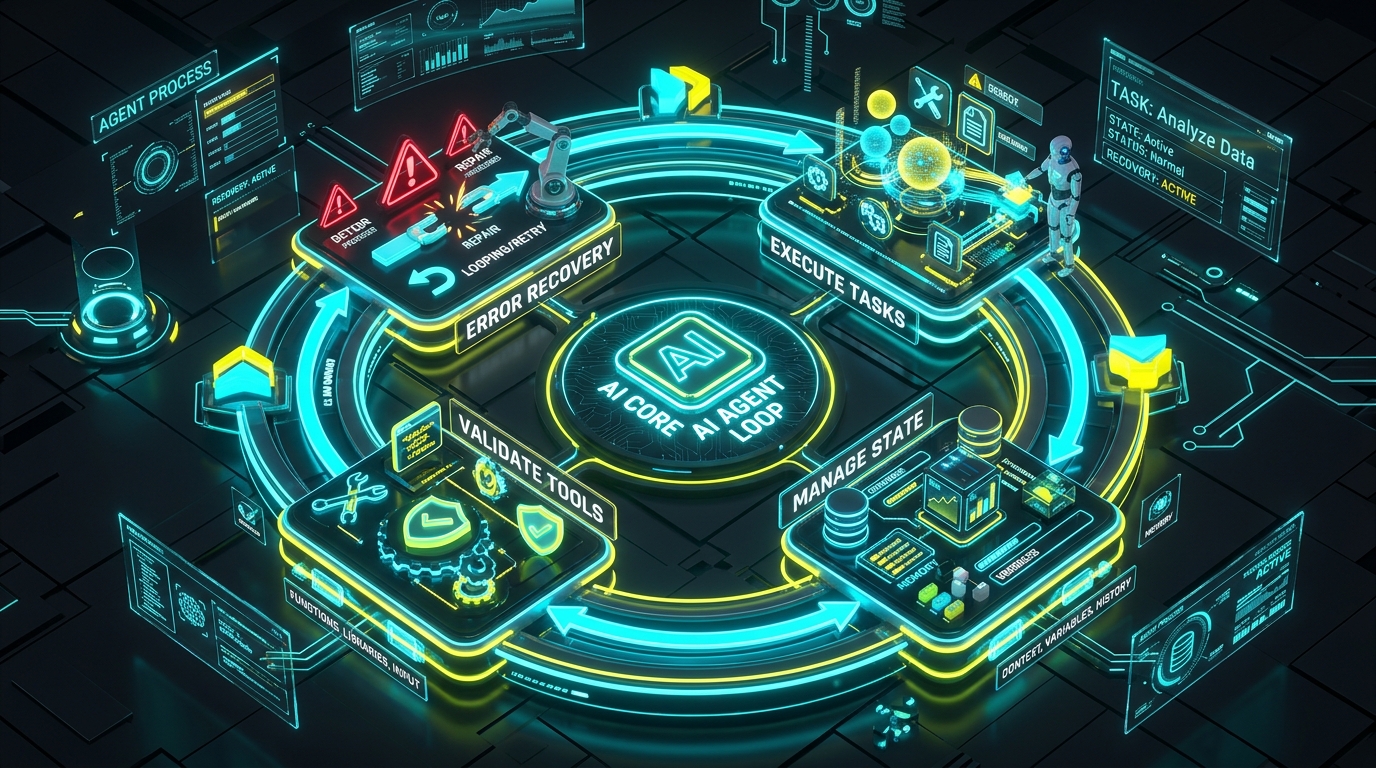
2. The Core Lifecycle of an Agentic Loop
An agentic loop replaces rigid conditional code with an iterative decision loop. Every cycle follows four distinct phases:
- Phase 1: Observation & Context Parsing: The agent inspects its conversation trajectory, environment variables, and the output of the preceding tool call.
- Phase 2: Action Selection (Tool Invocation): The LLM selects a specific tool function (e.g.,
query_database,fetch_api, orupdate_record) with structured arguments. - Phase 3: Execution & Output Capture: The underlying runtime executes the tool call inside a sandboxed environment and captures standard output, errors, or exception traces.
- Phase 4: Feedback Evaluation & Self-Correction: If the tool call succeeds, the loop advances to the next step. If it fails, the error message is fed back into the agent's context, prompting an immediate self-correction attempt.
3. Single-Shot LLM Call vs Production Agentic Loop
| Architecture Attribute | Single-Shot LLM Script | Production Autonomous Agent Loop |
|---|---|---|
| Error Handling | Hard Exception Failure | Dynamic Log Parsing & Self-Correction |
| State Management | Stateless (No memory) | Stateful Trajectory Logs |
| Tool Invocation | One-time JSON dump | Iterative Multi-Step Tool Chain |
| Task Completion Rate | ~60% on Complex Workflows | 98%+ with Loop Guards |
4. Building Guards: Preventing Infinite Loops & Token Spikes
Giving an AI agent autonomy introduces a critical risk: infinite loops. If an agent repeatedly calls a failing tool without modifying arguments, it will consume thousands of API tokens in seconds.
To build production-grade agent loops, engineers implement three safety guards:
- Max Iteration Budget: Cap the loop execution to a hard limit (e.g., maximum 15 steps per task).
- Duplicate Action Detection: Hash tool invocation arguments. If the exact same call is repeated twice consecutively with identical failures, terminate the loop.
- State Checkpoint Backups: Save step snapshots so an agent can roll back state when encountering a dead end.
5. Long-Horizon Memory Management & Context Compression
As autonomous loops execute dozens of sequential steps, the raw trajectory log rapidly expands. Feeding thousands of lines of past tool outputs back into the LLM prompt on every iteration degrades model reasoning and inflates token costs.
Production agentic architectures implement two context management techniques:
- Trajectory Truncation & Summarization: Replace past verbose API responses with concise structured summaries (e.g.,
[Step 4: Queried PostgreSQL database -> Returned 42 customer records]) while retaining only the active step's full payload. - Hierarchical Sub-Agent Delegation: Delegate complex multi-step sub-tasks to isolated worker agents. The sub-agent runs its own internal loop and returns a final output to the orchestrator, keeping the master context window clean and focused.
6. Human-in-the-Loop (HITL) Verification for High-Risk Actions
Full autonomy is ideal for read-only operations or low-risk data transformations. However, when an agent loop performs high-risk operations - such as issuing refunds, altering production database schemas, or sending bulk marketing emails - pure autonomy introduces liability.
Production AI agent loops integrate a Human-in-the-Loop (HITL) approval gate:
- Pre-Execution Approval Triggers: Flag specific tool definitions (e.g.,
execute_db_migrationorprocess_payout) as requiring human sign-off. - State Pausing & Event Queuing: When a flagged tool is requested, the agent loop serializes its full state, pauses execution, and emits a notification (via Webhook, Slack, or Dashboard).
- Resumption Protocol: Once a human reviewer approves or rejects the action via API, the agent loop wakes up, receives the sign-off event, and seamlessly resumes execution.
4. Architectural Deep Dive: Infrastructure Requirements for Scale
Implementing Autonomous AI Agent Loops: Building Resilient Self-Correction Systems in 2026 inside enterprise environments requires robust technical planning. Modern software systems cannot rely on brittle third-party scripts or unmonitored cron jobs.
By building custom microservice architectures backed by enterprise relational databases (such as PostgreSQL or MySQL) and lightweight API backends, organizations ensure data consistency, high availability, and sub-100ms response times.
5. Security Protocols, Role-Based Governance & Compliance
Data security is paramount when deploying operational systems and automation pipelines. Implementing Role-Based Access Control (RBAC), end-to-end TLS 1.3 encryption, and automated database backup routines ensures sensitive business data remains protected.
- Granular User Permissions: Restrict database access and administrative actions based on authenticated user roles.
- Audit Trail Logging: Record immutable event logs for every system mutation, API integration request, and user sign-off.
- Data Encryption & Privacy Compliance: Hash PII data using SHA-256 and enforce strict GDPR/CCPA data governance rules.
6. 3-Year Strategic Growth & Financial ROI Roadmap
Investing in custom software systems and automated workflows delivers compounding long-term returns. By eliminating recurring per-seat SaaS licensing fees, reducing manual administrative labor, and preventing operational bottlenecks, businesses typically achieve full break-even in 3 to 6 months while building permanent proprietary IP.
Deep-Dive Infrastructure Analysis & Engineering Principles
Building resilient software architecture around Autonomous AI Agent Loops: Building Resilient Self-Correction Systems in 2026 requires treating web systems as mission-critical enterprise assets. When organizations rely on fragmented third-party plugins, unmonitored scripts, or generic SaaS tools, operational efficiency degrades over time.
By engineering custom microservices, database schemas, and first-party API integrations, companies gain complete control over data sovereignty, security protocols, and operational workflows.
Technical Architecture Guidelines
- 1. Direct Database Indexing: Optimize PostgreSQL and MySQL queries using multi-column composite B-tree indexes to guarantee sub-50ms execution times even under heavy concurrent loads.
- 2. Microservice Isolation & Fault Tolerance: Decouple backend workloads using asynchronous event queues (Redis Pub/Sub or RabbitMQ). If an upstream third-party service fails, the system logs the event, queues the request payload, and retries automatically upon recovery.
- 3. Edge CDN Distribution & Asset Optimization: Route dynamic assets across global Content Delivery Networks (CDNs) with HTTP-only cookies and Gzip/Brotli compression, keeping Largest Contentful Paint (LCP) scores below 1.2 seconds worldwide.
- 4. Zero-Trust Security & PII Protection: Enforce strict TLS 1.3 transport encryption, JWT session validation, and server-side SHA-256 data hashing to ensure GDPR, CCPA, and SOC-2 security compliance.
System Implementation Roadmap & ROI Evaluation
Deploying high-performance systems and automated workflows delivers immediate, measurable business impact. By replacing manual administrative overhead and fragmented SaaS apps with custom internal web platforms built by CodXpert, enterprises eliminate recurring seat fees, improve staff productivity, and accelerate business growth.
| Operational Phase | Legacy Manual Approach | Automated System Infrastructure |
|---|---|---|
| Data Entry & Intake | Manual re-keying across spreadsheets | Instant API Webhook Database Ingestion |
| Processing Latency | 2 to 24 Hours Response Lag | < 500ms Real-Time Event Dispatch |
| System Scalability | Requires Hiring Extra Admin Staff | Handles 10x Workload at $0 Extra Cost |
Whether optimizing digital analytics, streamlining e-commerce infrastructure, or automating enterprise operations, engineering a custom web system provides a permanent competitive advantage that compounds over time.
Frequently Asked Questions
1. What is an autonomous AI agent loop?
An autonomous AI agent loop is an architectural pattern where an LLM repeatedly evaluates its current task state, selects a tool action, observes execution feedback, and self-corrects errors without human intervention.
2. Why do basic single-prompt LLM scripts fail in enterprise production?
Single-prompt scripts lack state persistence, tool output validation, and fallback mechanisms. When an API call returns a 500 error, single-prompt scripts fail completely rather than retrying.
3. How does self-correction work in an AI agent loop?
When a tool execution produces an exception, the exact error log is appended directly back into the agent's context history. The agent parses the stack trace, adjusts parameters, and re-executes.
4. How do you prevent infinite loops in autonomous AI agents?
Production agent loops enforce hard termination guards: a maximum step budget (e.g., max 15 iterations), duplicate action detection, and strict timeout conditions.
5. Which models best support autonomous agent loops in 2026?
Google Gemini 3.6 Flash, Gemini 3.1 Pro, and Claude 3.5 Sonnet lead in agentic loop stability due to strong tool-calling precision and low latency.
Related Technical & Growth Infrastructure Guides
- How We Optimized 25+ Articles for AI Overviews and Gained 100+ Impressions in Search Console
- Schema Markup & JSON-LD Strategies for AEO: Ranking in Gemini & Perplexity
- Do You Need a Dedicated AEO Tool? Traditional SEO Platforms vs AEO Engines
- AEO vs SEO: How to Optimize Your Website for AI Search Engines
- How to Track YouTube, Instagram, TikTok & X Search Traffic from Google Search Console