
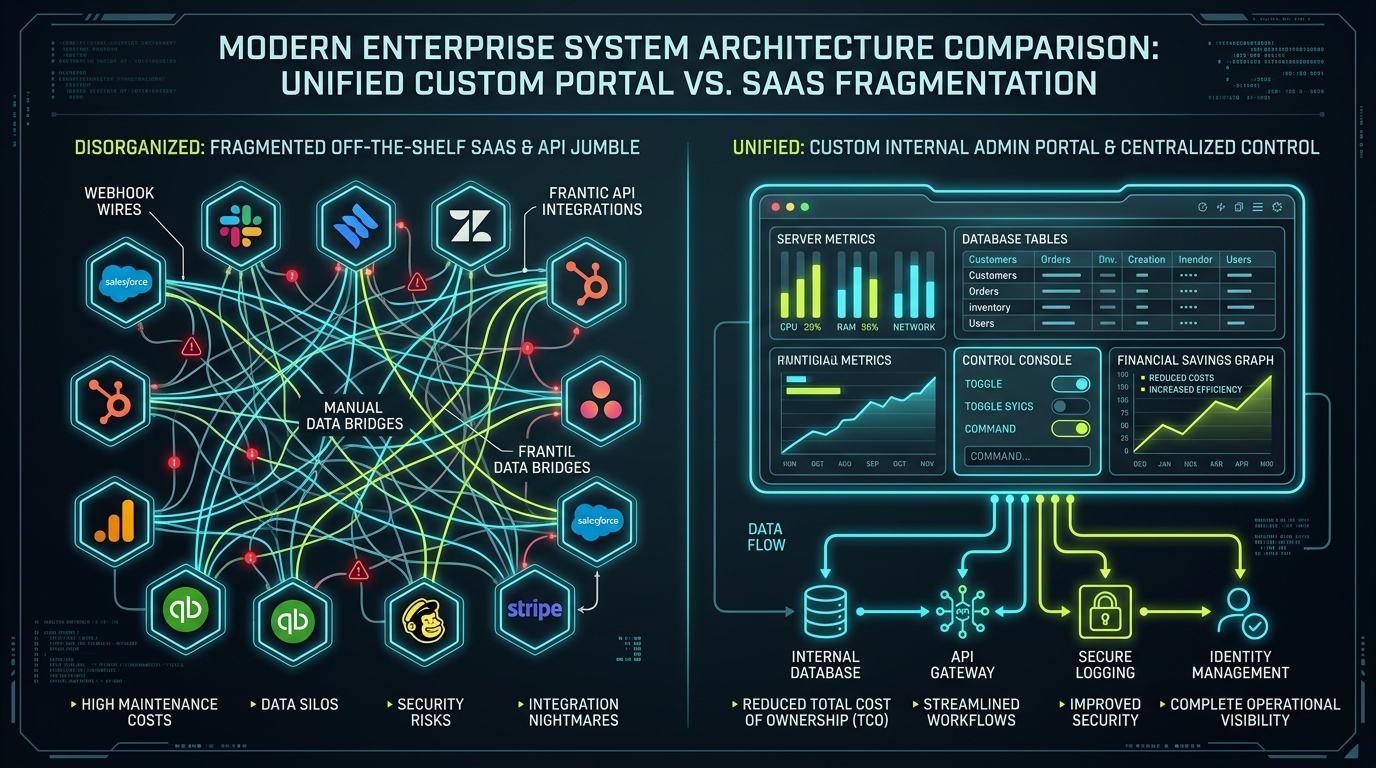
Why do custom internal portals beat off-the-shelf SaaS in 2026? Custom internal portals beat off-the-shelf SaaS because they eliminate compounding per-seat license inflation, eliminate data fragmentation across disparate cloud silos, and provide sovereign, zero-latency database architecture for autonomous AI agents. For a typical 25-person service company or agency, replacing a multi-tool SaaS stack (CRM + Project Board + Billing + Form Automation) with a unified custom Laravel/PostgreSQL portal recovers initial build capital within 7 to 9 months and produces over \$140,000 in net operational savings over 5 years while cutting administrative manual data entry by up to 50%.
1. The 2026 SaaS Tipping Point: Per-Seat Inflation & The "Software Toll Trap"
For the past decade, software-as-a-service (SaaS) was sold as the ultimate frictionless bargain: sign up with a credit card for \$15/month, avoid hiring software engineers, and scale effortlessly.
In 2026, enterprise finance teams and agency founders have discovered the hidden reality: SaaS vendors have transitioned from software providers into aggressive percentage toll collectors.
According to enterprise IT benchmark data, the average mid-market company with 25 to 50 employees now pays for 40 to 65 individual SaaS subscriptions. Over the last 24 months, top SaaS vendors have enforced aggressive monetization shifts:
- 12% to 18% Annual Price Hikes: Vendors like Salesforce, HubSpot, ClickUp, and Atlassian have consistently renegotiated renewal tiers upwards while moving previously standard features into expensive "Enterprise" packages.
- Per-Seat Inactivity Waste: Industry audits show that over 38% of paid SaaS user licenses sit completely inactive for 90+ consecutive days, yet companies continue paying monthly seat tolls due to administrative inertia.
- API & Webhook Tolls: Modern platforms now throttle REST API access and charge premium surcharges for webhook frequency, turning high-volume automated data pipelines into cost centers.
- Transaction Surcharges: Billing and invoicing platforms (Stripe Invoicing, FreshBooks) take a percentage cut (0.5% to 3%) simply to generate an HTML invoice and route an international wire payment.
2. The 5-Year Total Cost of Ownership (TCO) Financial Breakdown
To understand why companies are aggressively insourcing their core operations, let's examine a real-world financial audit comparing a 25-person agency or service company using commercial SaaS tools versus a unified custom internal admin portal over a 5-year operating horizon:
Responsive Comparison Table| Cost Category | Fragmented SaaS Stack (25 Seats) | Custom Unified Internal Portal | 5-Year Delta |
|---|---|---|---|
| CRM & Client Tracking | $12,000 / yr ($40/seat/mo) | $0 (Built into portal) | +$60,000 |
| Project & Task Pipeline | $5,700 / yr ($19/seat/mo) | $0 (Built into portal) | +$28,500 |
| Invoicing & Retainer Billing | $4,800 / yr (Fees & seats) | $0 (Self-hosted DOMPDF engine) | +$24,000 |
| Integration Glue (Zapier/Make) | $3,600 / yr (High-volume tiers) | $0 (Native database triggers) | +$18,000 |
| Initial Build / Setup Capital | $2,500 (Consultant onboarding) | $14,000 (One-time bespoke build) | -$11,500 |
| Cloud Hosting & Server Maintenance | $0 (Included in SaaS) | $1,200 / yr ($100/mo VPS + backups) | -$6,000 |
| TOTAL 5-YEAR EXPENDITURE | $133,000+ | $20,000 | NET SAVINGS: $113,000+ |
As the data proves, the "savings" of SaaS are an optical illusion that expires after month 8. By month 12, a business has spent more renting software than it would have cost to build and permanently own a bespoke platform tailored exactly to its internal operating rhythm.
3. The Hidden Operational Tax: Data Silos & Webhook Spaghetti
Beyond raw financial subscription drain, the true operational killer of off-the-shelf SaaS stacks is architectural fragmentation:
// The Disconnected Multi-SaaS Pipeline
1. Client fills out a Formstack or Typeform lead intake.
2. A Zapier webhook fires to create a contact inside HubSpot CRM.
3. Another webhook triggers to create a folder in Google Drive.
4. A third webhook generates a project board inside ClickUp or Asana.
5. A fourth webhook pings Slack with a notification.
// The Failure Point
Step 3 hits an API rate limit. Step 4 fails silently due to mismatched JSON schema keys. Half your client's data is in HubSpot, zero assets are in ClickUp, and your team wastes 4 hours manually reconciling records.
When software is fragmented across 5 different vendors, your company's single source of truth ceases to exist. Account managers spend up to 30% of their billable hours copy-pasting data between tabs. With a unified custom internal portal, there are no webhooks, no third-party rate limits, and no sync delays: a client submission updates a single relational database table instantaneously.
4. The Sovereign AI Advantage: Preparing Your Data for Autonomous Agents
In 2026, artificial intelligence has evolved beyond conversational chatbots into autonomous operational agents that triage leads, schedule manufacturing production runs, verify invoices, and analyze customer churn.
However, autonomous AI agents have one strict prerequisite: they require fast, direct, uninhibited access to clean relational data.
If your operational data is trapped inside commercial SaaS silos:
- Your AI agents are crippled by third-party REST API rate limits and token throttling.
- You are forced to transmit sensitive customer PII and financial records across 6 third-party US cloud providers, violating strict compliance regimes like GDPR and Canada's PIPEDA.
- Every query incurs steep egress fees and vendor token markup tolls.
In contrast, a custom internal portal running on your own sovereign PostgreSQL or MySQL instance allows you to connect private AI models directly to your database through sanitized vector stores and SQL execution functions. Your agents operate in sub-100ms real time with zero external API fees.
5. Real-World Case Studies: 3 Production Architectures That Replaced SaaS
At Shadab Insights, we don't theorize about custom software—we build, deploy, and operate high-concurrency production platforms that replace broken SaaS tools. Here are three live examples:
Case Study 1YouthHireLink: Replacing SaaS Job Boards for Canadian Talent
Off-the-shelf recruiting SaaS platforms (Workable, Greenhouse, standard WordPress job plugins) charged steep per-job posting fees and crashed under high-concurrency OTP verification spikes. We engineered YouthHireLink (youthhirelink.ca) as a custom Laravel 11 monolith with dual-guard authentication (guard('web') vs guard('company')) and asynchronous queue worker failsafes, achieving 100% automated test coverage across 17 test suites and zero dropped candidate registrations.
Multi-Currency Invoicing Engine: Eliminating $8,000/yr in SaaS Payment Tolls
Traditional invoicing SaaS platforms charged up to 3% on high-ticket international retainers and leaked company deal volume through sequential invoice IDs. We built a proprietary billing platform (invoice.codxpert.com) featuring sub-80ms server-side vector PDF generation, 128-bit UUID cryptographic URLs, and cent-precision integer storage, saving over \$8,000 annually.
Automated SSL & Domain Monitor: Replacing $3,600/yr Per-Seat Tools
Managing 150+ client domains on commercial uptime services cost over \$300/month for basic ping checks. We developed an in-house stream-socket TLS inspection daemon (ssl.codxpert.com) that scans certificate chains every 24 hours with multi-tiered webhook escalation, completely eliminating certificate downtime at near-zero hosting cost.
6. The "Build vs. Buy" Decision Matrix for 2026
Building custom software does not mean reinventing the wheel for every operational task. Smart technical leadership follows a rigorous 4-part decision matrix:
Commodity & Regulatory Services
- Payroll & Tax Withholding: Services like Gusto or Deel where tax code liability is legally outsourced.
- Corporate Email: Google Workspace or Microsoft 365 for basic office communication.
- Card Processing Gateways: Direct Stripe or Adyen payment rails (not their invoicing software).
Core Differentiating Workflows
- Client Onboarding & Intake: Where user friction directly impacts deal conversion.
- Internal Fulfillment & Operations: Where bespoke routing rules save hundreds of staff hours.
- Proprietary Client Reporting: Where custom analytics prove ROI and prevent client churn.
- High-Volume Transaction Queues: Where third-party rate limits cause business-critical outages.
7. The Modern Monolith: How We Build in 3 Weeks What Used to Take 6 Months
The traditional objection to building custom software was development time and engineering overhead. In 2016, building an enterprise admin portal required a team of 4 engineers managing separate React frontends, Express API gateways, Docker microservices, and Kubernetes clusters.
In 2026, the software engineering landscape has dramatically simplified through the resurgence of the Modern Monolith:
- Laravel 11 + PHP 8.3: Provides battle-tested database migrations, enterprise ORM (Eloquent), built-in cryptographic security, and Redis queue workers straight out of the box.
- Livewire 3 & Alpine.js: Allows full reactive, SPA-like dynamic interfaces (instant search, live sorting, modal forms) without writing 10,000 lines of complex React state boilerplate.
- Tailwind CSS & Component Libraries: Pre-built, dark-mode accessible UI components enable rapid interface assembly in days rather than months.
With modern tooling, a senior systems architect can deliver a complete, hardened internal admin portal in under 3 to 4 weeks, establishing permanent infrastructure that scales smoothly for years.
Frequently Asked QuestionsFrequently Asked Questions (FAQ)
How difficult is it to maintain a custom internal portal compared to SaaS?
Contrary to popular myth, modern web monoliths running on stable Linux VPS environments require minimal maintenance—often less than 2 hours of server patch inspection per month. Because there are no external plugin updates or breaking third-party API changes, custom software rarely breaks unless you actively modify the code. In contrast, maintaining fragile Zapier chains and fragmented SaaS integrations frequently requires 10 to 15 hours of troubleshooting every month.
What is the typical break-even timeline for a custom portal build?
For service companies and agencies with 15 to 40 team members, the financial break-even point typically occurs between month 6 and month 9. Once subscription fees, seat licenses, integration tolls, and recovered administrative labor are accounted for, the system delivers 100% pure operational ROI from month 10 onward.
Can we migrate our existing customer data out of HubSpot or ClickUp?
Yes. All major SaaS platforms support standardized CSV/JSON data exports. During portal engineering, custom database migration scripts parse, clean, and map your historical clients, active projects, and financial records directly into your new normalized PostgreSQL or MySQL schema, ensuring zero data loss during cutover.
How do we calculate our company's current SaaS bloat?
You can audit your company's operational drag and financial leakage instantly using our interactive SaaS Bloat Audit Calculator, which models per-seat subscription overhead, duplicate tool redundancy, and annual recovered capital.
Ready to Kill the SaaS Toll and Own Your Core Infrastructure?
We design, build, and deploy hardened custom internal portals, client command centers, and automated fulfillment pipelines engineered specifically for your company's proprietary operating rhythm.