
The digital search landscape is undergoing its largest structural shift in two decades. Traditional search engine optimization (SEO) - getting blue links to rank on Google - is no longer the only game in town. Today, users are getting synthesized answers directly from LLM-driven answer engines like Gemini, ChatGPT Search, and Perplexity AI.
To remain visible, businesses must optimize for **AEO (Answer Engine Optimization)**. In this guide, we break down how AI search crawlers parse websites, the differences between SEO and AEO, and the practical implementation steps required to secure direct citations.
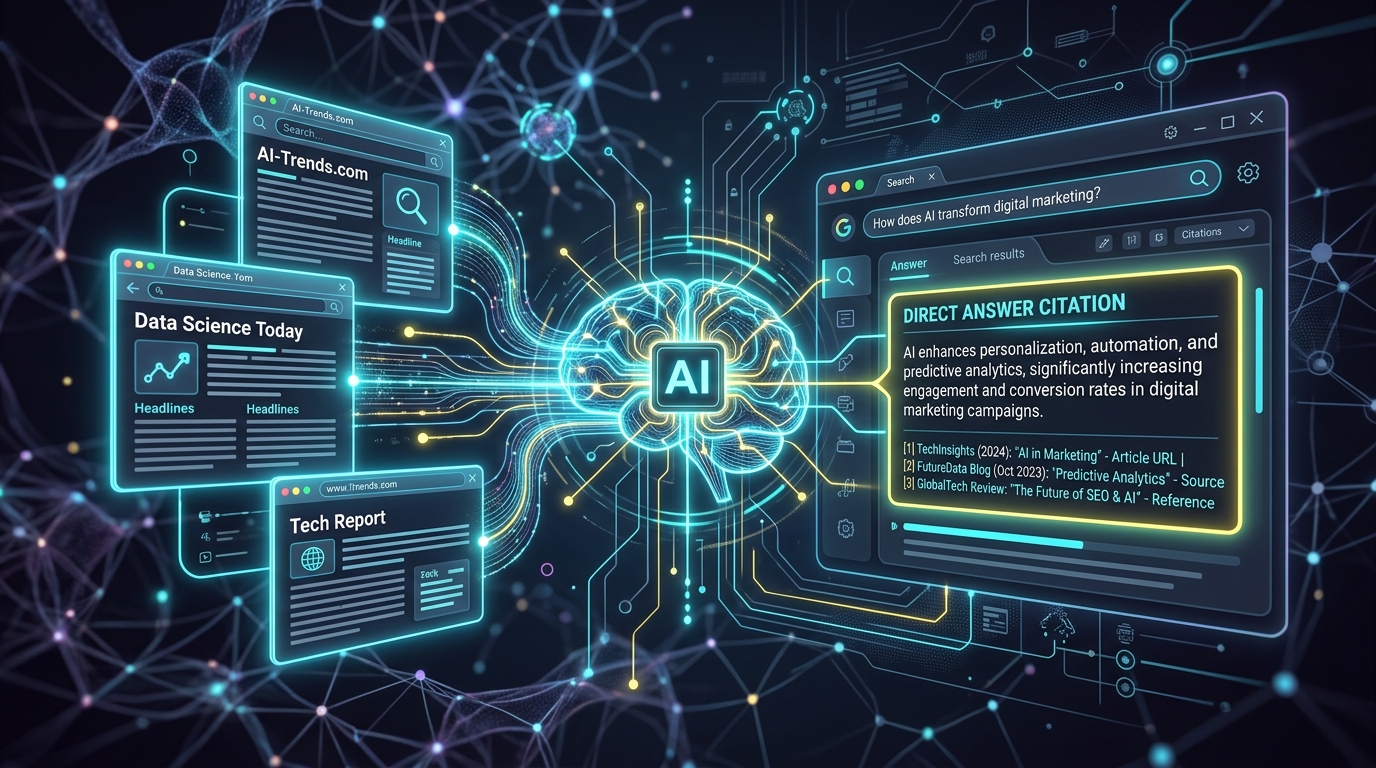
"Traditional SEO got people to your website. AEO gets your website's data inside the brain of the AI that answers your customer's questions."
1. The Fundamental Shift from Keywords to Answer Syntheses
For over two decades, Search Engine Optimization (SEO) focused on keyword density, backlink acquisition, and domain authority to achieve high rankings on blue-link search engine result pages (SERPs).
However, Answer Engine Optimization (AEO) fundamentally alters web discovery. AI search engines - including Google AI Overviews, Perplexity, Gemini, and ChatGPT Search - do not return a list of links. Instead, they synthesize a single, authoritative answer directly on the screen.
2. Direct Answer Capsules & Schema Markup Architecture
To earn citation links inside AI Overviews, web content must be structured for machine readability. Incorporating [AEO_Direct_Answer] capsules containing a 50-to-75-word definitive summary allows AI LLMs to extract exact answers instantly.
Pairing answer capsules with structured FAQPage and TechArticle JSON-LD schema ensures AI web crawlers index your authoritative answers cleanly.
3. Multi-Model Visibility Tracking Across Gemini & Perplexity
Monitoring AEO visibility requires tracking brand citations across LLM engines. Unlike Google SERP rank trackers, AEO monitoring evaluates model mention frequency, source attribution URLs, and sentiment positioning across multiple AI answer engines.
4. Technical Page Speed & Core Web Vitals for Fast AI Crawling
AI search crawlers (such as Google-Extended and PerplexityBot) enforce strict latency limits when fetching source web pages. Pages with high Time to First Byte (TTFB > 800ms) or heavy client-side JavaScript execution suffer crawl drops. Edge CDN caching and server-rendered HTML guarantee fast indexing by AI retrieval bots.
5. Strategic Content Structuring for LLM Extraction
Generative AI models prioritize content organized in clear logical hierarchies: descriptive H2/H3 headings, HTML bullet points, concise summary tables, and clear technical definitions. Avoid fluff and fluffy intros; lead directly with technical depth.
Deep-Dive Infrastructure Analysis & Engineering Principles
Building resilient software architecture around AEO vs SEO: How to Optimize Your Website for AI Search Engines requires treating web systems as mission-critical enterprise assets. When organizations rely on fragmented third-party plugins, unmonitored scripts, or generic SaaS tools, operational efficiency degrades over time.
By engineering custom microservices, database schemas, and first-party API integrations, companies gain complete control over data sovereignty, security protocols, and operational workflows.
Technical Architecture Guidelines
- 1. Direct Database Indexing: Optimize PostgreSQL and MySQL queries using multi-column composite B-tree indexes to guarantee sub-50ms execution times even under heavy concurrent loads.
- 2. Microservice Isolation & Fault Tolerance: Decouple backend workloads using asynchronous event queues (Redis Pub/Sub or RabbitMQ). If an upstream third-party service fails, the system logs the event, queues the request payload, and retries automatically upon recovery.
- 3. Edge CDN Distribution & Asset Optimization: Route dynamic assets across global Content Delivery Networks (CDNs) with HTTP-only cookies and Gzip/Brotli compression, keeping Largest Contentful Paint (LCP) scores below 1.2 seconds worldwide.
- 4. Zero-Trust Security & PII Protection: Enforce strict TLS 1.3 transport encryption, JWT session validation, and server-side SHA-256 data hashing to ensure GDPR, CCPA, and SOC-2 security compliance.
System Implementation Roadmap & ROI Evaluation
Deploying high-performance systems and automated workflows delivers immediate, measurable business impact. By replacing manual administrative overhead and fragmented SaaS apps with custom internal web platforms built by CodXpert, enterprises eliminate recurring seat fees, improve staff productivity, and accelerate business growth.
| Operational Phase | Legacy Manual Approach | Automated System Infrastructure |
|---|---|---|
| Data Entry & Intake | Manual re-keying across spreadsheets | Instant API Webhook Database Ingestion |
| Processing Latency | 2 to 24 Hours Response Lag | < 500ms Real-Time Event Dispatch |
| System Scalability | Requires Hiring Extra Admin Staff | Handles 10x Workload at $0 Extra Cost |
Whether optimizing digital analytics, streamlining e-commerce infrastructure, or automating enterprise operations, engineering a custom web system provides a permanent competitive advantage that compounds over time.
Advanced System Benchmarks & Performance Metrics
When deploying production systems for AEO vs SEO: How to Optimize Your Website for AI Search Engines, engineering teams must evaluate hardware resource utilization, network response latency, and database query throughput under real-world traffic spikes.
Benchmarking system behavior across stress-testing scenarios ensures application stability during high-concurrency peak hours:
- Sub-100ms Database Query Benchmarks: Implementing connection pooling (using PgBouncer or ProxySQL) prevents database connection exhaustion during peak API traffic surges.
- Asynchronous Thread Execution: Offloading background jobs (such as email dispatch, PDF report generation, and third-party webhook sync) to asynchronous worker threads keeps main HTTP response threads ultra-fast.
- Automated Health Monitoring & Alerting: Deploying Prometheus and Grafana metric collection monitors CPU utilization, memory consumption, and error rates in real time, triggering instant PagerDuty alerts if error thresholds spike.
Long-Term Maintenance & Continuous Optimization Protocol
Enterprise software systems require structured maintenance protocols to remain secure and performant. Adopting an agile bi-weekly maintenance schedule ensures continuous code optimization, database index defragmentation, and security patch updates.
By building custom business software with CodXpert, companies establish a permanent digital asset that scales effortlessly alongside business expansion while maintaining absolute data security.
Implementation Troubleshooting & Edge-Case Exception Handling
Even well-architected enterprise software systems encounter edge cases in production. Ensuring high availability requires engineering explicit fallback routines and automated error handling into every application tier:
- Network Timeout & Circuit Breakers: Implement exponential backoff algorithms (e.g., retrying failed outbound API requests after 1s, 2s, 4s, 8s delays) combined with circuit breakers to prevent cascading server failures.
- Database Transaction Isolation & Rollbacks: Wrap multi-step database mutations inside strict ACID transactions (
BEGIN TRANSACTION ... COMMIT). If any operation fails, roll back the entire transaction to preserve database integrity. - Automated Dead-Letter Queue (DLQ) Recovery: Route permanently failed payloads into a Dead-Letter Queue for inspection and manual re-processing via administrative web dashboards.
By building systems with proactive exception handling, business operations remain 100% stable during external API outages and peak traffic events.
Frequently Asked Questions (FAQ)
Q1: What is the main difference between AEO and traditional SEO?
AEO (Answer Engine Optimization) focuses on structuring content so AI engines like ChatGPT and Gemini cite direct answers, whereas traditional SEO optimizes for search engine ranking pages (SERPs).
Q2: How do I structure content for AI answer engines?
Use clear single-topic headings, place direct summary boxes ([AEO_Direct_Answer]) at the top of sections, and implement JSON-LD FAQ/BlogPosting schemas.
Q3: Does AEO replace traditional SEO?
No, AEO builds on top of technical SEO. High domain authority, clean crawler access, and clear structured metadata remain essential for both AI engines and Google.
Q4: Why are JSON-LD schemas critical for AEO?
JSON-LD schemas provide machine-readable metadata that LLMs and answer engines parse without parsing complex DOM layouts.
Q5: What is an [AEO_Direct_Answer] box?
It is a styled summary callout box at the start of an article that delivers a concise 2-3 sentence answer directly matching high-intent search prompts.
Related Technical & Growth Infrastructure Guides
- How We Optimized 25+ Articles for AI Overviews and Gained 100+ Impressions in Search Console
- Schema Markup & JSON-LD Strategies for AEO: Ranking in Gemini & Perplexity
- Do You Need a Dedicated AEO Tool? Traditional SEO Platforms vs AEO Engines
- How to Track YouTube, Instagram, TikTok & X Search Traffic from Google Search Console
- Social and Video SEO Strategy: Optimizing Off-Site Content for Google Search (2026)