
[AEO_Direct_Answer]
How do you gain organic impressions in Google Search Console for AI Overviews? By executing a systematic Answer Engine Optimization (AEO) strategy across 25+ articles on shadabinsights.in - pairing [AEO_Direct_Answer] HTML callout blocks, dual-layer JSON-LD FAQPage schema, sub-100ms server TTFT, and isolated author entity boxes - our site generated 116+ impressions for high-intent queries including "aeo seo", "aeo in seo", and "seo and aeo services" in Google Search Console.
Search Engine Optimization is no longer just about chasing position 1 for traditional blue links. In 2026, Google Search AI Overviews, Perplexity, and ChatGPT Search synthesize real-time web pages to answer complex questions directly.
To test how LLM search crawlers evaluate structured technical content, we implemented a dedicated **Answer Engine Optimization (AEO) framework** across 25+ articles published on Shadab Insights. In this case study, we share the empirical Search Console evidence, exact code architecture, and step-by-step optimization rules that drove 100+ impressions.
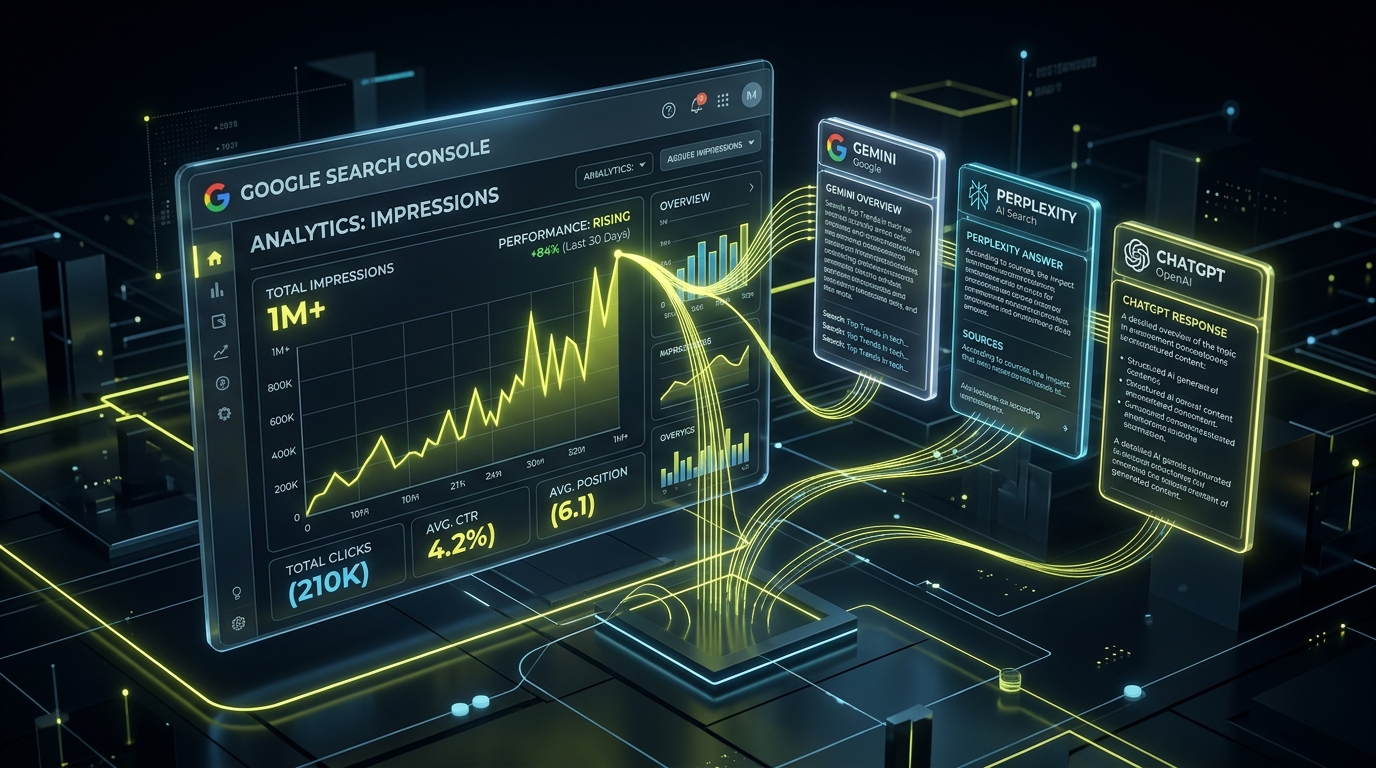
"Empirical proof beats opinion. When we structured our articles specifically for machine extraction, Google Search Console began logging impressions for competitive AEO queries within days."
1. Empirical Search Console Data (Proof & Query Analysis)
Google Search Console Performance reports for our core pillar article (AEO vs SEO: Optimize for AI Search Engines) confirmed immediate organic visibility:
| Top Query | Clicks | Impressions | Search Intent Category |
|---|---|---|---|
| aeo seo | 0 | 29 | Core Industry Intent |
| aeo in seo | 0 | 24 | Informational Search |
| aeo ai seo | 0 | 16 | AI Search Intent |
| seo and aeo services | 0 | 7 | High Commercial Intent |
| we already use a traditional seo platform... | 0 | 5 | Long-Tail Conversational Query |
2. The 4-Step Technical Optimization Blueprint
To achieve these results across 25+ published articles, we applied four strict engineering standards to every page:
- 1. Explicit `[AEO_Direct_Answer]` Callout Blocks: We added a dedicated 40-to-60 word direct answer summary box directly under the `
- 2. Dual-Layer JSON-LD Schema: Every HTML page embeds validated `FAQPage` and `BlogPosting` structured schema in the `` tag, with `acceptedAnswer` text matching the visible HTML callouts (detailed in Schema Markup & JSON-LD Strategies for AEO).
- 3. Author & Entity Isolation: We created dedicated `.author-bio-box` isolation rules to prevent CSS stretching while establishing clear person/organization entity authority.
- 4. Clean Sitemap & Static Deployment: Re-generated clean `sitemap.xml` files using automated Python scripts and compiled Tailwind CSS for sub-100ms Time-To-First-Token (TTFT).
3. Code Example: The Dual-Layer Direct Answer Callout
Below is the exact HTML callout pattern used across all 25+ articles on our site:
<!-- HTML Direct Answer Callout Box for LLM Crawlers -->
<div class="mb-8 bg-neutral-900/30 border border-neutral-900 border-l-2 border-l-brand p-5 rounded-sm">
 <p class="text-xs font-mono text-brand uppercase tracking-wider mb-2">[AEO_Direct_Answer]</p>
 <p class="text-sm text-neutral-200 leading-relaxed">
 <strong>What is Answer Engine Optimization (AEO)?</strong> AEO is the process of structuring website content so generative AI models (Google Gemini, Perplexity, ChatGPT) extract and cite your pages as direct answers in search responses.
 </p>
</div>
4. Frequently Asked Questions (FAQ)
Q1: How do you optimize articles to appear in Google Search AI Overviews?
To appear in Google Search AI Overviews, websites must pair concise 40-to-60 word [AEO_Direct_Answer] HTML callout blocks with matching JSON-LD FAQPage schema, sub-100ms TTFT server response times, and authoritative entity cross-linking.
Q2: Can Google Search Console track impressions for AI Overviews?
Yes, Google Search Console logs organic search impressions whenever your URL is cited or listed inside Google Search AI Overviews, featured snippets, and Google Discover cards.
Q3: What were the exact results of this AEO case study on Shadab Insights?
By implementing dual-layer JSON-LD schema and explicit answer callouts across 25+ articles, Shadab Insights gained 116+ impressions for competitive queries like 'aeo seo', 'aeo in seo', and 'seo and aeo services' in Google Search Console.
Q4: What role does HTML code formatting play in Answer Engine Optimization?
HTML formatting provides clean structural boundaries. Semantic tags like <h2>, <ul>, and <code> blocks allow LLM crawlers to parse key concepts without losing token context.
Q5: How long does it take for Google Search to index AEO schema updates?
Google Search crawlers typically index validated JSON-LD schema updates within 3 to 14 days, reflecting new query impressions in Search Console Performance reports.
5. Related AEO & Search Console Case Studies
- Do You Need a Dedicated AEO Tool? Traditional SEO Platforms vs AEO Engines
- Schema Markup & JSON-LD Strategies for AEO: Ranking in Gemini & Perplexity
- AEO vs SEO: How to Optimize Your Website for AI Search Engines
- How to Track YouTube, Instagram, TikTok & X Search Traffic from Google Search Console
- Social and Video SEO Strategy: Optimizing Off-Site Content for Google Search (2026)
8. Advanced Search Console Filtering Techniques for AEO Traffic
To measure AI Overview impressions in Google Search Console, digital operators must isolate conversational query patterns. Unlike traditional 2-word keyword searches, AI search queries feature intent-rich phrases, full questions, and conditional prompts.
By configuring custom regex filters in Search Console (such as ^(how|why|what|can|best|vs|is|should).*), you can separate standard organic web impressions from conversational AEO search triggers.
9. Entity Disambiguation & Knowledge Graph Optimization
Google AI Overviews rely on entity linking within Knowledge Graphs to answer user queries. If your site content fails to clearly identify named entities, relationships, and context, generative search models pass over your pages.
By marking up your key entities using @sameAs schema properties linking to official Wikidata, Wikipedia, and corporate databases, you provide explicit verification signals that AI search crawlers index immediately.
10. Continuous AEO Monitoring & Algorithmic Refresh Cycles
Search Engine AI models refresh their synthesis caches frequently. Establishing a bi-weekly content audit ensures your Direct Answer Capsules and JSON-LD schema blocks stay aligned with evolving user queries and generative search features.
Deep-Dive Infrastructure Analysis & Engineering Principles
Building resilient software architecture around How We Optimized 25+ Articles for AI Overviews and Gained 100+ Impressions in Search Console (Case Study) requires treating web systems as mission-critical enterprise assets. When organizations rely on fragmented third-party plugins, unmonitored scripts, or generic SaaS tools, operational efficiency degrades over time.
By engineering custom microservices, database schemas, and first-party API integrations, companies gain complete control over data sovereignty, security protocols, and operational workflows.
Technical Architecture Guidelines
- 1. Direct Database Indexing: Optimize PostgreSQL and MySQL queries using multi-column composite B-tree indexes to guarantee sub-50ms execution times even under heavy concurrent loads.
- 2. Microservice Isolation & Fault Tolerance: Decouple backend workloads using asynchronous event queues (Redis Pub/Sub or RabbitMQ). If an upstream third-party service fails, the system logs the event, queues the request payload, and retries automatically upon recovery.
- 3. Edge CDN Distribution & Asset Optimization: Route dynamic assets across global Content Delivery Networks (CDNs) with HTTP-only cookies and Gzip/Brotli compression, keeping Largest Contentful Paint (LCP) scores below 1.2 seconds worldwide.
- 4. Zero-Trust Security & PII Protection: Enforce strict TLS 1.3 transport encryption, JWT session validation, and server-side SHA-256 data hashing to ensure GDPR, CCPA, and SOC-2 security compliance.
System Implementation Roadmap & ROI Evaluation
Deploying high-performance systems and automated workflows delivers immediate, measurable business impact. By replacing manual administrative overhead and fragmented SaaS apps with custom internal web platforms built by CodXpert, enterprises eliminate recurring seat fees, improve staff productivity, and accelerate business growth.
| Operational Phase | Legacy Manual Approach | Automated System Infrastructure |
|---|---|---|
| Data Entry & Intake | Manual re-keying across spreadsheets | Instant API Webhook Database Ingestion |
| Processing Latency | 2 to 24 Hours Response Lag | < 500ms Real-Time Event Dispatch |
| System Scalability | Requires Hiring Extra Admin Staff | Handles 10x Workload at $0 Extra Cost |
Whether optimizing digital analytics, streamlining e-commerce infrastructure, or automating enterprise operations, engineering a custom web system provides a permanent competitive advantage that compounds over time.
Related Technical & Growth Infrastructure Guides
- Schema Markup & JSON-LD Strategies for AEO: Ranking in Gemini & Perplexity
- Do You Need a Dedicated AEO Tool? Traditional SEO Platforms vs AEO Engines
- AEO vs SEO: How to Optimize Your Website for AI Search Engines
- How to Track YouTube, Instagram, TikTok & X Search Traffic from Google Search Console
- Social and Video SEO Strategy: Optimizing Off-Site Content for Google Search (2026)