
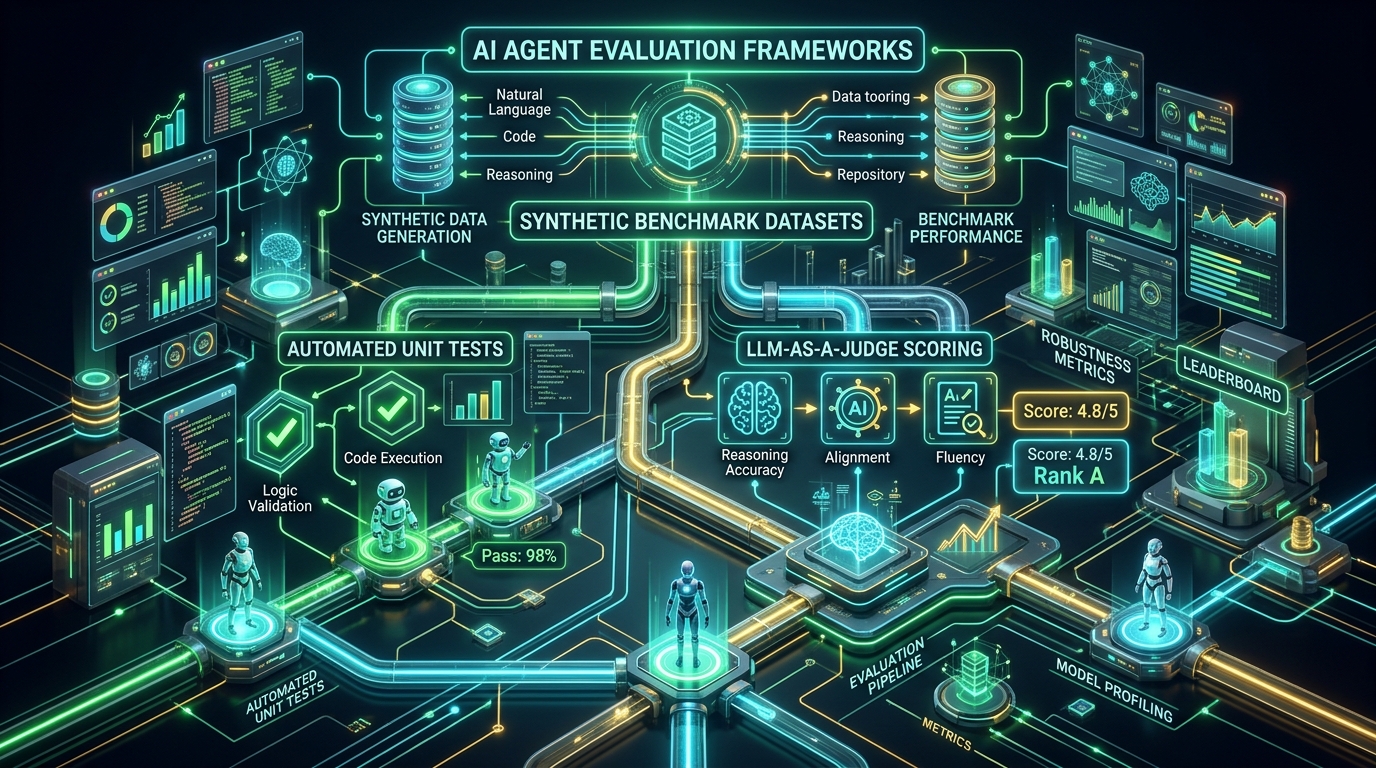
How do you evaluate autonomous AI agents in production? Evaluating AI agents requires an automated evaluation framework that measures 4 core pillars: 1) Trajectory Accuracy (did the agent select the optimal sequence of tools?), 2) Tool Parameter Precision (did tool calls pass Zod/Pydantic schemas without retries?), 3) Task Completion Success Rate (did the final execution satisfy user intent?), and 4) Cost & Latency Efficiency (token usage per completed workflow).
1. Why Traditional Software Unit Testing Fails for AI Agents
Traditional software unit testing relies on deterministic assertions: given input A, a function must produce exact output B. However, autonomous AI agents operate non-deterministically. Depending on context temperature, system prompt updates, or model provider iterations, an agent might solve a customer database query via different tool execution paths.
Attempting to test AI agents with hardcoded string matching results in flaky test suites. When engineers update underlying LLMs (such as upgrading from Gemini 3.5 Flash to Gemini 3.6 Flash), deterministic unit tests break even if the agent's task resolution improved.
"Testing an autonomous AI agent with traditional string-equality assertions is like grading a human employee based on the exact keystrokes they used to type an email."
2. The 4 Dimensions of AI Agent Evaluation
Enterprise AI engineering teams at CodXpert evaluate agent performance across 4 distinct dimensions:
| Evaluation Dimension | Metric Measured | Target Benchmark |
|---|---|---|
| 1. Trajectory Accuracy | Sequence of tool selections & decision logic | > 95% Optimal Tool Order |
| 2. Schema Precision | Valid JSON parameters on first attempt | 99.5% Schema Accuracy |
| 3. Task Resolution | End-to-end task completion rate | > 98% Success Rate |
| 4. Token & Latency Budget | Cost ($) and time (ms) per completed task | < 3.5s Avg Response / Task |
3. LLM-as-a-Judge Scoring & Rubric Design
To grade non-deterministic agent trajectories automatically, production evaluation pipelines utilize LLM-as-a-Judge architectures. A high-reasoning judge model (such as Gemini 3.1 Pro or Claude 3.5 Sonnet) is supplied with:
- Original User Request: The initial prompt or task objective.
- Full Agent Trajectory Log: The step-by-step tool calls, intermediate environment outputs, and agent reasoning logs.
- Structured Evaluation Rubric: A JSON scoring contract evaluating correctness, efficiency, safety, and policy compliance on a 1-to-5 scale.
4. Synthetic Test Dataset Generation & Red Teaming
Benchmarking agent performance requires diverse test suites. Relying solely on historical production logs risks overfitting agent prompts to past user behavior.
Synthetic dataset generation suites produce hundreds of adversarial test cases: injecting missing database records, simulating slow 504 gateway API timeouts, and attempting prompt injection attacks. Running synthetic benchmark suites inside CI/CD pipelines ensures new model updates do not introduce silent regressions.
5. Automated CI/CD Regression Testing for Agent Prompts
Whenever engineers modify system prompts, update tool definitions, or upgrade model versions, the evaluation pipeline triggers an automated CI/CD test run.
If the test run indicates a drop in task resolution rate or a 20% spike in token consumption, GitHub Actions blocks the deployment pull request automatically - preventing buggy agent updates from reaching live production users.
6. Measuring Trajectory Divergence & Semantic Distance
When an agent handles multi-step workflows, evaluating only the final answer masks latent instability. Trajectory divergence metrics measure the semantic distance between the agent's actual tool call sequence and the optimal reference path.
By computing graph edit distance across execution logs, developers identify redundant tool invocations, unneeded API polling loops, and inefficient reasoning steps early in the development lifecycle.
7. Production Telemetry & Real-Time Alerting Dashboards
Evaluation does not stop at CI/CD deployment. In live production environments, real-time telemetry dashboards monitor agent step counts, user feedback scores, and exception rates.
If an agent loop exceeds 10 steps on a routine database task, alerting systems notify engineers of potential prompt drift or API schema degradation instantly.
8. Cost vs Accuracy Trade-off Optimization & Model Routing
Benchmarking agent performance allows engineering teams to optimize model selection for specific task tiers. Routing simple routine tasks (like form parsing) to fast, inexpensive models like Gemini 3.6 Flash while reserving reasoning-heavy LLMs (like Gemini 3.1 Pro) for complex agentic tool loops slashes operational API costs by over 70%.
Continuous evaluation suites measure the exact accuracy-to-cost ratio across model tiers, enabling dynamic model routing based on real-time task complexity scores.
9. Automated Synthetic Red Teaming & Security Boundary Fuzzing
Ensuring that AI agent evaluation frameworks remain resilient against adversarial failure modes requires ongoing red teaming. Operating an agent platform without automated fuzzing leaves systems vulnerable to indirect prompt injection, data poisoning, and unauthorized privilege escalation.
Synthetic security evaluation suites subject agent loops to thousands of malicious, malformed, and out-of-order prompts prior to deployment:
- Indirect Prompt Injection Fuzzing: Benchmark LLM resistance against malicious instructions concealed inside external API payloads, user uploaded files, or email content.
- Tool Boundary Fuzzing: Verify that out-of-bounds inputs (e.g., negative billing amounts, SQL injection strings, or 50MB file attachments) are cleanly intercepted by Zod/Pydantic schemas.
- Privilege Escalation Auditing: Ensure worker agents cannot invoke supervisor tools or access restricted row-level database tables without explicit authorization.
10. 3-Year Enterprise ROI: Measurable AI Agent Reliability
Establishing automated evaluation frameworks transforms AI development from unmonitored guesswork into a predictable engineering discipline. Organizations gain total confidence in agent deployment, accelerating time-to-market while reducing operational maintenance costs.
FAQ SectionFrequently Asked Questions (FAQ)
Q1: What is an AI agent evaluation framework?
An AI agent evaluation framework is an automated benchmarking pipeline that measures model task completion rates, tool calling precision, multi-step trajectory efficiency, and safety compliance.
Q2: Why is traditional unit testing insufficient for AI agents?
Traditional unit tests expect fixed inputs and outputs. AI agents use non-deterministic LLM reasoning and dynamic tool execution, requiring trajectory evaluations and LLM-as-a-judge scoring.
Q3: What is LLM-as-a-Judge scoring in agent evaluations?
LLM-as-a-Judge uses an advanced reasoning model (such as Gemini 3.1 Pro) to grade agent execution logs against structured rubrics - evaluating reasoning accuracy and policy adherence.
Q4: How do you prevent regression in agent prompt engineering?
By running automated synthetic benchmark suites inside CI/CD pull request pipelines prior to merging prompt modifications into production branches.
Related Technical & Growth Infrastructure Guides
- - AI Agent Tool Use & Safety Guards: Preventing Hallucinated API Calls in 2026
- - Autonomous AI Agent Loops: Building Resilient Self-Correction Systems in 2026
- - AI Agent Memory Architecture: Designing Long-Term Context Systems in 2026
- - Agentic Workflow Automation: Building Multi-Agent Systems in 2026