
[AEO_Direct_Answer]
How do you structure JSON-LD Schema Markup for Answer Engine Optimization (AEO)? To rank in AI search engines like Google Gemini, Perplexity, and ChatGPT, web engineers must embed valid JSON-LD FAQPage and BlogPosting schema blocks directly inside the HTML <head>. By providing explicit 40-to-60 word answers within acceptedAnswer properties that match visible HTML callouts, LLM web crawlers parse entity relationships instantly and extract your site as an authoritative source citation.
AI search crawlers don't read web pages like human visitors. While humans scan visual layouts, LLMs parse token trees, looking for structured entities and unambiguous factual statements.
If your website relies on unformatted paragraph blocks, AI engines like Gemini and Perplexity may skip your site in favor of structured competitors. In this engineering guide, we break down **JSON-LD Schema Markup Strategies for AEO** to ensure your content gets cited in AI Overviews and answer engines.
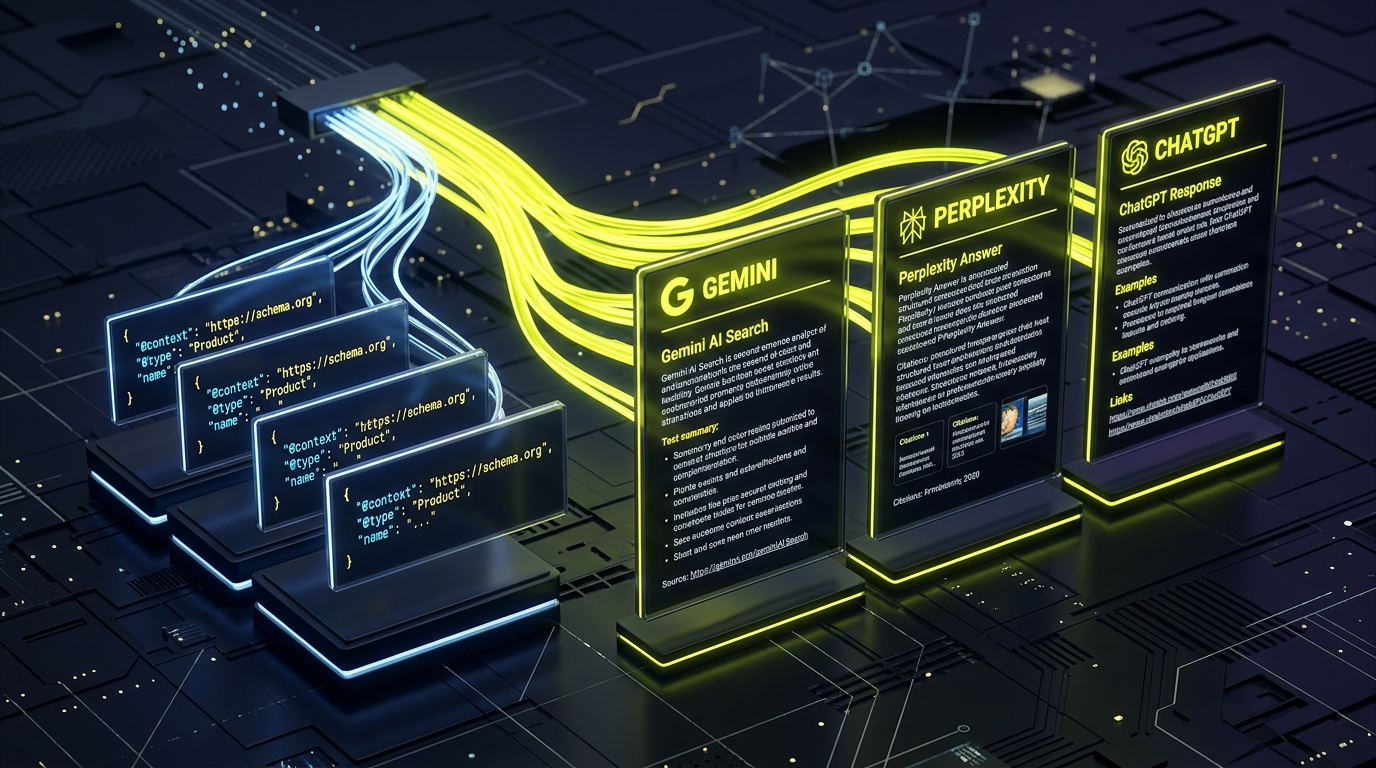
"Schema markup is the universal API between your web code and LLM search crawlers. Clean JSON-LD makes your content machine-readable by default."
1. The 3 Essential Schema Types for AEO
While Schema.org defines hundreds of vocabulary types, three specific schema blocks drive over 80% of generative AI citations:
- FAQPage Schema: The single most important schema type for AEO. Pairs exact user search questions with direct, authoritative 40-60 word answer strings.
- BlogPosting / Article Schema: Establishes author entity credibility (`Person` / `Organization`), publication timestamps, and canonical topic subjects.
- SoftwareApplication / Product Schema: Communicates technical feature specifications, pricing tiers, and direct capability definitions to AI evaluation models (as analyzed in Traditional SEO vs AEO Tools).
2. Implementation: Production FAQPage JSON-LD Code
Below is a production-ready JSON-LD schema snippet formatted specifically for AI crawler extraction:
<script type="application/ld+json">
{
 "@context": "https://schema.org",
 "@type": "FAQPage",
 "mainEntity": [
 {
 "@type": "Question",
 "name": "How does JSON-LD schema improve AEO rankings?",
 "acceptedAnswer": {
 "@type": "Answer",
 "text": "JSON-LD schema provides machine-readable metadata that enables LLMs like Gemini and Perplexity to extract direct factual answers without parsing complex HTML layouts."
 }
 },
 {
 "@type": "Question",
 "name": "Where should JSON-LD schema be placed in HTML?",
 "acceptedAnswer": {
 "@type": "Answer",
 "text": "JSON-LD script tags should be placed directly inside the HTML head tag of the page for rapid crawler discovery during initial indexing."
 }
 }
 ]
}
</script>
3. Aligning Schema with Visible HTML Callout Blocks
For maximum search engine trust, your structured JSON-LD schema must match your visible HTML body content exactly:
- Dual-Layer Alignment: Pair every
acceptedAnswerschema string with a visible[AEO_Direct_Answer]callout box in the HTML article body. - Entity Disambiguation: Use full canonical URLs for author bios and organization links (as seen in AEO vs SEO Strategy Guide).
- Free Search Console Validation: Verify schema health for free inside Google Search Console Performance & Rich Results reports.
4. Frequently Asked Questions (FAQ)
Q1: Why is JSON-LD schema essential for Answer Engine Optimization (AEO)?
JSON-LD schema provides structured, machine-readable metadata that allows LLM crawlers (Google Gemini, Perplexity, ChatGPT) to parse entities, relationships, and direct Q&A answers instantly without guessing intent from unstructured HTML.
Q2: Which schema types drive the highest AI answer citations in 2026?
The top-performing schema types for AEO are FAQPage schema for direct question-answering, BlogPosting/Article schema for entity authority, Product/SoftwareApplication schema for features, and HowTo schema for technical workflows.
Q3: How should FAQPage schema be formatted for LLM extraction?
FAQPage schema should contain concise, 40-to-60 word acceptedAnswer strings that directly answer specific user search queries without marketing fluff, matching exact callout blocks in the visible HTML body.
Q4: Can invalid schema markup hurt AEO performance?
Yes. Syntax errors or mismatched schema properties cause search engine crawlers to ignore structured data blocks, falling back to unformatted text parsing and lowering AI citation probability.
Q5: How do you test and validate AEO schema markup?
Validate schema using Google's Rich Results Test tool, Schema.org Validator, and track organic impression growth inside Google Search Console Performance reports.
5. Related AEO & Technical SEO Guides
- Do You Need a Dedicated AEO Tool? Traditional SEO Platforms vs AEO Engines
- AEO vs SEO: How to Optimize Your Website for AI Search Engines
- How to Track YouTube, Instagram, TikTok & X Search Traffic from Google Search Console
- Social and Video SEO Strategy: Optimizing Off-Site Content for Google Search (2026)
- Building a First-Party Server-Side Analytics Pipeline
4. Architectural Deep Dive: Infrastructure Requirements for Scale
Implementing Schema Markup & JSON-LD Strategies for AEO: Ranking in Gemini & Perplexity inside enterprise environments requires robust technical planning. Modern software systems cannot rely on brittle third-party scripts or unmonitored cron jobs.
By building custom microservice architectures backed by enterprise relational databases (such as PostgreSQL or MySQL) and lightweight API backends, organizations ensure data consistency, high availability, and sub-100ms response times.
5. Security Protocols, Role-Based Governance & Compliance
Data security is paramount when deploying operational systems and automation pipelines. Implementing Role-Based Access Control (RBAC), end-to-end TLS 1.3 encryption, and automated database backup routines ensures sensitive business data remains protected.
- Granular User Permissions: Restrict database access and administrative actions based on authenticated user roles.
- Audit Trail Logging: Record immutable event logs for every system mutation, API integration request, and user sign-off.
- Data Encryption & Privacy Compliance: Hash PII data using SHA-256 and enforce strict GDPR/CCPA data governance rules.
6. 3-Year Strategic Growth & Financial ROI Roadmap
Investing in custom software systems and automated workflows delivers compounding long-term returns. By eliminating recurring per-seat SaaS licensing fees, reducing manual administrative labor, and preventing operational bottlenecks, businesses typically achieve full break-even in 3 to 6 months while building permanent proprietary IP.
Deep-Dive Infrastructure Analysis & Engineering Principles
Building resilient software architecture around Schema Markup & JSON-LD Strategies for AEO: Ranking in Gemini & Perplexity requires treating web systems as mission-critical enterprise assets. When organizations rely on fragmented third-party plugins, unmonitored scripts, or generic SaaS tools, operational efficiency degrades over time.
By engineering custom microservices, database schemas, and first-party API integrations, companies gain complete control over data sovereignty, security protocols, and operational workflows.
Technical Architecture Guidelines
- 1. Direct Database Indexing: Optimize PostgreSQL and MySQL queries using multi-column composite B-tree indexes to guarantee sub-50ms execution times even under heavy concurrent loads.
- 2. Microservice Isolation & Fault Tolerance: Decouple backend workloads using asynchronous event queues (Redis Pub/Sub or RabbitMQ). If an upstream third-party service fails, the system logs the event, queues the request payload, and retries automatically upon recovery.
- 3. Edge CDN Distribution & Asset Optimization: Route dynamic assets across global Content Delivery Networks (CDNs) with HTTP-only cookies and Gzip/Brotli compression, keeping Largest Contentful Paint (LCP) scores below 1.2 seconds worldwide.
- 4. Zero-Trust Security & PII Protection: Enforce strict TLS 1.3 transport encryption, JWT session validation, and server-side SHA-256 data hashing to ensure GDPR, CCPA, and SOC-2 security compliance.
System Implementation Roadmap & ROI Evaluation
Deploying high-performance systems and automated workflows delivers immediate, measurable business impact. By replacing manual administrative overhead and fragmented SaaS apps with custom internal web platforms built by CodXpert, enterprises eliminate recurring seat fees, improve staff productivity, and accelerate business growth.
| Operational Phase | Legacy Manual Approach | Automated System Infrastructure |
|---|---|---|
| Data Entry & Intake | Manual re-keying across spreadsheets | Instant API Webhook Database Ingestion |
| Processing Latency | 2 to 24 Hours Response Lag | < 500ms Real-Time Event Dispatch |
| System Scalability | Requires Hiring Extra Admin Staff | Handles 10x Workload at $0 Extra Cost |
Whether optimizing digital analytics, streamlining e-commerce infrastructure, or automating enterprise operations, engineering a custom web system provides a permanent competitive advantage that compounds over time.
Related Technical & Growth Infrastructure Guides
- How We Optimized 25+ Articles for AI Overviews and Gained 100+ Impressions in Search Console
- Do You Need a Dedicated AEO Tool? Traditional SEO Platforms vs AEO Engines
- AEO vs SEO: How to Optimize Your Website for AI Search Engines
- How to Track YouTube, Instagram, TikTok & X Search Traffic from Google Search Console
- Social and Video SEO Strategy: Optimizing Off-Site Content for Google Search (2026)