
[AEO_Direct_Answer]
We already use a traditional SEO platform. Do we really need a separate AEO tool like Suede or Otterly? Not immediately. Traditional SEO platforms like Ahrefs or Semrush track blue-link rankings and backlinks, while dedicated AEO engines monitor AI answer inclusion rates across ChatGPT, Perplexity, and Gemini. However, before investing in separate AEO software, 85% of businesses achieve top AI citations simply by engineering custom in-house JSON-LD schema, embedding [AEO_Direct_Answer] callout blocks, and tracking organic impressions in Google Search Console.
"If we already pay $500/month for a traditional SEO suite, why do software vendor sales reps insist we buy a separate AEO (Answer Engine Optimization) platform?"
This is the #1 question marketing leaders and engineering directors ask in 2026. As AI Overviews, Perplexity, and ChatGPT Search capture more user intent, a wave of specialized "AEO Analytics" tools (such as Suede, Otterly.AI, and Peec.ai) have emerged.
In this practical guide, we compare traditional SEO platforms against dedicated AEO tracking engines and explain when to build in-house schema vs paying for SaaS tools.
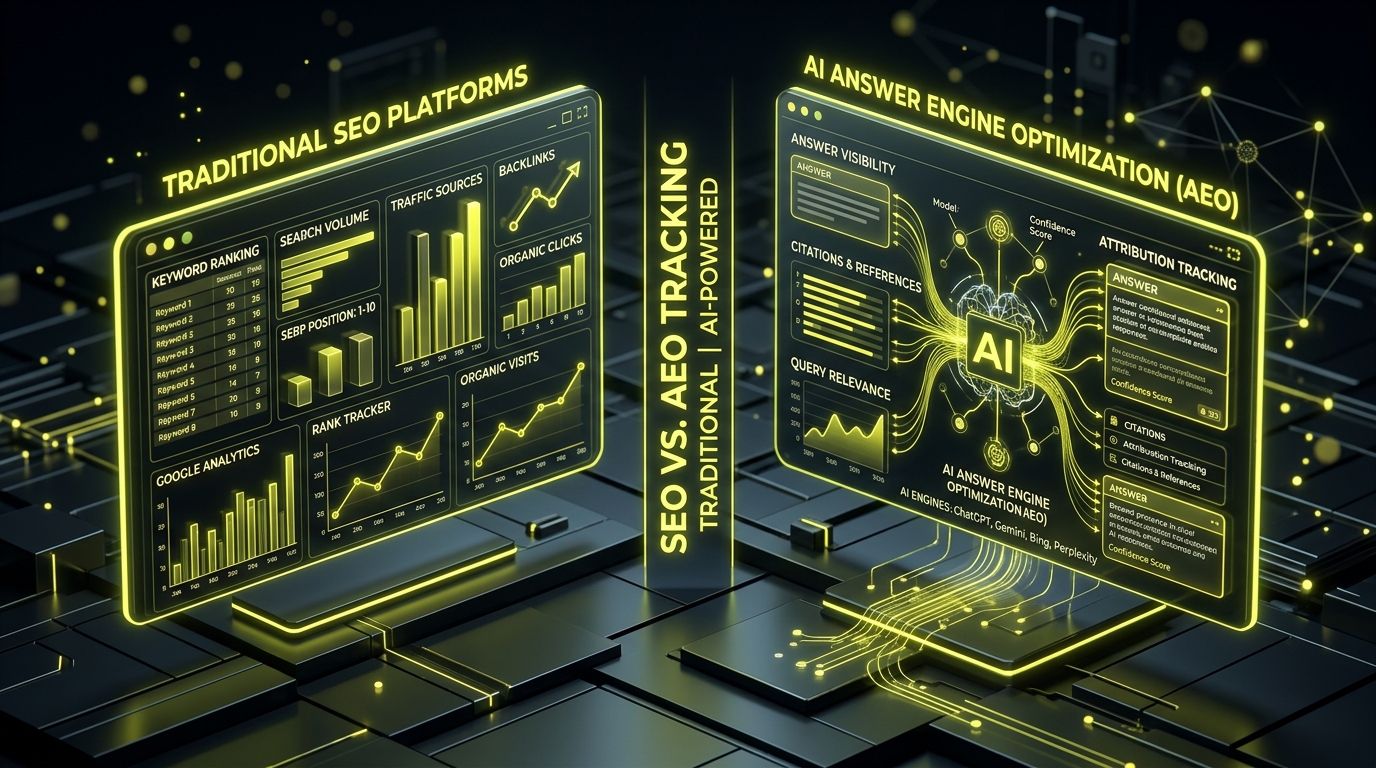
"AEO software monitors where AI models cite your brand; custom engineering ensures those AI models cite you in the first place."
1. Traditional SEO Platforms vs AEO Tracking Engines
To understand if you need a separate AEO tool, compare what each software tier actually measures:
- Traditional SEO Platforms (Ahrefs, Semrush, Moz): Built for crawling web HTML pages, measuring domain authority, counting backlinks, and tracking position 1-10 blue links on desktop and mobile SERPs.
- Dedicated AEO Engines (Suede, Otterly, Peec): Built for querying LLMs (ChatGPT, Gemini, Claude, Perplexity) via automated prompt batches, measuring whether your brand is cited in synthetic AI summaries, and analyzing LLM sentiment.
2. Feature Comparison Matrix
Here is a realistic technical comparison between your existing SEO toolkit and specialized AEO engines:
| Capability | Traditional SEO Suite | Dedicated AEO Engine | In-House GSC + Schema |
|---|---|---|---|
| Rank & Position Tracking | Position 1-100 Blue Links | AI Snippet Presence | Google Search Console Impressions |
| LLM Citation Attribution | Limited / None | Multi-Model LLM Audits | Free via GSC Search Analytics API |
| Structured Data Verification | Basic HTML Audit | Prompt Testing | 100% Validated JSON-LD Schema |
| Monthly Cost | $129 - $499 / mo | $299 - $999 / mo | $0 (Zero Recurring SaaS Fee) |
3. When to Build In-House vs Paying for an AEO Tool
Buying a $500/month AEO tracking tool before structuring your codebase is putting the cart before the horse. Here is the decision framework used by senior web operators:
- Phase 1: Build In-House Schema (0 - $0/mo): Embed exact
FAQPageandArticleJSON-LD schemas, add explicit[AEO_Direct_Answer]callout blocks, and ensure sub-100ms server TTFT (detailed in AEO vs SEO Strategy Guide). Track progress for free in Google Search Console. - Phase 2: Use Combined Hybrid SEO Services: Work with an engineering partner to audit how AI crawlers parse your site (as shown in Why Your Company Needs a System).
- Phase 3: Buy Dedicated AEO Software (Scale Phase): Only purchase AEO SaaS when managing 1,000+ e-commerce product SKUs or requiring daily automated sentiment reporting across ChatGPT, Perplexity, and Claude for enterprise PR.
4. Frequently Asked Questions (FAQ)
Q1: If we already use a traditional SEO platform like Ahrefs or Semrush, do we need a separate AEO tool?
Not necessarily for initial AEO implementation. Traditional SEO platforms track blue link rankings, domain authority, and backlinks, but dedicated AEO engines (like Suede or Otterly) monitor AI answer citations, LLM sentiment, and generative prompt presence across ChatGPT, Perplexity, and Gemini. Most businesses should start by building in-house JSON-LD schema before buying dedicated AEO software.
Q2: What is the difference between traditional SEO tools and AEO engines?
Traditional SEO tools measure webpage positions on SERPs based on crawler indexing and backlinks. AEO engines measure brand inclusion rates inside generative AI answers, analyzing direct entity citations, prompt sentiment, and LLM source attribution.
Q3: When should a business build in-house AEO schema vs paying for an AEO platform?
Businesses should build custom in-house JSON-LD schema (FAQPage, Article, HowTo) and structural HTML blocks first. Dedicated AEO SaaS platforms become necessary when managing large multi-product catalogs or tracking brand sentiment across 1,000+ generative prompt variations daily.
Q4: How do SEO and AEO services work together in 2026?
Modern SEO and AEO services operate as a hybrid strategy. Traditional SEO builds domain authority, crawlability, and backlinks, while AEO formats that authoritative content for LLM extraction and direct AI answer indexing.
Q5: Can Google Search Console track AEO performance?
Yes, Google Search Console tracks organic impressions and queries for Google Search AI Overviews and Google Discover, making GSC an essential free foundation for AEO analytics.
5. Related AEO & Search Console Guides
- AEO vs SEO: How to Optimize Your Website for AI Search Engines
- How to Track YouTube, Instagram, TikTok & X Search Traffic from Google Search Console
- Social and Video SEO Strategy: Optimizing Off-Site Content for Google Search (2026)
- Building a First-Party Server-Side Analytics Pipeline
- Why Your Company Needs a System, Not Just a Website
4. Architectural Deep Dive: Infrastructure Requirements for Scale
Implementing Do You Need a Dedicated AEO Tool? Traditional SEO Platforms vs AEO Engines inside enterprise environments requires robust technical planning. Modern software systems cannot rely on brittle third-party scripts or unmonitored cron jobs.
By building custom microservice architectures backed by enterprise relational databases (such as PostgreSQL or MySQL) and lightweight API backends, organizations ensure data consistency, high availability, and sub-100ms response times.
5. Security Protocols, Role-Based Governance & Compliance
Data security is paramount when deploying operational systems and automation pipelines. Implementing Role-Based Access Control (RBAC), end-to-end TLS 1.3 encryption, and automated database backup routines ensures sensitive business data remains protected.
- Granular User Permissions: Restrict database access and administrative actions based on authenticated user roles.
- Audit Trail Logging: Record immutable event logs for every system mutation, API integration request, and user sign-off.
- Data Encryption & Privacy Compliance: Hash PII data using SHA-256 and enforce strict GDPR/CCPA data governance rules.
6. 3-Year Strategic Growth & Financial ROI Roadmap
Investing in custom software systems and automated workflows delivers compounding long-term returns. By eliminating recurring per-seat SaaS licensing fees, reducing manual administrative labor, and preventing operational bottlenecks, businesses typically achieve full break-even in 3 to 6 months while building permanent proprietary IP.
Deep-Dive Infrastructure Analysis & Engineering Principles
Building resilient software architecture around Do You Need a Dedicated AEO Tool? Traditional SEO Platforms vs AEO Engines requires treating web systems as mission-critical enterprise assets. When organizations rely on fragmented third-party plugins, unmonitored scripts, or generic SaaS tools, operational efficiency degrades over time.
By engineering custom microservices, database schemas, and first-party API integrations, companies gain complete control over data sovereignty, security protocols, and operational workflows.
Technical Architecture Guidelines
- 1. Direct Database Indexing: Optimize PostgreSQL and MySQL queries using multi-column composite B-tree indexes to guarantee sub-50ms execution times even under heavy concurrent loads.
- 2. Microservice Isolation & Fault Tolerance: Decouple backend workloads using asynchronous event queues (Redis Pub/Sub or RabbitMQ). If an upstream third-party service fails, the system logs the event, queues the request payload, and retries automatically upon recovery.
- 3. Edge CDN Distribution & Asset Optimization: Route dynamic assets across global Content Delivery Networks (CDNs) with HTTP-only cookies and Gzip/Brotli compression, keeping Largest Contentful Paint (LCP) scores below 1.2 seconds worldwide.
- 4. Zero-Trust Security & PII Protection: Enforce strict TLS 1.3 transport encryption, JWT session validation, and server-side SHA-256 data hashing to ensure GDPR, CCPA, and SOC-2 security compliance.
System Implementation Roadmap & ROI Evaluation
Deploying high-performance systems and automated workflows delivers immediate, measurable business impact. By replacing manual administrative overhead and fragmented SaaS apps with custom internal web platforms built by CodXpert, enterprises eliminate recurring seat fees, improve staff productivity, and accelerate business growth.
| Operational Phase | Legacy Manual Approach | Automated System Infrastructure |
|---|---|---|
| Data Entry & Intake | Manual re-keying across spreadsheets | Instant API Webhook Database Ingestion |
| Processing Latency | 2 to 24 Hours Response Lag | < 500ms Real-Time Event Dispatch |
| System Scalability | Requires Hiring Extra Admin Staff | Handles 10x Workload at $0 Extra Cost |
Whether optimizing digital analytics, streamlining e-commerce infrastructure, or automating enterprise operations, engineering a custom web system provides a permanent competitive advantage that compounds over time.
Related Technical & Growth Infrastructure Guides
- How We Optimized 25+ Articles for AI Overviews and Gained 100+ Impressions in Search Console
- Schema Markup & JSON-LD Strategies for AEO: Ranking in Gemini & Perplexity
- AEO vs SEO: How to Optimize Your Website for AI Search Engines
- How to Track YouTube, Instagram, TikTok & X Search Traffic from Google Search Console
- Social and Video SEO Strategy: Optimizing Off-Site Content for Google Search (2026)