
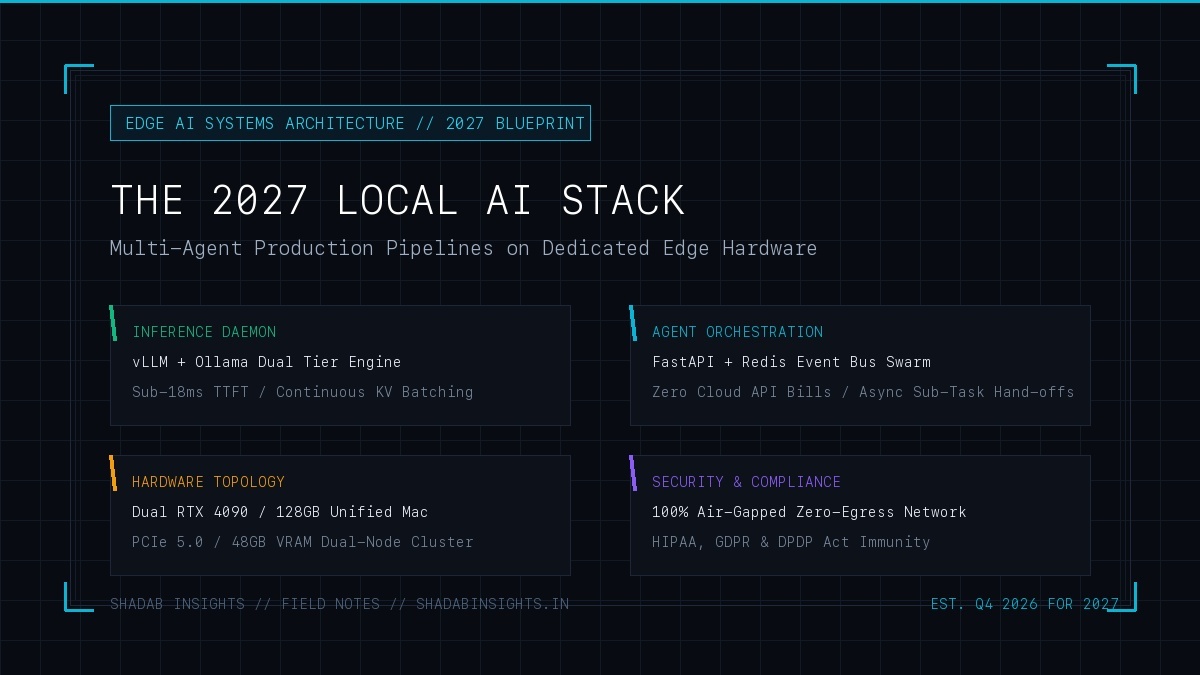
The 2027 Local AI Stack is the architectural shift from per-token cloud API billing (OpenAI, Anthropic) to dedicated on-premise edge inference hardware running multi-agent swarms. As autonomous agent workflows evolve from single-prompt chatbots to recursive multi-step loops consuming 50,000+ tokens per task, cloud API bills explode exponentially.
By pairing a high-throughput GPU inference cluster (Dual RTX 4090s or Apple Silicon Unified Memory) with vLLM continuous batching and an event-driven Redis message bus, engineering teams can run infinite agent iterations at $0 marginal token cost, sub-20ms first-token latency, and 100% air-gapped data compliance.
The Recursive Token Tax: Why Cloud APIs Break Multi-Agent Economics
Between 2023 and 2025, commercial software teams operated under a simple assumption: "Compute is cheap; just query the OpenAI or Anthropic API." For single-turn chat interfaces, marketing copy generation, and simple search queries, this assumption held true. A customer question consumed 400 prompt tokens and returned 250 completion tokens, costing fractions of a cent.
However, the enterprise software landscape of 2026 and 2027 is not built on chatbots. It is driven by autonomous multi-agent pipelines. When building production systems—such as our automated workforce management platform at Taskly or enterprise intake engines engineered at CodXpert—a single user request triggers a cascade of autonomous interactions:
- Triage & Intent Router: Parses unstructured incoming text, checks customer history, and plans a multi-step tool execution path (4,500 tokens).
- Context Retrieval & Vector RAG: Pulls 12 documentation snippets, SQL schema definitions, and recent customer tickets (18,000 tokens).
- Execution Agent: Synthesizes code, queries databases, or updates ERP state via webhooks (6,500 tokens).
- Self-Correction & Reflection Critic: Compares output against strict compliance rules, spots schema discrepancies, and forces a re-prompt loop (14,000 tokens).
- Formatting & Dispatch Agent: Converts output into human-readable WhatsApp messages, PDF manifests, or accounting entries (3,000 tokens).
A task that feels like "one operation" to an end-user actually burns 46,000 to 120,000 tokens across internal reasoning loops. If your application handles just 1,000 customer interactions per day:
| Deployment Model | Tokens / Day | Rate / 1M Tokens | Monthly Cost | 5-Year TCO |
|---|---|---|---|---|
| Cloud Frontier Model (Claude 3.5 Sonnet / GPT-4o) | 80,000,000 | $3.00 In / $15.00 Out (~$6.00 blended) | $14,400 / mo | $864,000 |
| Cloud Lightweight (Gemini 2.5/3.5 Flash) | 80,000,000 | $0.35 In / $1.05 Out (~$0.55 blended) | $1,320 / mo | $79,200 |
| Dedicated 2027 Edge Node (Dual RTX 4090 48GB) | Unlimited (Local Hardware) | $0.00 (Electricity: ~$45/mo) | $45 / mo (Power) | $7,500 (CAPEX + Power) |
The math is indisputable: once an organization relies on autonomous multi-agent pipelines, cloud token tolls become an unacceptable recurring tax. By owning the underlying edge hardware, your cost per execution drops to zero, enabling aggressive self-correction loops and deep reasoning passes that would otherwise cost thousands of dollars on a metered API.
The 2027 Crossover Threshold: When On-Premise Beats Cloud APIs
Just as we highlighted in our teardown of Build vs. Buy Invoicing Engines, software ownership is governed by clear crossover volumes. Building an in-house inference cluster is not necessary for a company sending 50 casual prompts a week.
However, the tipping point occurs far earlier than most CTOs realize:
The 4-Metric Crossover Formula for Edge AI
An enterprise must transition to an on-premise local AI inference stack when any two of the following four conditions are met:
- Monthly Cloud Token Spend Exceeds $750: A modern high-performance edge server (Dual RTX 4090 or Mac Studio M4 Max) costs approximately $4,500 to assemble. At $750/month in API fees, the payback period is 6 months. At $2,000/month, the payback period drops to 68 days.
- Multi-Agent Swarm Concurrency > 8 Agents: When 8 or more agents communicate asynchronously, cloud rate limits (TPM - Tokens Per Minute, and RPM - Requests Per Minute) cause 429 throttling errors, requiring complicated exponential backoff queues that destroy system responsiveness.
- Sub-50ms Latency Requirements: Round-trip network transit to US-East or EU-Central cloud inference endpoints introduces 180ms to 450ms of pure HTTP overhead before token generation begins. A local PCIe 5.0 inference pipeline delivers Time-To-First-Token (TTFT) in 14ms to 28ms.
- Zero-Egress Regulatory Mandates (DPDP / HIPAA / GDPR): When processing internal payroll data, client financial contracts, or healthcare telemetry, sending raw data to third-party model providers creates severe compliance liability.
Hardware Topology: Building the Dual-Tier Edge Node
In 2027, enterprise local AI is not powered by massive $300,000 NVIDIA H100 racks that require three-phase industrial cooling. The revolution in model quantization (GGUF, AWQ, EXL2) and open-weight architectures (DeepSeek-R1, Qwen 2.5, Llama 3.3) means that world-class intelligence runs efficiently on consumer and prosumer silicon.
We deploy a Dual-Tier Hardware Topology designed specifically for office server closets or colocation micro-racks:
Dual RTX 4090 48GB VRAM Rig
Engineered for high-speed continuous batching, rapid tool-calling, and code generation. Capable of running 32B and 70B parameter models at quantized Q4_K_M with sustained token throughput exceeding 75 tok/sec.
Apple Silicon 128GB Unified Mac Studio
Dedicated to long-context document synthesis, legal analysis, and full repository codebase ingestion. Unified memory allows models to address a single 100GB+ KV cache without PCIe bus fragmentation.
Inference Daemon Architecture: vLLM vs. Ollama Under Concurrent Load
As explored in our comprehensive benchmark of Ollama vs. LM Studio, desktop inference runners are fantastic for local development on a workstation. However, when deploying an enterprise multi-agent stack, Ollama chokes under concurrent load because it handles requests in a linear FIFO queue.
In a multi-agent environment where 12 agents make simultaneous calls to evaluate sub-tasks, linear queuing leads to catastrophic latency spikes (head-of-line blocking).
For production 2027 pipelines, the industry standard is vLLM powered by PagedAttention:
- PagedAttention Memory Management: Traditional LLM engines pre-allocate contiguous VRAM for each request's KV cache. If a request finishes early or varies in size, VRAM is fragmented and wasted. vLLM treats the KV cache like virtual memory pages, packing up to 5x more concurrent requests into the same 48GB VRAM pool.
- Continuous Batching (Iteration-Level Scheduling): Instead of waiting for an entire batch of 8 requests to complete token generation, vLLM injects new agent requests dynamically on every single token iteration step. Time-To-First-Token stays consistent under 25ms regardless of active queue depth.
- Native Tensor Parallelism: Splits 70B parameter models automatically across both RTX 4090 GPUs with zero manual layer mapping.
services:
  vllm-inference-core:
    image: vllm/vllm-openai:latest
    container_name: local_ai_vllm_core
    restart: always
    runtime: nvidia
    environment:
      - CUDA_VISIBLE_DEVICES=0,1
      - HUGGING_FACE_HUB_TOKEN=${HF_TOKEN}
    ports:
      - "8000:8000"
    ipc: host
    volumes:
      - /opt/models/cache:/root/.cache/huggingface
    command: >
      --model Qwen/Qwen2.5-32B-Instruct-AWQ
      --tensor-parallel-size 2
      --dtype half
      --gpu-memory-utilization 0.94
      --max-model-len 32768
      --max-num-seqs 64
      --enforce-eager
      --port 8000
    deploy:
      resources:
        reservations:
          devices:
            - driver: nvidia
              count: 2
              capabilities: [gpu]
Orchestration Blueprint: The Event-Driven Agent Bus
The fatal mistake most engineering teams make when adopting AI agents is chaining them together via synchronous HTTP REST requests (e.g., Agent A -> HTTP POST Agent B -> HTTP POST Agent C).
If Agent B takes 4 seconds to execute a database lookup, the entire call stack blocks, timeouts cascade through the web server, and intermediate prompt state is lost if a single network glitch occurs.
The 2027 enterprise architecture replaces synchronous HTTP with an Event-Driven Message Bus built on Redis Streams:
agent:tasks:pending
Production Python Pipeline: FastAPI, Redis Streams & vLLM
Here is a production-tested asynchronous worker implementation in Python using httpx and redis.asyncio that connects your application core to the local vLLM inference engine:
import asyncio
import json
import httpx
import redis.asyncio as redis

VLLM_API_URL = "http://127.0.0.1:8000/v1/chat/completions"
REDIS_URL = "redis://127.0.0.1:6379/0"
MODEL_NAME = "Qwen/Qwen2.5-32B-Instruct-AWQ"

async def execute_local_agent(system_prompt: str, user_prompt: str) -> str:
    payload = {
        "model": MODEL_NAME,
        "messages": [
            {"role": "system", "content": system_prompt},
            {"role": "user", "content": user_prompt}
        ],
        "temperature": 0.2,
        "max_tokens": 4096,
        "stream": False
    }

    async with httpx.AsyncClient(timeout=30.0) as client:
        response = await client.post(VLLM_API_URL, json=payload)
        response.raise_for_status()
        data = response.json()
        return data["choices"][0]["message"]["content"]

async def process_task_stream():
    r = redis.from_url(REDIS_URL)
    stream_key = "agent:tasks:pending"
    group_name = "local_inference_cluster"
    consumer_name = "worker_node_alpha"

    # Initialize consumer group if not present
    try:
        await r.xgroup_create(stream_key, group_name, id="0", mkstream=True)
    except Exception:
        pass  # Group already exists

    print(f"[*] Local AI Agent Worker active. Listening on {stream_key}...")

    while True:
        try:
            entries = await r.xreadgroup(group_name, consumer_name, {stream_key: ">"}, count=4, block=2000)
            if not entries:
                continue

            for stream, messages in entries:
                for message_id, raw_data in messages:
                    task = json.loads(raw_data[b"payload"].decode("utf-8"))
                    print(f"[>] Processing Task #{task.get('task_id')} | Category: {task.get('category')}")

                    # Execute agent loop locally with $0 token cost
                    result = await execute_local_agent(
                        system_prompt="You are a senior systems verification agent at CodXpert. Audit the input payload and return valid JSON with corrective actions.",
                        user_prompt=task.get("input_data")
                    )

                    # Acknowledge task completion and publish result
                    await r.xadd("agent:tasks:completed", {"task_id": task.get("task_id"), "result": result})
                    await r.xack(stream_key, group_name, message_id)
                    print(f"[v] Task #{task.get('task_id')} completed successfully.")

        except Exception as e:
            print(f"[!] Worker Error: {e}")
            await asyncio.sleep(1)

if __name__ == "__main__":
    asyncio.run(process_task_stream())
Zero-Egress Security & Regulatory Immunity in 2027
Beyond the overwhelming cost savings, the second major driver of the 2027 local AI migration is data sovereignty and regulatory enforcement.
Governments worldwide have moved from theoretical AI policy to aggressive financial penalties for cross-border PII exposure:
- India's DPDP Act (Digital Personal Data Protection Act): Imposes penalties of up to ₹250 Crore (~$30M USD) for unauthorized data processing or failure to prevent data breaches. Sending sensitive customer data across third-party LLM cloud APIs violates strict consent frameworks.
- EU AI Act (Full Operational Enforcement in 2026/2027): Mandates complete auditability of training weights, input logging, and algorithmic decision pathways for high-risk corporate systems. Closed-source APIs that update model weights without notice make compliance audits impossible.
- Enterprise Client Contract Clauses: Fortune 500 corporations and GCC logistics conglomerates—such as enterprise supply chain networks modernizing with WMS Middle East—now explicitly mandate in vendor Master Service Agreements (MSAs) that no proprietary telemetry or operational manifests may be ingested by public model APIs.
An on-premise edge stack provides absolute regulatory immunity:
The local inference server sits on an isolated physical VLAN. Nginx and Docker firewall rules block outbound external traffic (Port 80/443 egress disallowed). The model weights execute in GPU memory, process internal databases, and return results to your local network. Not a single byte of telemetry ever leaves your physical building.
Production Failure Modes & Recovery Protocols
Running on-premise hardware requires software engineering discipline. In cloud setups, auto-scaling hides inefficiencies; in local setups, unoptimized code crashes GPUs.
Here are the three production failure modes we encountered while building on-premise pipelines, and how to safeguard against them:
1. KV Cache Exhaustion (CUDA OOM Out-Of-Memory)
The Symptom: An autonomous agent enters an infinite loop, recursively injecting prior thoughts into the context window until GPU VRAM is exhausted and the vLLM process terminates.
The Fix: Enforce strict hard token limits in vLLM with --max-model-len 32768 and configure an application-level context compressor. When an agent's memory window exceeds 16k tokens, a lightweight 7B model summarizes older interactions into a 500-token executive digest before continuing.
2. GPU Thermal Throttling Under Continuous Overnight Batches
The Symptom: Dual RTX 4090 cards running continuous batching reach 84°C, triggering thermal throttling that drops token generation from 75 tok/sec down to 18 tok/sec.
The Fix: Apply a slight power limit (undervolt) using nvidia-smi -pl 350 (reducing power target from 450W to 350W per card). This results in a negligible 3% throughput drop while dropping core temperatures by 12°C and eliminating thermal throttling entirely.
3. Hybrid Cloud Failover Circuit Breaker
The Symptom: A catastrophic hardware failure (power supply trip or NVMe drive fault) takes the on-premise server offline during peak business hours.
The Fix: Implement a client-side circuit breaker in your application adapter. If 3 consecutive heartbeat pings to http://127.0.0.1:8000/health fail within 5 seconds, the router automatically fails over to an encrypted Gemini Flash API tunnel for temporary continuity while dispatching an instant alert to your engineering team.
Frequently Asked Questions (FAQ)
At what monthly API volume does self-hosting local AI hardware become cheaper?
For standard single-turn LLM generation, the crossover is roughly $800 to $1,200/month. However, for multi-agent workflows where reflection, tool execution, and critique loops consume between 40,000 and 150,000 tokens per task, self-hosting crosses into massive cost savings at just 35 to 50 complex workflow runs per day, paying for a $4,800 dual RTX 4090 rig in under 45 days.
Why is vLLM preferred over Ollama for enterprise multi-agent pipelines?
Ollama is optimized for single-user desktop exploration with sequential request queuing. vLLM implements PagedAttention, which treats the KV cache like virtual memory, enabling continuous request batching and parallel multi-agent tool execution without context thrashing or sequential queuing bottlenecks.
Can Apple Silicon M-series chips run enterprise inference pipelines in 2027?
Yes. Apple Silicon Mac Studio devices (M3/M4 Max with 128GB unified memory) provide an unbeatable price-to-VRAM ratio for long-context memory nodes (256k context windows) and 70B parameter models, achieving 25+ tokens/second while consuming under 110 watts of power.
How does an air-gapped local AI stack ensure DPDP and HIPAA compliance?
By running model weights on dedicated on-premise hardware inside an isolated VLAN with egress firewall rules, zero telemetry, embeddings, prompt logs, or customer PII ever cross network perimeters, eliminating third-party data processing agreements and cloud breach vectors.

Architected by Shadab Alam
Founder @ CodXpert | Principal Systems Architect
At CodXpert, we design and build dedicated on-premise AI automation pipelines, internal admin dashboards, and custom software architectures that liberate high-growth enterprises from monthly SaaS tolls and API token bills. If your organization is ready to transition to owned edge AI infrastructure, explore our AI Systems Engineering Services or reach out directly for a technical feasibility assessment.