
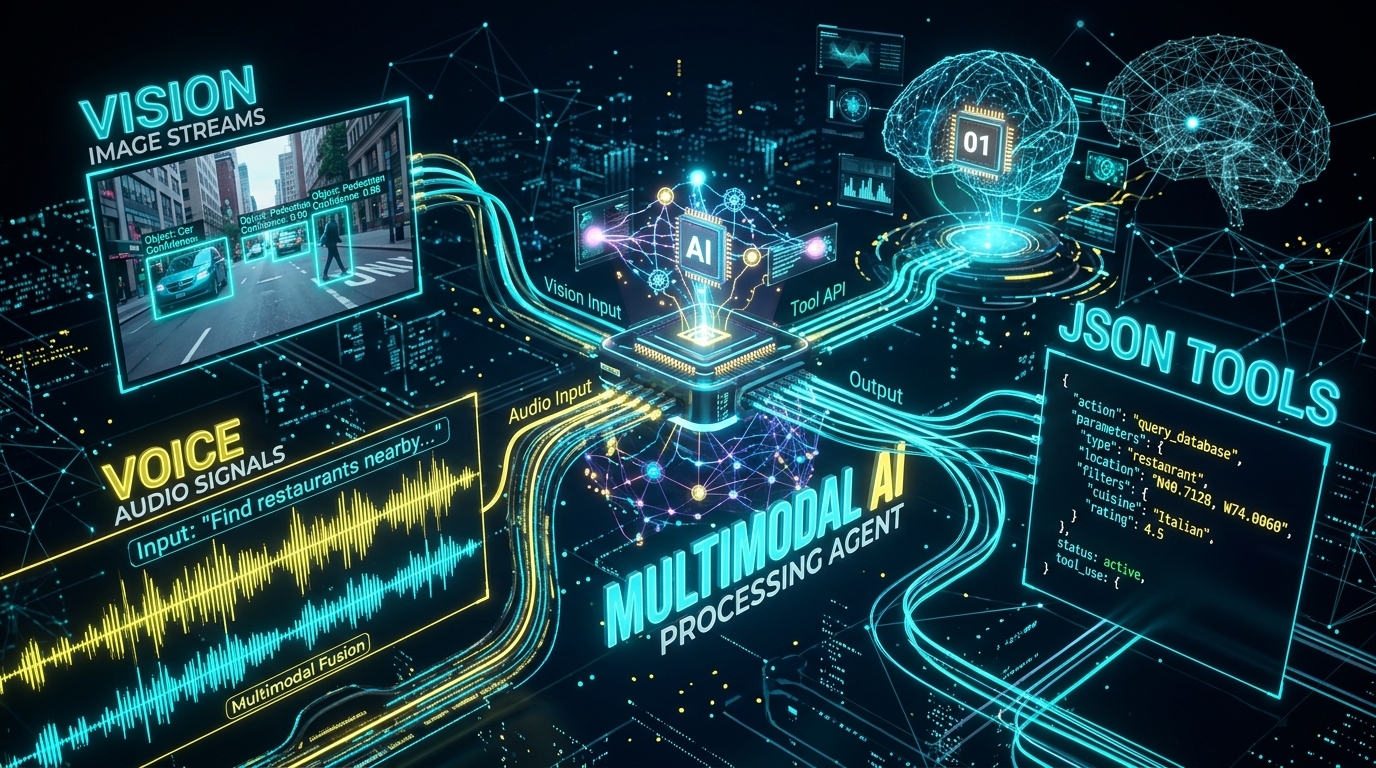
What is a Multimodal AI Agent? A Multimodal AI Agent is an autonomous software system capable of natively processing multiple input channels - such as visual image frames, real-time audio streams, and plain text - within a single unified neural context. Unlike legacy pipelines that chain separate OCR or Speech-to-Text models, multimodal agents directly reason across vision, voice, and structured JSON tool APIs to execute complex operational workflows.
For years, software developers interacted with Large Language Models (LLMs) through a narrow pipe: text in, text out. If an application needed to process a document image or a voice command, engineers had to chain together disparate single-purpose models: a Speech-to-Text (STT) transcriber, followed by an LLM text parser, followed by a Text-to-Speech (TTS) synthesizer.
In 2026, this fragmented approach is rapidly giving way to native Multimodal AI Agents.
Models such as Gemini 1.5 Pro, Gemini Flash, and native vision-language models process audio PCM streams, visual video frames, and text tokens inside a unified attention space. This enables AI agents to perceive the real world like humans do - seeing UI layouts, hearing vocal nuances, and triggering code tools in real time.
1. The Architecture of Native Multimodal AI Processing
Traditional AI pipelines suffered from compounding latency and semantic error propagation. If an OCR tool misread a single digit on an invoice, the downstream LLM received corrupt input and hallucinated invalid tool calls.
Native multimodal architectures eliminate these failure modes by encoding visual pixel patches and audio spectral embeddings directly into the model's primary embedding space:
Multimodal Token Fusion Pipeline:
- Vision Patch Tokenization: Images are divided into 256x256 pixel patches and converted into visual tokens via a Vision Transformer (ViT) encoder.
- Audio Stream Framing: Continuous audio is chunked into 20ms frames and mapped directly into acoustic vector representations without intermediate text transcription.
- Unified Attention Matrix: Text, vision tokens, and audio vectors share self-attention weight layers, preserving cross-modal context.
- Structured Tool Emission: The model outputs deterministic JSON schemas to invoke external APIs based on visual or vocal instructions.
2. Vision-Driven Tool Execution & GUI Automation
One of the most powerful applications of Multimodal AI Agents is Visual GUI Automation.
Instead of relying on brittle DOM selectors or static API endpoints, a vision-enabled agent can look at a web application screenshot, identify bounding box coordinates of UI elements, and issue mouse click or keyboard input commands:
- - Visual QA & Bug Triage: Inspecting visual layout regressions on mobile viewports and logging bug reports automatically.
- - Legacy Software Automation: Operating desktop legacy ERP tools that lack public HTTP APIs by visually reading UI screens.
- - Document Extraction: Parsing complex tabular data, handwritten notes, and scanned receipts directly into database schemas.
3. Real-Time Streaming Audio & Voice Interaction
Processing audio natively enables ultra-low-latency voice agents for customer support, technical troubleshooting, and executive voice assistants.
Using WebSockets or WebRTC protocols, audio streams flow continuously between client devices and multimodal backend servers. The model detects user interruption (barge-in), understands tone of voice, and executes backend database queries while speaking naturally.
// Example Multimodal Tool Calling Payload
{
 "agent_id": "multimodal_support_v4",
 "perceived_inputs": {
 "vision_frame": "frame_10492.jpg (scanned shipping label)",
 "audio_transcript_hint": "User asked: 'Where is my order?'"
 },
 "tool_call": {
 "name": "lookup_tracking_status",
 "parameters": {
 "tracking_number": "1Z9999999999999999",
 "carrier": "UPS",
 "require_signature": true
 }
 }
}
4. Performance Optimization: Managing Token Budgets & Latency
Multimodal tokens consume significantly more context window space and compute memory than plain text tokens.
To maintain sub-second response times and control cloud infrastructure costs, engineer strict optimization controls:
Crop or downscale non-critical visual frames to reduce vision token costs by up to 60% without losing OCR accuracy.
Extract 1 keyframe per second from video streams instead of feeding raw 30 FPS video into model context.
Pre-fetch tool schemas concurrently while audio stream processing evaluates user intent.
5. Enterprise Safety Guards for Multimodal Agents
Empowering an AI agent to see screens, hear voice inputs, and execute database queries requires multi-layered safety guards:
- - Visual PII Redaction: Automatically masking credit card numbers, passwords, and personal information before frames reach LLM endpoints.
- - Vocal Authorization Gates: Verifying user biometric or pin credentials prior to executing high-risk financial transactions.
- - Tool Parameter Schema Validation: Enforcing strict Pydantic or Zod schema validation on all generated tool payloads.
Frequently Asked Questions (FAQ)
Q1: What is a Multimodal AI Agent?
A Multimodal AI Agent is an autonomous software system capable of natively processing multiple input data modalities - including text, high-resolution vision frames, raw audio streams, and structured JSON tool APIs.
Q2: How do Multimodal AI Agents execute external tools?
Multimodal agents parse visual or auditory cues (such as a dashboard screenshot or spoken user command), construct structured JSON parameter payloads, evaluate schema guards, and execute external backend APIs asynchronously.
Q3: What are the latency bottlenecks in Multimodal AI systems?
Key latency bottlenecks include vision tokenization size, audio streaming chunk sizes, and network round-trips during tool execution. Optimizations include image downsampling, WebRTC audio streaming, and speculative tool calling.
Q4: Why is native multimodality better than chaining separate models?
Native multimodality processes vision, audio, and text in a single shared attention layer, reducing latency, eliminating OCR/transcription errors, and preserving subtle cross-modal context.