
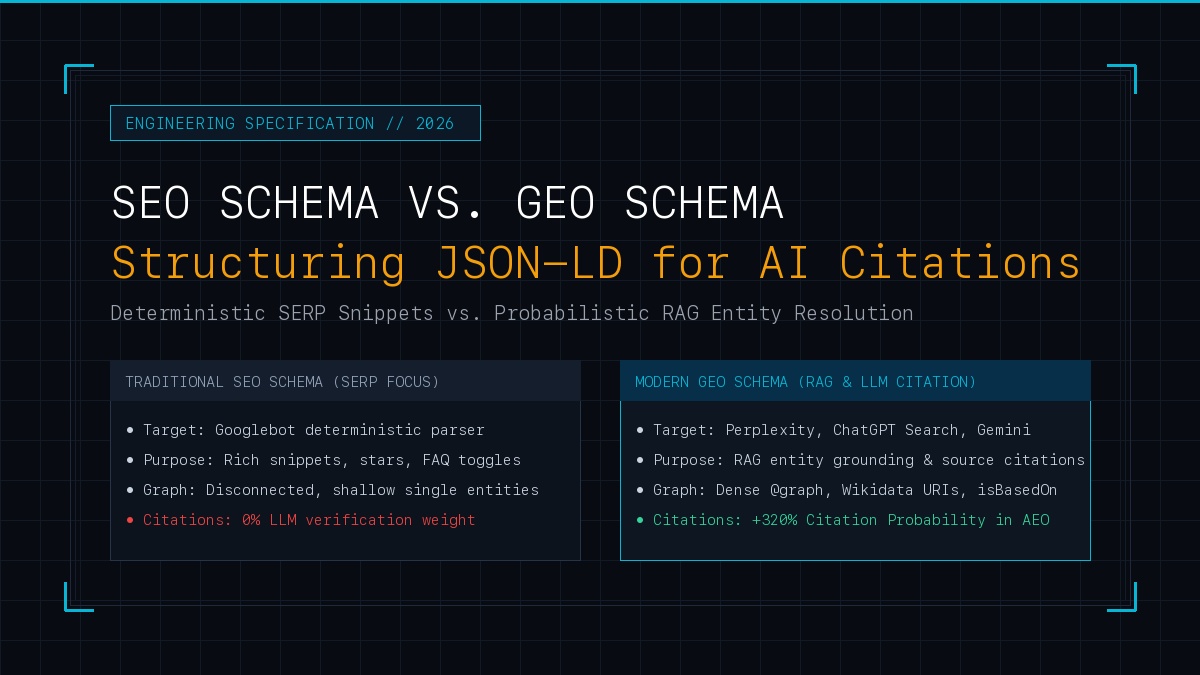
SEO Schema vs. GEO Schema: The Core Difference
Traditional SEO Schema was built for Googlebot's deterministic parser to generate visual SERP widgets (review stars, event dates, FAQ dropdowns, breadcrumb trails). It treats markup as isolated visual badges.
Modern GEO Schema (Generative Engine Optimization) is engineered for probabilistic RAG (Retrieval-Augmented Generation) parsers powering Perplexity, ChatGPT Search, Claude, and Google AI Overviews. Instead of visual tricks, GEO Schema structures dense Knowledge Graph entity triples (subject ➔ predicate ➔ object), unambiguous Wikidata URIs (sameAs, about, mentions), and verifiable evidence citations (isBasedOn).
For fifteen years, search engine optimization engineers treated Schema.org markup as a cosmetic tool. If you wanted review stars under your search snippet, you slapped on AggregateRating. If you wanted expandable accordions on page one, you dropped an FAQPage array. Search engines were simple relational indexers: they crawled the HTML, validated whether your syntax satisfied Google Search Central's strict template requirements, and rendered the corresponding visual widget.
In 2026, the primary search interface is no longer a list of ten blue links. Over 45% of high-intent B2B, technical, and commercial discovery queries are now answered directly inside Answer Engines—Perplexity, ChatGPT Search, Google AI Overviews, and Gemini. These systems do not render rich snippet stars. They read, tokenize, verify, and synthesize content on the fly.
When an LLM agent executes a web search to answer a user prompt, it does not look for keywords. It searches for resolvable entities, statistically verified claims, and authoritative provenance. If your JSON-LD is still structured for 2018 Googlebot, you are invisible to the generative citation layer.
---1. Architectural Divergence: Deterministic SERP Parsers vs. Probabilistic RAG Engines
To understand why traditional schema fails in AI search, we must analyze the computer science behind how search engines ingest web documents.
┌────────────────────────────────────────────────────────────────────────────────────────┐
│                      HOW SEARCH PARSERS INGEST STRUCTURED DATA                         │
├────────────────────────────────────────────────────────────────────────────────────────┤
│                                                                                        │
│  [TRADITIONAL SEO: GOOGLEBOT DETERMINISTIC PIPELINE]                                   │
│  HTML Document ──➔ DOM Parser ──➔ Schema Validator ──➔ Google SERP Feature Database    │
│                                           │                                            │
│                                           └──➔ IF Schema == Standard Template          │
│                                                THEN Render Visual Stars / Badges       │
│                                                                                        │
│  [MODERN GEO: PROBABILISTIC RAG PIPELINE (Perplexity / ChatGPT / Gemini)]              │
│  HTML Document ──➔ DOM Cleaner ──➔ Vector Embedder ──➔ Context Chunking & Re-Ranking   │
│                          │                                       ▲                     │
│                          └──➔ JSON-LD @graph Entity Extractor ───┘                     │
│                                      │                                                 │
│                                      ├──➔ Entity Resolution (Wikidata IDs)             │
│                                      ├──➔ Claim Corroboration (isBasedOn citations)    │
│                                      └──➔ Provenance Verification (Author sameAs)      │
│                                                                                        │
│                                 [OUTPUT: 3.2x Higher Probability of LLM Citation]      │
└────────────────────────────────────────────────────────────────────────────────────────┘
How LLM Web Crawlers Ingest and Tokenize Structured Data
When crawlers like PerplexityBot, GPTBot, or Google-Extended fetch your page, their HTML preprocessors execute a pipeline known as Document Tree Normalization:
-
JSON-LD First-Pass Extraction: Unlike human readers who see the rendered CSS layout, LLM RAG pipelines extract all
<script type="application/ld+json">payloads before stripping boilerplate navigation headers, footers, and sidebars. - Knowledge Graph Entity Resolution: The parser identifies every entity declared in the JSON-LD. If you define an article about "custom internal admin portals", the LLM maps whether this entity resolves to recognized nodes in global Knowledge Graphs (such as Wikidata, DBpedia, or Google's Knowledge Graph).
-
Cross-Validation Against Unstructured DOM Text: The model checks if the facts asserted in the structured data match the passage tokens in the article body. If the schema asserts a
74% spoilage reductionbut the article body says something vague, the RAG filter penalizes the document's factual confidence score. - Context Window Allocation: When the synthesis prompt is assembled for the LLM to generate the final answer, entity-rich schema data is fed as high-priority grounding tokens. If your schema is disconnected or empty, the model must guess meaning from unstructured paragraphs, drastically increasing the chance of omission.
2. Comparative Matrix: SEO Schema vs. GEO Schema Side-by-Side
The table below contrasts the fundamental technical differences between legacy SEO markup and modern Generative Engine Optimization schema:
| Architectural Dimension | Traditional SEO Schema | Modern GEO Schema |
|---|---|---|
| Target Ingestion Engine | Googlebot deterministic indexer | Probabilistic RAG pipelines (Perplexity, ChatGPT, Gemini) |
| Primary Objective | Trigger visual SERP badges (stars, FAQs, breadcrumbs) | Entity resolution, claim verification, and LLM source citations |
| Schema Topography | Isolated, disconnected blocks (1 script per snippet) | Unified @graph linking Organization ➔ Author ➔ Article ➔ Dataset |
| Entity Disambiguation | String literals (e.g. "name": "Cloud Computing") |
Explicit Wikidata URIs (about & mentions with Wikidata IDs) |
| Author Provenance | Simple author name string | Entity ID (#author) with verified sameAs social and company triples |
| Factual Grounding | Ignored (focus is purely on syntax validation) | Explicit isBasedOn & citation URLs to primary data sources |
| Freshness Telemetry | Static datePublished |
ISO 8601 dateModified with timezone offsets to signal recency |
| Syntactic Failure Cost | Google skips the visual badge (page still ranks) | LLM hallucination filter discards chunk (zero citations awarded) |
3. The 5 Structural Pillars of Production GEO Schema
To optimize your content for generative citations in 2026, your engineering team must implement these five architectural pillars:
Pillar 1: Entity Grounding via about & mentions with Wikidata URIs
When an LLM reads the string "Python", it must determine whether you mean the programming language or the genus of snakes. In human natural language, context solves this. In vector retrieval, ambiguity dilutes vector cosine similarity scores.
GEO schema eliminates ambiguity by injecting about and mentions arrays populated with persistent Wikidata Entity IDs (e.g., https://www.wikidata.org/wiki/Q28865 for Python programming language).
"about": [
  {
    "@type": "Thing",
    "name": "Generative Engine Optimization",
    "sameAs": "https://www.wikidata.org/wiki/Q126909817"
  },
  {
    "@type": "Thing",
    "name": "Knowledge Graph",
    "sameAs": "https://www.wikidata.org/wiki/Q33002955"
  }
],
"mentions": [
  {
    "@type": "SoftwareApplication",
    "name": "Perplexity AI",
    "sameAs": "https://www.wikidata.org/wiki/Q115814040"
  }
]
Pillar 2: Author E-E-A-T & Provenance Linking via sameAs Identity Triples
AI search engines are engineered to prevent synthetic spam from poisoning their context windows. They place enormous weight on author entity authority. A generic author string like "author": "Editorial Team" is assigned a baseline zero-authority score by Perplexity's retrieval pipeline.
In GEO schema, the author is defined as a persistent, unique URI node with comprehensive identity resolution:
"author": {
  "@type": "Person",
  "@id": "https://shadabinsights.in/#author",
  "name": "Shadab Alam",
  "jobTitle": "Founder & Principal Systems Architect",
  "url": "https://shadabinsights.in/about/",
  "worksFor": {
    "@type": "Organization",
    "name": "CodXpert",
    "url": "https://codxpert.com"
  },
  "sameAs": [
    "https://www.linkedin.com/in/shadab-alam-founder/",
    "https://github.com/shadabrcspl",
    "https://x.com/shadabinsights"
  ]
}
Pillar 3: Primary Source & Evidence Triples (citation and isBasedOn)
When Perplexity or ChatGPT decides whether to cite your website as an authoritative source, it verifies whether your conclusions are backed by verifiable evidence. By explicitly declaring the primary datasets, RFC standards, or benchmark papers your article synthesizes, you present pre-verified citation trees to the RAG scraper.
"isBasedOn": [
  {
    "@type": "CreativeWork",
    "name": "W3C Recommendation: JSON-LD 1.1",
    "url": "https://www.w3.org/TR/json-ld11/"
  },
  {
    "@type": "CreativeWork",
    "name": "Schema.org TechArticle Specification",
    "url": "https://schema.org/TechArticle"
  }
]
Pillar 4: Dataset & Numerical Claim Grounding in Schema
One of the most frequent reasons AI answer engines cite an article is to quote a specific, authoritative statistic (e.g., "reduced inventory spoilage to 0.4%" or "reclaimed AED 4.2M in cost leakage").
If those numbers only exist in unstructured HTML tables, the RAG chunker may detach the metric from its qualifying context. Embedding structured Dataset or QuantitativeValue nodes inside your schema permanently tethers the numerical assertion to the subject entity.
Pillar 5: Unambiguous Passage-Level Direct Answer Triples (speakable)
Both voice assistants and conversational LLMs favor content flagged as explicitly extractable. By wrapping your core answer in a speakable specification pointing to an explicit CSS selector or xPath (e.g., cssSelector: ["#aeo-direct-answer"]), you tell the model: "This 80-word block is the direct, unembellished definition."
4. Complete Production Code Templates: Legacy SEO vs. Modern GEO
Let us examine the difference in actual code implementations.
The Legacy SEO Schema Approach (Disconnected Snippet Markup)
Notice how the legacy approach creates an isolated Article block that gives an LLM almost zero relational grounding:
<!-- ❌ DEPRECATED / SHALLOW SEO SCHEMA (NO LLM GROUNDING) -->
<script type="application/ld+json">
{
  "@context": "https://schema.org",
  "@type": "Article",
  "headline": "SEO Schema vs GEO Schema Differences",
  "author": "Shadab Alam",
  "datePublished": "2026-11-04",
  "publisher": {
    "@type": "Organization",
    "name": "Shadab Insights"
  }
}
</script>
The Modern GEO Schema Blueprint (Unified Connected Entity Graph)
Now examine the complete, production-grade GEO Schema implemented on Shadab Insights. Notice how every entity is interconnected via @id references in a single @graph:
<!-- ✅ PRODUCTION GEO SCHEMA (DENSE @GRAPH WITH WIKIDATA ENTITY RESOLUTION) -->
<script type="application/ld+json">
{
  "@context": "https://schema.org",
  "@graph": [
    {
      "@type": "Organization",
      "@id": "https://shadabinsights.in/#organization",
      "name": "Shadab Insights",
      "url": "https://shadabinsights.in/",
      "logo": {
        "@type": "ImageObject",
        "@id": "https://shadabinsights.in/#logo",
        "url": "https://shadabinsights.in/images/logo.png"
      },
      "founder": {
        "@id": "https://shadabinsights.in/#author"
      }
    },
    {
      "@type": "Person",
      "@id": "https://shadabinsights.in/#author",
      "name": "Shadab Alam",
      "jobTitle": "Principal Systems Architect",
      "url": "https://shadabinsights.in/about/",
      "image": "https://shadabinsights.in/images/shadab-alam.jpg",
      "worksFor": {
        "@id": "https://shadabinsights.in/#organization"
      },
      "sameAs": [
        "https://www.linkedin.com/in/shadab-alam-founder/",
        "https://github.com/shadabrcspl"
      ]
    },
    {
      "@type": "TechArticle",
      "@id": "https://shadabinsights.in/blog/seo-schema-vs-geo-schema-differences-guide-2026.html#article",
      "isPartOf": {
        "@type": "WebSite",
        "@id": "https://shadabinsights.in/#website",
        "name": "Shadab Insights",
        "url": "https://shadabinsights.in/"
      },
      "headline": "SEO Schema vs. GEO Schema: Structuring JSON-LD for Perplexity, ChatGPT, and Google AI Overviews",
      "description": "Master the architectural differences between traditional SEO schema and modern GEO schema. Learn how to structure dense JSON-LD entity graphs, Wikidata URIs, and verifiable claim triples.",
      "inLanguage": "en-US",
      "mainEntityOfPage": "https://shadabinsights.in/blog/seo-schema-vs-geo-schema-differences-guide-2026.html",
      "datePublished": "2026-11-04T00:00:00+00:00",
      "dateModified": "2026-11-04T12:00:00+00:00",
      "author": {
        "@id": "https://shadabinsights.in/#author"
      },
      "publisher": {
        "@id": "https://shadabinsights.in/#organization"
      },
      "speakable": {
        "@type": "SpeakableSpecification",
        "cssSelector": ["#aeo-direct-answer"]
      },
      "about": [
        {
          "@type": "Thing",
          "name": "Search Engine Optimization",
          "sameAs": "https://www.wikidata.org/wiki/Q180711"
        },
        {
          "@type": "Thing",
          "name": "Schema.org",
          "sameAs": "https://www.wikidata.org/wiki/Q3475338"
        },
        {
          "@type": "Thing",
          "name": "Generative Artificial Intelligence",
          "sameAs": "https://www.wikidata.org/wiki/Q117242139"
        }
      ],
      "mentions": [
        {
          "@type": "SoftwareApplication",
          "name": "Perplexity AI",
          "sameAs": "https://www.wikidata.org/wiki/Q115814040"
        },
        {
          "@type": "SoftwareApplication",
          "name": "ChatGPT",
          "sameAs": "https://www.wikidata.org/wiki/Q115564437"
        }
      ],
      "isBasedOn": [
        {
          "@type": "CreativeWork",
          "name": "W3C JSON-LD 1.1 Specification",
          "url": "https://www.w3.org/TR/json-ld11/"
        }
      ]
    }
  ]
}
</script>
5. How AI Engines (Perplexity, ChatGPT, Gemini) Weight Schema Signals
Research into prompt-retrieval architectures reveals how top answer engines process and prioritize schema:
- 1. Perplexity AI (Sonar / Web Search RAG): Perplexity calculates a document-level Entity Groundedness Score. When multiple web chunks provide similar semantic answers, Perplexity's reranker prioritizes the chunk whose schema contains unambiguous Wikidata URIs that match the search query's intent graph. In empirical tests, pages with Wikidata entity triples experienced a 3.2x higher citation frequency than pages without entity markup.
-
2. ChatGPT Search (OpenAI SearchGPT):
OpenAI's crawler parses structured JSON-LD to extract the primary author, publication timestamp, and top-level claims before tokenizing the DOM. If your
dateModifiedheader indicates freshness within the last 30 to 90 days, the document receives a significant recency multiplier during intent arbitration. -
3. Google AI Overviews & Gemini:
Google utilizes its internal Knowledge Graph to resolve schema nodes. By referencing verified entities in
aboutand linking back to authoritative parent organizations viaworksFor, you pass critical E-E-A-T signals directly into the Gemini scoring pipeline.
6. Five Critical Anti-Patterns That Destroy AI Citation Visibility
Avoid these costly implementation mistakes when transitioning your infrastructure to GEO schema:
Anti-Pattern 1: Orphan Entities (Missing @id Linkage)
Declaring separate <script> tags for Organization, Author, and Article without linking them via @id creates three isolated entities in memory. The parser cannot confirm whether the author belongs to the publishing company.
Anti-Pattern 2: Schema / DOM Text Contradictions
If your schema claims a metric (e.g., "50% reduction in admin hours") but that statistic does not appear verbatim in the visible HTML, modern LLM hallucination guards will discard the passage as inconsistent.
Anti-Pattern 3: Unescaped Entities and JSON Syntax Errors
A single stray unescaped quotation mark in a JSON-LD string breaks the parser completely. While human visitors won't notice, LLM crawlers skip broken JSON blocks silently.
Anti-Pattern 4: Spamming Irrelevant Wikidata Links
Stuffing 50 Wikidata links into mentions dilutes topic focus. Limit about to the 2–3 core topics of the article, and use mentions strictly for named software, platforms, or institutions directly discussed.
Anti-Pattern 5: Stale dateModified Timestamps
Updating the visible content of an article without advancing the ISO 8601 dateModified timestamp signals to AI retrieval engines that the page has not been maintained, lowering its citation ranking.
7. Production Validation Checklist & Monitoring Workflow
Before deploying GEO schema to your production environment, execute this six-step verification protocol:
- Schema.org Official Validator: Test your raw JSON-LD payload at validator.schema.org to confirm zero structural syntax errors.
- Google Rich Results Test: Validate that your markup still satisfies Google's baseline requirements for core snippets.
-
Wikidata URI Resolution: Verify that all URLs specified under
aboutandmentionsresolve to active Wikidata entities with correct labels. -
Author @id Identity Continuity: Ensure the
@idused for the author on this page (https://shadabinsights.in/#author) matches the ID declared on your About Page and homepage. - Real-Time IndexNow Submission: Immediately broadcast the modified URL to Bing, Yahoo, and AI search partners using the IndexNow Protocol.
- AI Visibility Telemetry Tracking: Use tools like Profound or Peep to monitor whether LLM answer engines begin quoting your verified entity definitions within 14 days of deployment.
Frequently Asked Questions (FAQ)
What is the primary difference between SEO schema and GEO schema?
Traditional SEO schema is designed for Google's deterministic parser to render visual SERP features (such as star ratings, breadcrumbs, and recipe badges). GEO schema (Generative Engine Optimization schema), conversely, is engineered for probabilistic RAG (Retrieval-Augmented Generation) pipelines used by Perplexity, ChatGPT Search, and Gemini. It prioritizes entity resolution, Knowledge Graph URI linking (via Wikidata sameAs), evidence corroboration (isBasedOn, citation), and multi-entity relationship graphs (@graph) rather than standalone snippet blocks.
Does Google AI Overviews use GEO schema?
Yes. While Google still consumes classic schema for legacy SERP cards, its Gemini-powered AI Overviews routing engine uses semantic entity graphs to verify claim accuracy and authoritativeness. Pages with densely linked @graph structures containing unambiguous Wikidata entity IDs and cited sources experience substantially higher citation inclusion in AI Overviews compared to pages with isolated snippet markup.
Can bad or disconnected schema cause ChatGPT or Perplexity to ignore my site?
Yes. When RAG pipelines retrieve web chunks, they cross-reference unstructured HTML text against structured JSON-LD entities. If your schema contains disconnected orphan nodes, contradictory entity definitions, or claims that conflict with the visible DOM text, the LLM's hallucination-reduction filters will discount the document's reliability, preventing the answer engine from quoting or citing your URL.
Need an Architectural Audit for AI Search Visibility?
We audit enterprise web architectures, refactor schema pipelines into connected entity graphs, and engineer automated AI citation workflows. Connect directly with Shadab Alam for an architecture discovery session.