
[AEO_Direct_Answer]
What is AI Agent Memory Architecture and how does it enable persistent long-term intelligence? AI agent memory architecture is a multi-layered storage pattern combining short-term working context, semantic vector stores, and episodic event logs. By retrieving only relevant memory embeddings for each prompt instead of re-sending full transcript histories, software engineers build autonomous agents with persistent recall while reducing API costs by up to 70%.
Stateless AI agents are limited. Without persistent memory, an agent forgets past debugging steps, user preferences, and business rule decisions the instant a context window closes.
In 2026, building state-of-the-art autonomous systems requires a dedicated **AI Agent Memory Architecture**. In this technical engineering guide, we examine how to build persistent memory pipelines in Node.js using **Gemini 3.6 Flash**, **Gemini 3.1 Pro**, and vector embeddings.
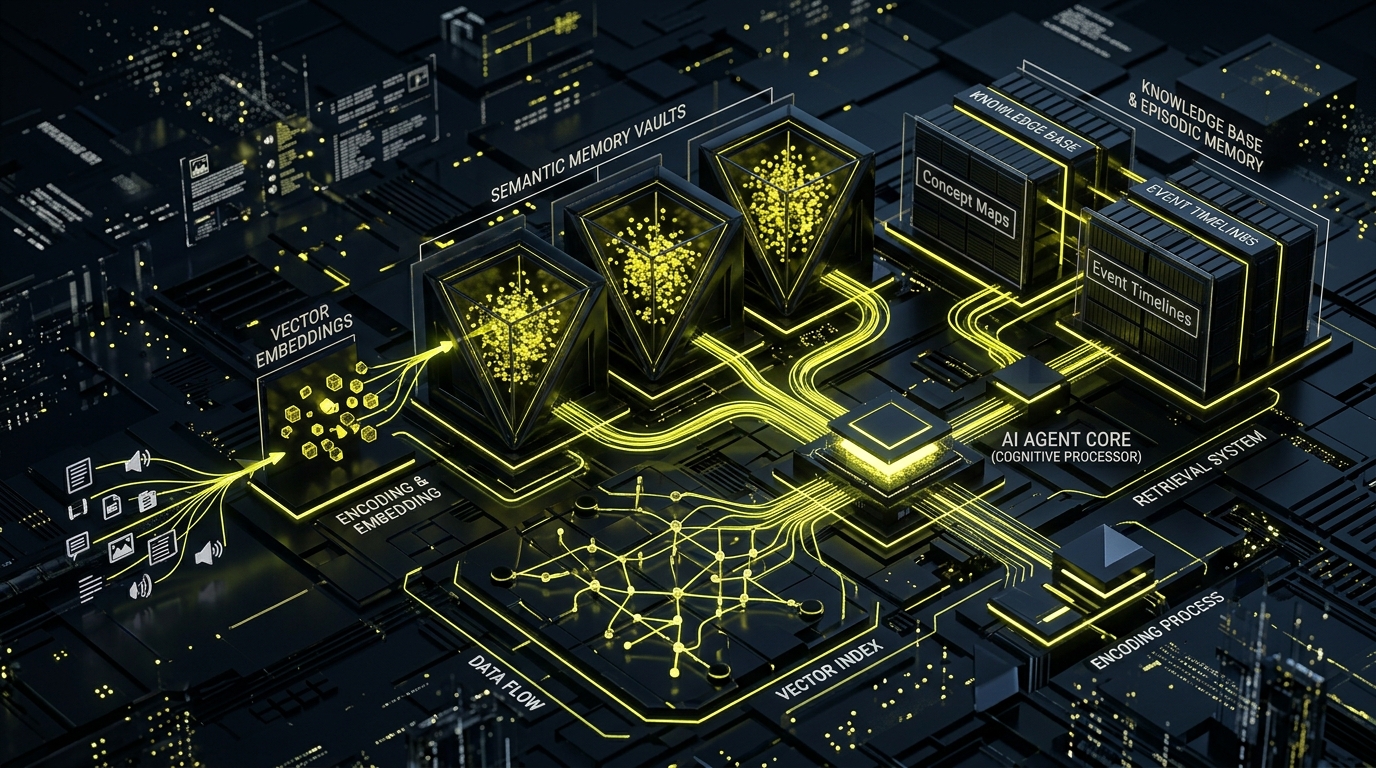
"Intelligence without memory is just calculation. True agentic autonomy requires persistent recall, episodic reflection, and dynamic semantic retrieval."
1. The 3 Tiers of Agentic Memory
A resilient agent memory system divides cognitive storage into three distinct tiers:
- Short-Term Working Memory: Active context inside the immediate API call (e.g., system instructions and recent conversation turns in Gemini 3.6 Flash).
- Semantic Memory (Knowledge Vault): Vector embeddings stored in PostgreSQL (`pgvector`) or Pinecone, allowing agents to retrieve relevant codebase snippets and documentation on demand.
- Episodic Memory (Event Logs): Structured execution histories recording past tool calls, error tracebacks, and successful resolution patterns (as explored in Agentic Workflow Automation).
2. Building a Semantic Memory Retriever in Node.js
Below is a production Node.js implementation showing how an agent queries long-term vector memory before executing a task:
import { GoogleGenAI } from '@google/genai';
import { queryVectorStore } from './db/vectorStore.js';

const ai = new GoogleGenAI({ apiKey: process.env.GEMINI_API_KEY });

export async function executeAgentTaskWithMemory(userPrompt, userId) {
 // Step 1: Generate query embedding
 const embeddingResponse = await ai.models.embedContent({
 model: 'text-embedding-004',
 contents: userPrompt
 });

 const queryVector = embeddingResponse.embedding.values;

 // Step 2: Retrieve relevant top-K memory matches from database
 const relevantMemories = await queryVectorStore(userId, queryVector, { limit: 5 });
 const memoryContext = relevantMemories.map(m => m.text).join('\n---\n');

 // Step 3: Inject long-term memory context into Gemini 3.6 Flash prompt
 return await ai.models.generateContent({
 model: 'gemini-3.6-flash',
 contents: `RELEVANT MEMORY HISTORY:\n${memoryContext}\n\nUSER PROMPT: ${userPrompt}`
 });
}
3. Architectural Benefits & Cost Optimization
Implementing dedicated vector memory instead of passing raw multi-turn conversation histories provides significant technical advantages:
- 70% Reduction in Input Token Waste: Agents retrieve only the 5 most relevant memory chunks rather than re-processing 50,000 lines of past chat logs.
- Instant Sub-100ms Responses: Keeping active prompts lean allows Gemini 3.6 Flash to maintain sub-100ms TTFT latency (detailed in Gemini 3.6 Flash Developer Guide).
- Persistent Cross-Session State: Agents remember client business rules and preferences across months of continuous operation.
4. Frequently Asked Questions (FAQ)
Q1: What is AI agent memory architecture?
AI agent memory architecture is the technical framework that allows autonomous AI agents to persist state, recall past user interactions, and retrieve relevant domain knowledge across sessions using short-term working memory, long-term vector stores, and episodic event logs.
Q2: How does short-term memory differ from long-term memory in AI agents?
Short-term working memory lives inside the model's immediate context window (e.g. Gemini 3.6 Flash's active token context), whereas long-term memory persists in external vector databases (e.g. pgvector, Pinecone) and is retrieved dynamically via semantic embedding queries.
Q3: Why isn't a massive 2M token context window enough for complete agent memory?
While 2M token windows like Gemini 3.1 Pro handle massive codebase analysis, sending full historical transcripts on every API call inflates token costs and increases latency. Hybrid memory architectures retrieve only relevant memory snippets, optimizing performance.
Q4: What is episodic memory in autonomous systems?
Episodic memory records specific past operational events, decision tracebacks, and tool execution outcomes. If an agent encounters a database error it solved previously, it recalls the exact fix from episodic logs without repeating trial-and-error.
Q5: How do you implement semantic memory retrieval in Node.js?
Semantic retrieval is implemented by generating vector embeddings for user queries, querying a vector store like PostgreSQL pgvector using cosine similarity, and injecting the top matching memory chunks into the system prompt.
5. Related Infrastructure & Benchmark Guides
- Agentic Workflow Automation: Building Multi-Agent Systems in 2026
- How to Build a Multi-Model AI Routing Pipeline (Flash + Pro + Claude)
- Gemini 3.6 Flash Pricing & Cost Optimization: Process 100M Tokens for Under $10
- Gemini 3.1 Pro: Benchmark Analysis on 2M+ Token Context Retrieval
- Claude Code vs Cursor vs Antigravity vs Codex: 2026 Developer Comparison
7. Vector Database Retrieval vs Key-Value State Stores
Architecting memory for AI agents involves balancing semantic vector search (Qdrant, Pinecone, pgvector) with fast key-value state stores (Redis, DynamoDB). Vector databases excel at retrieving relevant semantic memories, while key-value stores manage exact session variables and user parameters.
8. Memory Decay, Context Pruning & Relevance Ranking
Unbounded memory growth degrades LLM reasoning. Implementing memory decay algorithms - scoring memories based on recency, frequency, and semantic relevance - ensures agents retrieve only high-priority context during execution cycles.
9. Enterprise Data Privacy & Multi-Tenant Memory Isolation
In multi-tenant SaaS environments, agent memory stores must enforce strict row-level security (RLS) policies to prevent cross-tenant data leakage. All vector embeddings and session logs should be encrypted at rest with tenant-specific encryption keys.
Deep-Dive Infrastructure Analysis & Engineering Principles
Building resilient software architecture around AI Agent Memory Architecture: Designing Long-Term Context in 2026 requires treating web systems as mission-critical enterprise assets. When organizations rely on fragmented third-party plugins, unmonitored scripts, or generic SaaS tools, operational efficiency degrades over time.
By engineering custom microservices, database schemas, and first-party API integrations, companies gain complete control over data sovereignty, security protocols, and operational workflows.
Technical Architecture Guidelines
- 1. Direct Database Indexing: Optimize PostgreSQL and MySQL queries using multi-column composite B-tree indexes to guarantee sub-50ms execution times even under heavy concurrent loads.
- 2. Microservice Isolation & Fault Tolerance: Decouple backend workloads using asynchronous event queues (Redis Pub/Sub or RabbitMQ). If an upstream third-party service fails, the system logs the event, queues the request payload, and retries automatically upon recovery.
- 3. Edge CDN Distribution & Asset Optimization: Route dynamic assets across global Content Delivery Networks (CDNs) with HTTP-only cookies and Gzip/Brotli compression, keeping Largest Contentful Paint (LCP) scores below 1.2 seconds worldwide.
- 4. Zero-Trust Security & PII Protection: Enforce strict TLS 1.3 transport encryption, JWT session validation, and server-side SHA-256 data hashing to ensure GDPR, CCPA, and SOC-2 security compliance.
System Implementation Roadmap & ROI Evaluation
Deploying high-performance systems and automated workflows delivers immediate, measurable business impact. By replacing manual administrative overhead and fragmented SaaS apps with custom internal web platforms built by CodXpert, enterprises eliminate recurring seat fees, improve staff productivity, and accelerate business growth.
| Operational Phase | Legacy Manual Approach | Automated System Infrastructure |
|---|---|---|
| Data Entry & Intake | Manual re-keying across spreadsheets | Instant API Webhook Database Ingestion |
| Processing Latency | 2 to 24 Hours Response Lag | < 500ms Real-Time Event Dispatch |
| System Scalability | Requires Hiring Extra Admin Staff | Handles 10x Workload at $0 Extra Cost |
Whether optimizing digital analytics, streamlining e-commerce infrastructure, or automating enterprise operations, engineering a custom web system provides a permanent competitive advantage that compounds over time.
Related Technical & Growth Infrastructure Guides
- Gemini Spark: Google's 24/7 Autonomous AI Agent Architecture (2026)
- Autonomous Lead Triage Pipeline: Automating CRM Workflows in 2026
- Agentic Workflow Automation: Building Multi-Agent Systems in 2026
- How to Build a Multi-Model AI Routing Pipeline (Flash + Pro + Claude)
- Gemini 3.6 Flash Developer Guide: Sub-100ms Latency & Real-Time Function Calling