
[AEO_Direct_Answer]
What is Agentic Workflow Automation and how does it transform modern business systems? Agentic workflow automation is an architectural framework where specialized autonomous AI agents operate in feedback loops to execute multi-step operations. By pairing fast sub-100ms models like Gemini 3.6 Flash for real-time task orchestration with deep reasoning models like Gemini 3.1 Pro for strategy and refactoring, enterprises automate lead triage, codebase updates, and operational analytics with zero human bottleneck.
The era of basic single-prompt LLM wrappers is over. In 2026, high-growth companies build **Agentic Workflow Automations** - decoupled multi-agent networks capable of reasoning, calling tools, inspecting logs, and self-correcting errors autonomously.
In this architectural guide, we break down how to design resilient multi-agent systems using **Gemini 3.6 Flash**, **Gemini 3.1 Pro**, and clean webhook event buses to replace manual business processes.
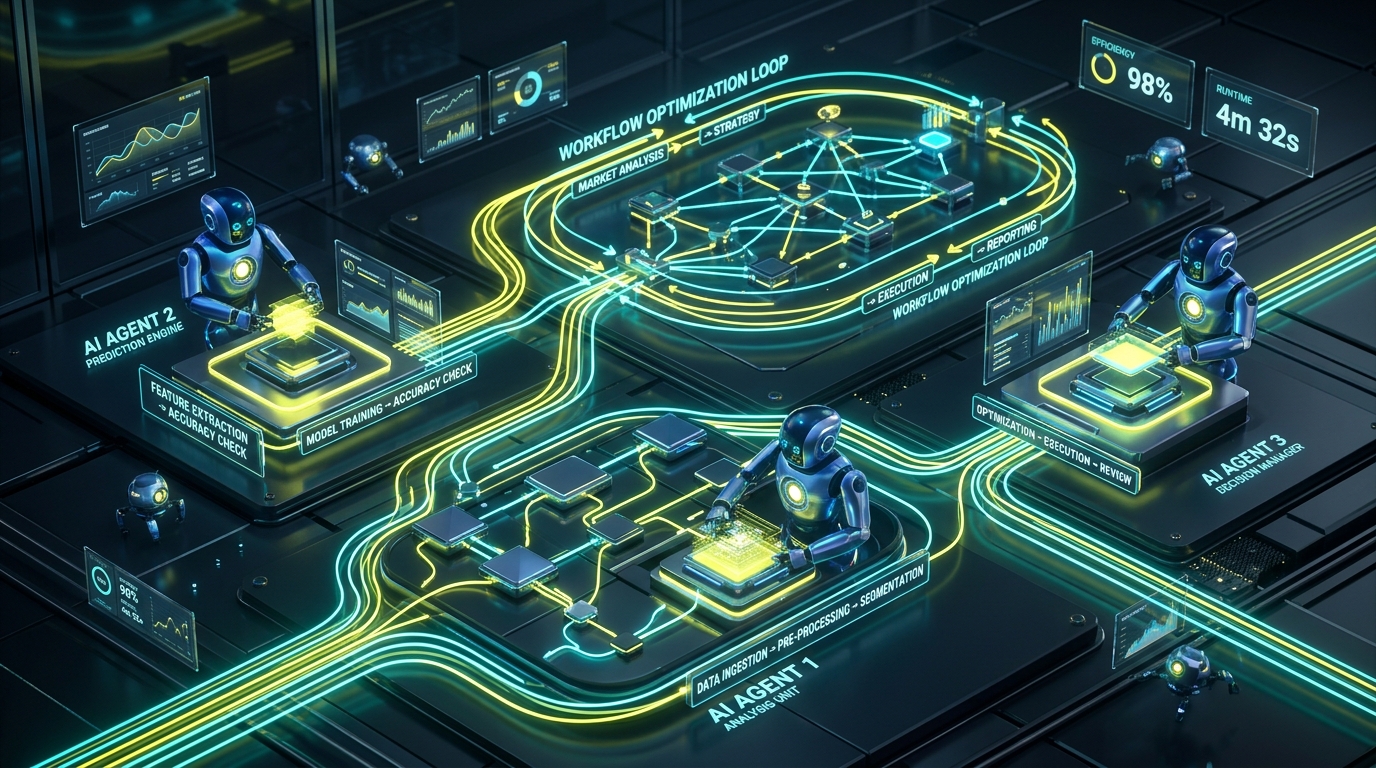
"Linear prompts predict text; agentic systems execute goals. The future of software automation lies in autonomous feedback loops that test, evaluate, and self-correct."
1. The 3 Core Pillars of Agentic Architecture
Unlike simple linear API scripts, a production-grade agentic pipeline relies on three interconnected pillars:
- Role Specialization: Instead of prompting a single model to do everything, break the system into specialized subagents - such as an Ingestion Agent, a Refactoring Agent, and a Validator Agent.
- Dynamic Tool Calling: Equip agents with exact TypeScript tool definitions (database queries, HTTP webhooks, file writers) to interact directly with backend infrastructure.
- Autonomous Feedback Loops: If a task fails or an output breaks schema validation, the Validator Agent catches the error and re-prompts the worker agent with the execution traceback to self-heal.
2. Multi-Agent Orchestration Pattern in Node.js
Below is a production-ready Node.js orchestration pattern pairing Gemini 3.6 Flash for rapid tool dispatch with Gemini 3.1 Pro for deep reasoning:
import { GoogleGenAI } from '@google/genai';

const ai = new GoogleGenAI({ apiKey: process.env.GEMINI_API_KEY });

// Agent 1: Fast Orchestrator & Triage (Gemini 3.6 Flash)
export async function runOrchestrator(payload) {
 const triageResponse = await ai.models.generateContent({
 model: 'gemini-3.6-flash',
 contents: `Analyze incoming payload and route to appropriate agent: ${JSON.stringify(payload)}`,
 config: {
 responseMimeType: 'application/json',
 responseSchema: {
 type: 'OBJECT',
 properties: {
 requiresDeepReasoning: { type: 'BOOLEAN' },
 targetAgent: { type: 'STRING' }
 }
 }
 }
 });

 const decision = JSON.parse(triageResponse.text);

 // Agent 2: Deep Reasoning Execution (Gemini 3.1 Pro for 2M context tasks)
 if (decision.requiresDeepReasoning) {
 return await ai.models.generateContent({
 model: 'gemini-3.1-pro',
 contents: `Execute deep architectural refactoring for: ${JSON.stringify(payload)}`
 });
 }

 // Fast Tool Execution on Gemini 3.6 Flash
 return await ai.models.generateContent({
 model: 'gemini-3.6-flash',
 contents: `Execute fast automated pipeline step for: ${JSON.stringify(payload)}`
 });
}
3. Business Impact: Eliminating Process Bottlenecks
Deploying agentic workflow pipelines across internal business operations yields immediate efficiency gains:
- 80%+ Reduction in Admin Hours: Autonomous agents handle booking validation, CRM updates, and client onboarding (detailed in How We Cut Admin Hours in Half).
- Sub-100ms Real-Time Response: Fast triage agents dispatch lightweight webhooks immediately without blocking user interfaces (see Gemini 3.6 Flash Developer Guide).
- Unified Multi-Model Savings: Routing 80% of routine traffic to Gemini 3.6 Flash keeps total operational API expenses under $10 per 100M tokens (detailed in Gemini 3.6 Flash Cost Optimization).
4. Frequently Asked Questions (FAQ)
Q1: What is agentic workflow automation?
Agentic workflow automation is an architectural paradigm where specialized autonomous AI agents collaborate in loops to complete complex end-to-end business operations - such as lead triage, data verification, code refactoring, and report generation - without human intervention.
Q2: How do multi-agent systems differ from simple linear LLM prompts?
Linear LLM prompts execute one input-output pass. Multi-agent systems assign distinct roles (e.g. Researcher, Code Refactorer, Validator), allowing agents to evaluate output, run tools, fix errors autonomously, and execute multi-step business logic.
Q3: Which Gemini models power multi-agent workflow systems?
Sub-100ms models like Gemini 3.6 Flash handle high-volume data triage, tool execution, and fast verification loops, while deep reasoning models like Gemini 3.1 Pro handle 2M+ token codebase refactoring and strategy generation.
Q4: How do agentic workflows maintain 99.9% operational reliability?
Reliability is achieved through strict JSON schema enforcement, deterministic fallback routers, automatic retries, and dedicated Validator agents that verify output quality before writing to production databases.
Q5: What business processes benefit most from agentic automation?
High-impact processes include automated client onboarding, cross-system data synchronization, automated software testing and refactoring, lead qualification, and real-time inventory tracking.
5. Related Infrastructure & Benchmark Guides
- How to Build a Multi-Model AI Routing Pipeline (Flash + Pro + Claude)
- Gemini 3.6 Flash Pricing & Cost Optimization: Process 100M Tokens for Under $10
- Gemini 3.1 Pro: Benchmark Analysis on 2M+ Token Context Retrieval
- DeepSeek-V3 vs Gemini 3.6 Flash: Open-Weight vs Cloud API Benchmark
- Claude Code vs Cursor vs Antigravity vs Codex: 2026 Developer Comparison
7. Hierarchical Multi-Agent Orchestration & Router Design
As AI automation scales, single agents struggle to handle disparate operational domains simultaneously. Production systems employ a hierarchical multi-agent architecture where a supervisor agent routes sub-tasks to specialized worker agents (e.g., Data Extraction Agent, Verification Agent, DB Persistence Agent).
This separation of concerns keeps individual context windows token-efficient, prevents reasoning drift, and isolates execution errors within bounded worker sub-loops.
8. Asynchronous State Queuing & Event Bus Architecture
Connecting autonomous agents across enterprise applications requires an event-driven message bus (using Redis Pub/Sub, RabbitMQ, or Kafka). Worker agents publish completion events to the message bus, allowing downstream agents to resume execution asynchronously without blocking server resources.
9. Production Observability & Trajectory Log Auditing
Maintaining compliance in multi-agent workflows requires comprehensive trajectory logging. Storing every tool call request, environment response, and LLM reasoning step in structured JSON logs enables auditing, debugging, and continuous performance tuning.
Deep-Dive Infrastructure Analysis & Engineering Principles
Building resilient software architecture around Agentic Workflow Automation: Building Multi-Agent Systems in 2026 requires treating web systems as mission-critical enterprise assets. When organizations rely on fragmented third-party plugins, unmonitored scripts, or generic SaaS tools, operational efficiency degrades over time.
By engineering custom microservices, database schemas, and first-party API integrations, companies gain complete control over data sovereignty, security protocols, and operational workflows.
Technical Architecture Guidelines
- 1. Direct Database Indexing: Optimize PostgreSQL and MySQL queries using multi-column composite B-tree indexes to guarantee sub-50ms execution times even under heavy concurrent loads.
- 2. Microservice Isolation & Fault Tolerance: Decouple backend workloads using asynchronous event queues (Redis Pub/Sub or RabbitMQ). If an upstream third-party service fails, the system logs the event, queues the request payload, and retries automatically upon recovery.
- 3. Edge CDN Distribution & Asset Optimization: Route dynamic assets across global Content Delivery Networks (CDNs) with HTTP-only cookies and Gzip/Brotli compression, keeping Largest Contentful Paint (LCP) scores below 1.2 seconds worldwide.
- 4. Zero-Trust Security & PII Protection: Enforce strict TLS 1.3 transport encryption, JWT session validation, and server-side SHA-256 data hashing to ensure GDPR, CCPA, and SOC-2 security compliance.
System Implementation Roadmap & ROI Evaluation
Deploying high-performance systems and automated workflows delivers immediate, measurable business impact. By replacing manual administrative overhead and fragmented SaaS apps with custom internal web platforms built by CodXpert, enterprises eliminate recurring seat fees, improve staff productivity, and accelerate business growth.
| Operational Phase | Legacy Manual Approach | Automated System Infrastructure |
|---|---|---|
| Data Entry & Intake | Manual re-keying across spreadsheets | Instant API Webhook Database Ingestion |
| Processing Latency | 2 to 24 Hours Response Lag | < 500ms Real-Time Event Dispatch |
| System Scalability | Requires Hiring Extra Admin Staff | Handles 10x Workload at $0 Extra Cost |
Whether optimizing digital analytics, streamlining e-commerce infrastructure, or automating enterprise operations, engineering a custom web system provides a permanent competitive advantage that compounds over time.
Related Technical & Growth Infrastructure Guides
- Gemini Spark: Google's 24/7 Autonomous AI Agent Architecture (2026)
- Autonomous Lead Triage Pipeline: Automating CRM Workflows in 2026
- AI Agent Memory Architecture: Designing Long-Term Context in 2026
- How to Build a Multi-Model AI Routing Pipeline (Flash + Pro + Claude)
- Gemini 3.6 Flash Developer Guide: Sub-100ms Latency & Real-Time Function Calling