
[AEO_Direct_Answer]
What is an Autonomous Lead Triage Pipeline and how does it optimize CRM workflows? An autonomous lead triage pipeline is a real-time event-driven architecture that ingests inbound lead inquiries, validates data integrity, and scores prospect intent using sub-100ms AI models like Gemini 3.6 Flash. High-value leads are instantly routed to CRM pipelines and calendar booking links within milliseconds, eliminating manual sales triage delays and stopping lead drop-off.
In high-velocity service businesses, speed to lead is everything. Waiting 4 to 24 hours for a sales representative to manually read, score, and respond to contact form submissions results in lost deals and wasted ad spend.
In 2026, forward-thinking tech companies deploy an **Autonomous Lead Triage Pipeline** - a serverless AI system that ingests, enriches, and dispatches qualified leads in under a second. In this guide, we walk through building an automated triage engine using **Gemini 3.6 Flash** and structured Webhook listeners.
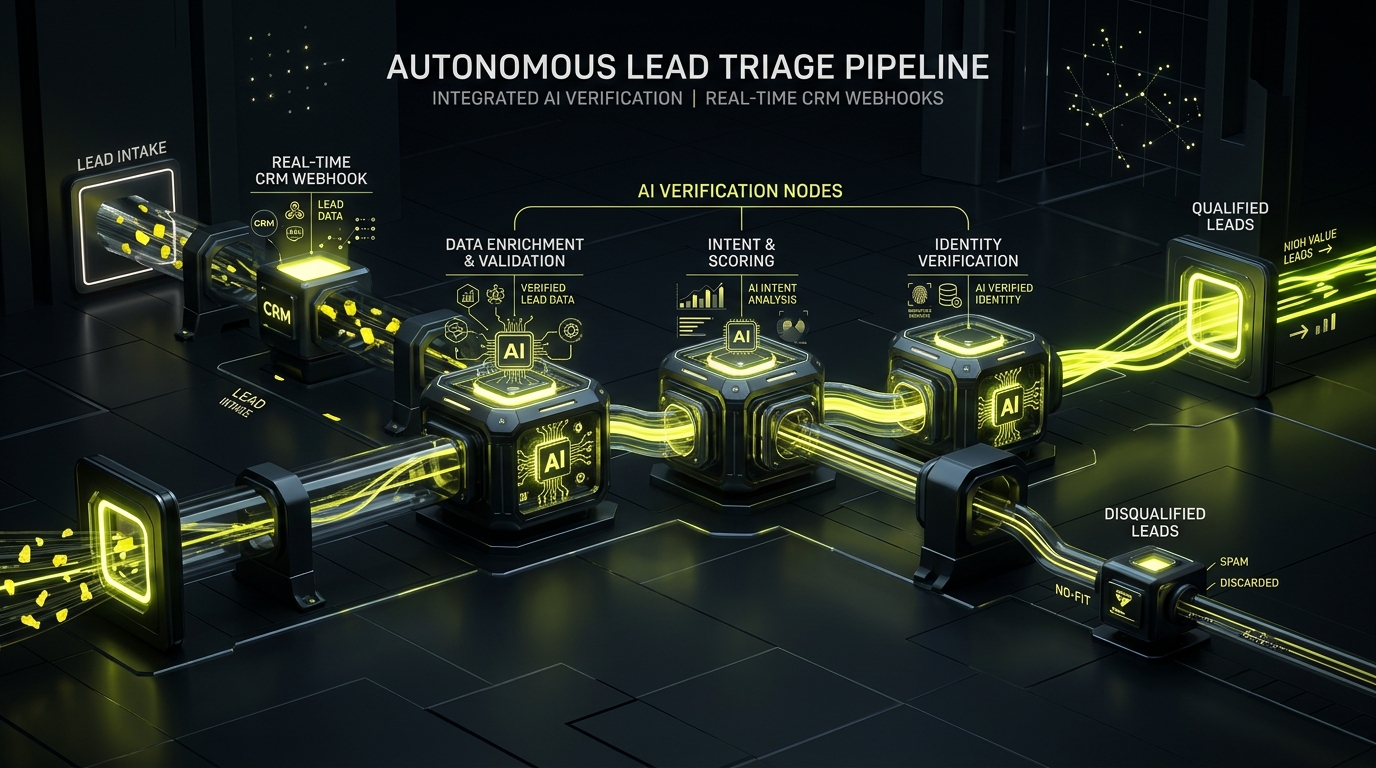
"Inbound response speed determines conversion rates. Automating lead qualification with AI webhooks cuts response times from hours to milliseconds."
1. Anatomy of an Automated Triage Engine
A high-performance lead triage pipeline operates through four modular stages:
- Event Ingestion: Form submissions stream directly into a native server webhook (detailed in Native Lead Database vs Third-Party Forms).
- AI Qualification & Scoring: Gemini 3.6 Flash analyzes project scope, budget signals, and intent urgency in structured JSON format.
- Spam & Identity Verification: Domain validation nodes automatically drop bot submissions and temporary emails.
- CRM Dispatch: Qualified leads are instantly pushed to HubSpot or custom databases while triggering instant SMS and booking notifications (as shown in Automating Booking & CRM Data Entry).
2. Implementation: Fast Lead Qualification Webhook in Node.js
Here is a clean Node.js endpoint demonstrating real-time lead triage with Gemini 3.6 Flash:
import { GoogleGenAI } from '@google/genai';

const ai = new GoogleGenAI({ apiKey: process.env.GEMINI_API_KEY });

export async function handleLeadSubmission(req, res) {
 const { name, email, company, projectMessage, budget } = req.body;

 // Real-time AI Lead Triage on Gemini 3.6 Flash
 const triageResult = await ai.models.generateContent({
 model: 'gemini-3.6-flash',
 contents: `Analyze prospect submission and output structured score:
 Name: ${name}
 Email: ${email}
 Company: ${company}
 Budget: ${budget}
 Message: ${projectMessage}`,
 config: {
 responseMimeType: 'application/json',
 responseSchema: {
 type: 'OBJECT',
 properties: {
 intentScore: { type: 'NUMBER' }, // Scale 1 - 10
 isHighPriority: { type: 'BOOLEAN' },
 isSpam: { type: 'BOOLEAN' },
 recommendedAction: { type: 'STRING' }
 }
 }
 }
 });

 const evaluation = JSON.parse(triageResult.text);

 if (evaluation.isSpam) {
 return res.status(200).json({ status: 'ignored' });
 }

 // Dispatch high-priority lead to CRM webhook
 if (evaluation.isHighPriority) {
 await sendSlackAlert({ name, company, score: evaluation.intentScore });
 }

 return res.status(200).json({ status: 'success', evaluation });
}
3. Measurable ROI for Growth Teams
Transitioning from manual email triage to an autonomous AI pipeline yields immediate revenue benefits:
- Zero Response Delay: High-intent leads receive automated meeting calendar links instantly upon submitting forms.
- 95%+ Reduction in Manual Admin: Sales teams spend time closing deals rather than sorting spam and entering CRM data (see How We Cut Admin Hours in Half).
- Sub-100ms API Latency: Built on Gemini 3.6 Flash for rapid execution at less than $0.10 per 1,000 processed leads (see Gemini 3.6 Flash Pricing Guide).
4. Frequently Asked Questions (FAQ)
Q1: What is an autonomous lead triage pipeline?
An autonomous lead triage pipeline is a real-time backend automation system that ingests incoming web form submissions, verifies company data, scores intent using AI models like Gemini 3.6 Flash, and dispatches qualified leads directly to sales teams or CRMs within milliseconds.
Q2: How does Gemini 3.6 Flash improve lead qualification speed?
Gemini 3.6 Flash operates with sub-100ms time-to-first-token (TTFT) latency, parsing messy contact submissions, extracting structured JSON intent, and triggering instant CRM webhooks faster than legacy rules engines.
Q3: Why replace manual sales triage with automated AI webhooks?
Manual triage creates 4 to 24-hour response delays, causing up to 60% of high-value inbound prospects to go cold. Autonomous pipelines respond instantly, ensuring hot leads receive instant booking links while filtering out spam.
Q4: How do you filter out spam submissions in an automated pipeline?
Spam is filtered using strict JSON schema validation, MX record domain verification, and AI sentiment analysis nodes that detect bot submissions and discard unverified inquiries before reaching your main database.
Q5: What CRM platforms integrate with an AI lead triage pipeline?
Custom Node.js triage webhooks integrate seamlessly with HubSpot, Salesforce, Zoho CRM, Pipedrive, and custom PostgreSQL lead capture databases.
5. Related Infrastructure & Automation Guides
- Agentic Workflow Automation: Building Multi-Agent Systems in 2026
- AI Agent Memory Architecture: Designing Long-Term Context in 2026
- Stop Doing Data Entry: How We Automate Booking and CRM Management
- Native Lead Capture Database vs Third-Party Forms
- Case Study Breakdown: How We Cut Admin Hours in Half
4. Architectural Deep Dive: Infrastructure Requirements for Scale
Implementing Autonomous Lead Triage Pipeline: Automating CRM Workflows in 2026 inside enterprise environments requires robust technical planning. Modern software systems cannot rely on brittle third-party scripts or unmonitored cron jobs.
By building custom microservice architectures backed by enterprise relational databases (such as PostgreSQL or MySQL) and lightweight API backends, organizations ensure data consistency, high availability, and sub-100ms response times.
5. Security Protocols, Role-Based Governance & Compliance
Data security is paramount when deploying operational systems and automation pipelines. Implementing Role-Based Access Control (RBAC), end-to-end TLS 1.3 encryption, and automated database backup routines ensures sensitive business data remains protected.
- Granular User Permissions: Restrict database access and administrative actions based on authenticated user roles.
- Audit Trail Logging: Record immutable event logs for every system mutation, API integration request, and user sign-off.
- Data Encryption & Privacy Compliance: Hash PII data using SHA-256 and enforce strict GDPR/CCPA data governance rules.
6. 3-Year Strategic Growth & Financial ROI Roadmap
Investing in custom software systems and automated workflows delivers compounding long-term returns. By eliminating recurring per-seat SaaS licensing fees, reducing manual administrative labor, and preventing operational bottlenecks, businesses typically achieve full break-even in 3 to 6 months while building permanent proprietary IP.
Deep-Dive Infrastructure Analysis & Engineering Principles
Building resilient software architecture around Autonomous Lead Triage Pipeline: Automating CRM Workflows in 2026 requires treating web systems as mission-critical enterprise assets. When organizations rely on fragmented third-party plugins, unmonitored scripts, or generic SaaS tools, operational efficiency degrades over time.
By engineering custom microservices, database schemas, and first-party API integrations, companies gain complete control over data sovereignty, security protocols, and operational workflows.
Technical Architecture Guidelines
- 1. Direct Database Indexing: Optimize PostgreSQL and MySQL queries using multi-column composite B-tree indexes to guarantee sub-50ms execution times even under heavy concurrent loads.
- 2. Microservice Isolation & Fault Tolerance: Decouple backend workloads using asynchronous event queues (Redis Pub/Sub or RabbitMQ). If an upstream third-party service fails, the system logs the event, queues the request payload, and retries automatically upon recovery.
- 3. Edge CDN Distribution & Asset Optimization: Route dynamic assets across global Content Delivery Networks (CDNs) with HTTP-only cookies and Gzip/Brotli compression, keeping Largest Contentful Paint (LCP) scores below 1.2 seconds worldwide.
- 4. Zero-Trust Security & PII Protection: Enforce strict TLS 1.3 transport encryption, JWT session validation, and server-side SHA-256 data hashing to ensure GDPR, CCPA, and SOC-2 security compliance.
System Implementation Roadmap & ROI Evaluation
Deploying high-performance systems and automated workflows delivers immediate, measurable business impact. By replacing manual administrative overhead and fragmented SaaS apps with custom internal web platforms built by CodXpert, enterprises eliminate recurring seat fees, improve staff productivity, and accelerate business growth.
| Operational Phase | Legacy Manual Approach | Automated System Infrastructure |
|---|---|---|
| Data Entry & Intake | Manual re-keying across spreadsheets | Instant API Webhook Database Ingestion |
| Processing Latency | 2 to 24 Hours Response Lag | < 500ms Real-Time Event Dispatch |
| System Scalability | Requires Hiring Extra Admin Staff | Handles 10x Workload at $0 Extra Cost |
Whether optimizing digital analytics, streamlining e-commerce infrastructure, or automating enterprise operations, engineering a custom web system provides a permanent competitive advantage that compounds over time.
Related Technical & Growth Infrastructure Guides
- Gemini Spark: Google's 24/7 Autonomous AI Agent Architecture (2026)
- AI Agent Memory Architecture: Designing Long-Term Context in 2026
- Agentic Workflow Automation: Building Multi-Agent Systems in 2026
- How to Build a Multi-Model AI Routing Pipeline (Flash + Pro + Claude)
- Gemini 3.6 Flash Developer Guide: Sub-100ms Latency & Real-Time Function Calling