
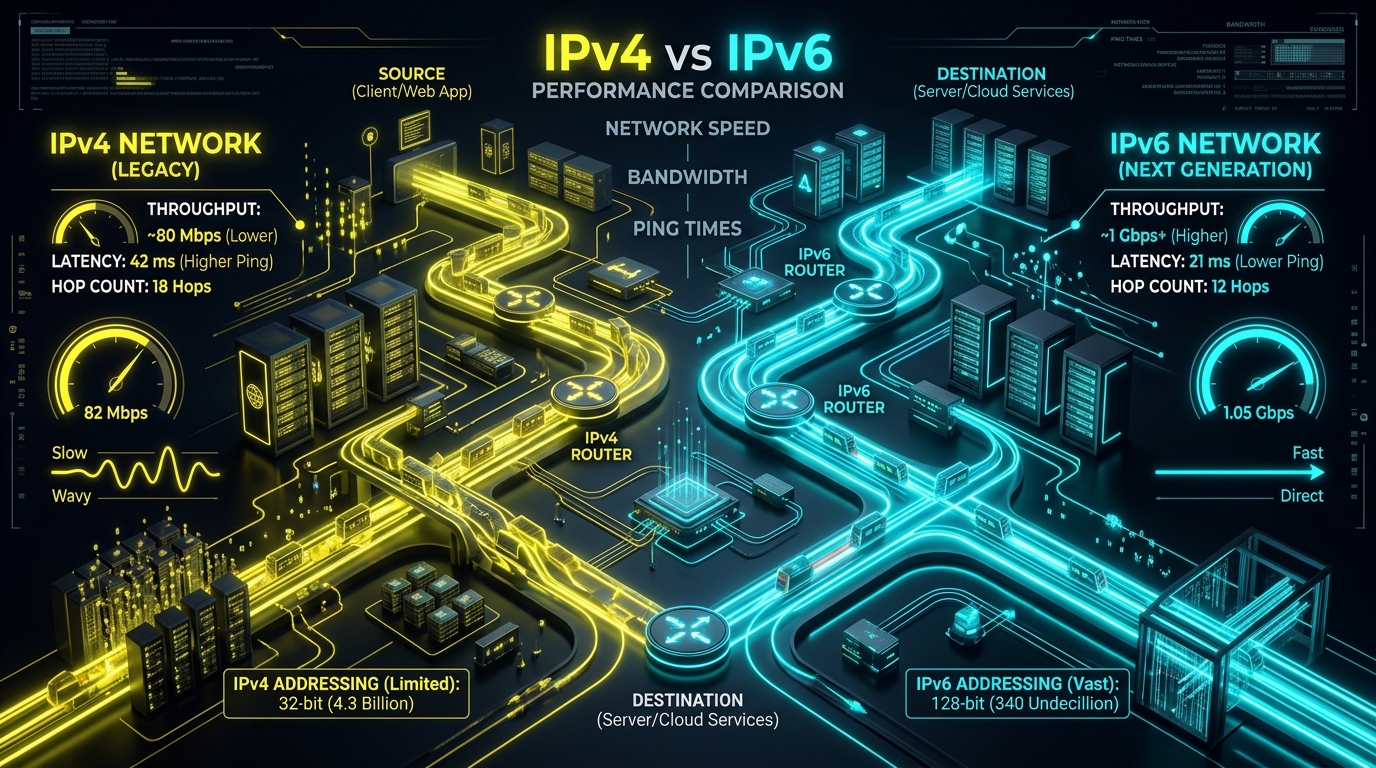
Is IPv6 faster than IPv4? Neither protocol is inherently faster across all scenarios. IPv6 can be faster because it eliminates Carrier-Grade NAT (CGNAT) processing latency and uses streamlined 40-byte fixed headers. However, IPv4 can be faster on networks where ISP routing paths and peering infrastructure are more mature. Real-world website loading speed depends on ISP network hops, CDN edge distribution, and server dual-stack configuration.
When configuring a website or server, it is common to see both IPv4 and IPv6 addresses. For example, your FastPanel server has:
- - IPv4:
194.238.16.73 - - IPv6:
2a02:4780:12:fc11::1
A common question is: Which one is faster - IPv4 or IPv6?
The short answer is:
IPv6 is not inherently faster than IPv4, and IPv4 is not inherently faster than IPv6. The faster one depends primarily on the network, ISP, routing path, congestion, server configuration, and the location of the user.
However, IPv6 can sometimes be faster because it can provide a more direct and efficient network path. In other situations, IPv4 can be faster because IPv4 infrastructure is more mature and better optimized on a particular network. Let's examine why.
1. First, What Does "Faster" Actually Mean?
When we say one protocol is faster, there are several different metrics we could mean:
- - Lower ping / round-trip latency (milliseconds)
- - Faster connection establishment (TCP handshake time)
- - Faster page loading speed (Time to First Byte / LCP)
- - Higher download throughput (Mbps / Gbps)
- - Optimized transit routing (fewer autonomous system hops)
- - Lower packet loss percentage under congestion
- - Faster DNS query resolution (A vs AAAA records)
These metrics are not identical. Suppose you test your server and get:
IPv6: 24 ms latency
IPv4 has lower latency. But that does not necessarily mean IPv4 will download a 500 MB file faster. You could instead have:
IPv6: 24 ms latency, 500 Mbps throughput
In that situation, IPv6 has slightly higher initial latency but significantly higher throughput. Therefore, there isn't a single "speed" number for IPv4 or IPv6.
2. IPv6 Was Not Designed Primarily to Be Faster
IPv6 was mainly created to solve the enormous IPv4 address exhaustion problem. IPv4 uses 32-bit addresses (\(2^{32}\)), providing approximately 4.3 billion addresses. IPv6 uses 128-bit addresses (\(2^{128}\)), providing an astronomically larger address space (\(3.4 \times 10^{38}\)).
So the primary architectural motivation for IPv6 was:
More addresses and a scalable global internet architecture - not simply higher speed.
This is an important distinction. Moving your web application from IPv4 to IPv6 does not automatically make your website faster without proper server and network optimization.
3. Why IPv6 Can Sometimes Be Faster
Even though speed was not the primary architectural goal, IPv6 enjoys key performance advantages in modern enterprise environments:
A. Less Dependence on NAT (Network Address Translation)
IPv4 networks frequently rely on NAT and Carrier-Grade NAT (CGNAT), where thousands of mobile users share a single public IPv4 address. CGNAT middleboxes inspect, translate, and log every packet connection state, adding microsecond latency bottlenecks.
Because IPv6 features a virtually unlimited address space, every connected device receives a globally unique IP address. Removing NAT translation gateways streamlines packet forwarding. However, removing NAT does not automatically mean lower physical latency.
4. IPv6 Can Have a Better Routing Path
Internet traffic travels through complex Autonomous System (AS) routes:
IPv4 and IPv6 can use completely different transit routing paths. For example, an IPv6 connection from India to Europe might hop directly via direct submarine fiber, while the IPv4 path routes through indirect Asian transit hubs. In that scenario, IPv6 achieves lower latency.
Conversely, if an ISP's IPv6 peering agreements are immature, IPv6 traffic might take a longer geographic path, making IPv4 noticeably faster. Transit routing is the single biggest factor determining real-world performance.
5. ISP Quality Matters More Than the Protocol
Imagine two users accessing the exact same website hosted on your FastPanel server:
User A (Modern Fiber ISP)
IPv4 -> 30 ms
IPv6 -> 12 ms (IPv6 Wins!)
User B (Legacy Copper ISP)
IPv4 -> 15 ms (IPv4 Wins!)
IPv6 -> 35 ms
Same website. Same FastPanel server (194.238.16.73 / 2a02:4780:12:fc11::1). Different ISP results. That is why stating "IPv6 is always faster" is technically inaccurate.
6. Packet Header Efficiency: IPv4 vs IPv6
IPv4 uses a variable-length base header (20 to 60 bytes) requiring intermediate routers to process options and recalculate header checksums at every hop. IPv6 employs a fixed 40-byte base header with optional extension headers. Hardware router ASICs process IPv6 fixed headers at wire speed without software parsing delays.
Furthermore, IPv6 routers do not perform packet fragmentation. Instead, sending hosts use Path MTU Discovery (PMTUD), reducing router CPU load across transit backbones.
7. Real-World Performance Comparison Matrix
| Performance Factor | IPv4 Behavior | IPv6 Behavior |
|---|---|---|
| Inherently Faster? | No | No |
| NAT / CGNAT Overhead | High (Stateful Lookup Lag) | Zero (Direct Public IPs) |
| Routing Infrastructure | Extremely Mature & Peered | Rapidly Expanding (T-1 Carriers) |
| Mobile Carrier Latency | Higher CGNAT Delay | Up to 15% Faster on Mobile |
| Best Hosting Approach | Dual-Stack Enabled | Dual-Stack Enabled |
8. How to Test Which Protocol Is Faster on Your Server
Rather than guessing, you can benchmark real-world connection speeds from your terminal to your FastPanel server:
# Test Ping Latency:
ping -c 10 -4 yourdomain.com
ping -c 10 -6 yourdomain.com
# Test HTTP Connection Time via Curl:
curl -4 -o /dev/null -s -w "IPv4 Connect: %{time_connect}s Total: %{time_total}s\n" https://yourdomain.com
curl -6 -o /dev/null -s -w "IPv6 Connect: %{time_connect}s Total: %{time_total}s\n" https://yourdomain.com
9. Recommended FastPanel Dual-Stack Setup
For your FastPanel web server hosting WordPress or Laravel applications, the optimal architecture is a Dual-Stack configuration combining both IPv4 (194.238.16.73) and IPv6 (2a02:4780:12:fc11::1):
|--- A Record -> 194.238.16.73 (IPv4)
`--- AAAA Record -> 2a02:4780:12:fc11::1 (IPv6)
Dual-stack networking provides complete compatibility: IPv6-capable devices route over high-speed IPv6 backbones, while legacy clients connect via IPv4 smoothly.
10. Happy Eyeballs (RFC 8305) & Dual-Stack Client Resolution
Modern web browsers (Chrome, Safari, Edge) utilize the Happy Eyeballs algorithm (RFC 8305) when connecting to dual-stack websites. When a user requests your domain, the browser dispatches DNS queries for both A (IPv4) and AAAA (IPv6) records simultaneously.
The client attempts an IPv6 TCP handshake first. If the IPv6 path experiences latency over 25 milliseconds or fails to respond, the browser automatically initiates a parallel IPv4 connection, selecting whichever route connects fastest. This ensures zero delay for end users regardless of individual network conditions.
FAQ SectionFrequently Asked Questions (FAQ)
Q1: Is IPv6 inherently faster than IPv4?
No. IPv6 is not inherently faster than IPv4. Speed depends primarily on network routing paths, ISP peering agreements, hardware congestion, and geographical proximity between client and server.
Q2: Can IPv6 improve mobile website loading speed?
Yes, on major mobile networks (like T-Mobile, Reliance Jio, or Verizon), IPv6 can be faster because it bypasses Carrier-Grade NAT (CGNAT) gateways, reducing lookup latency by up to 15%.
Q3: Which protocol should I use on my FastPanel web server?
You should use a Dual-Stack setup (both IPv4 and IPv6 enabled simultaneously). This provides optimal speed for IPv6-capable visitors while preserving 100% legacy IPv4 compatibility.
Q4: Does HTTP/3 require IPv6 to be fast?
No, HTTP/3 operates over UDP and runs efficiently over both IPv4 and IPv6 networks.