
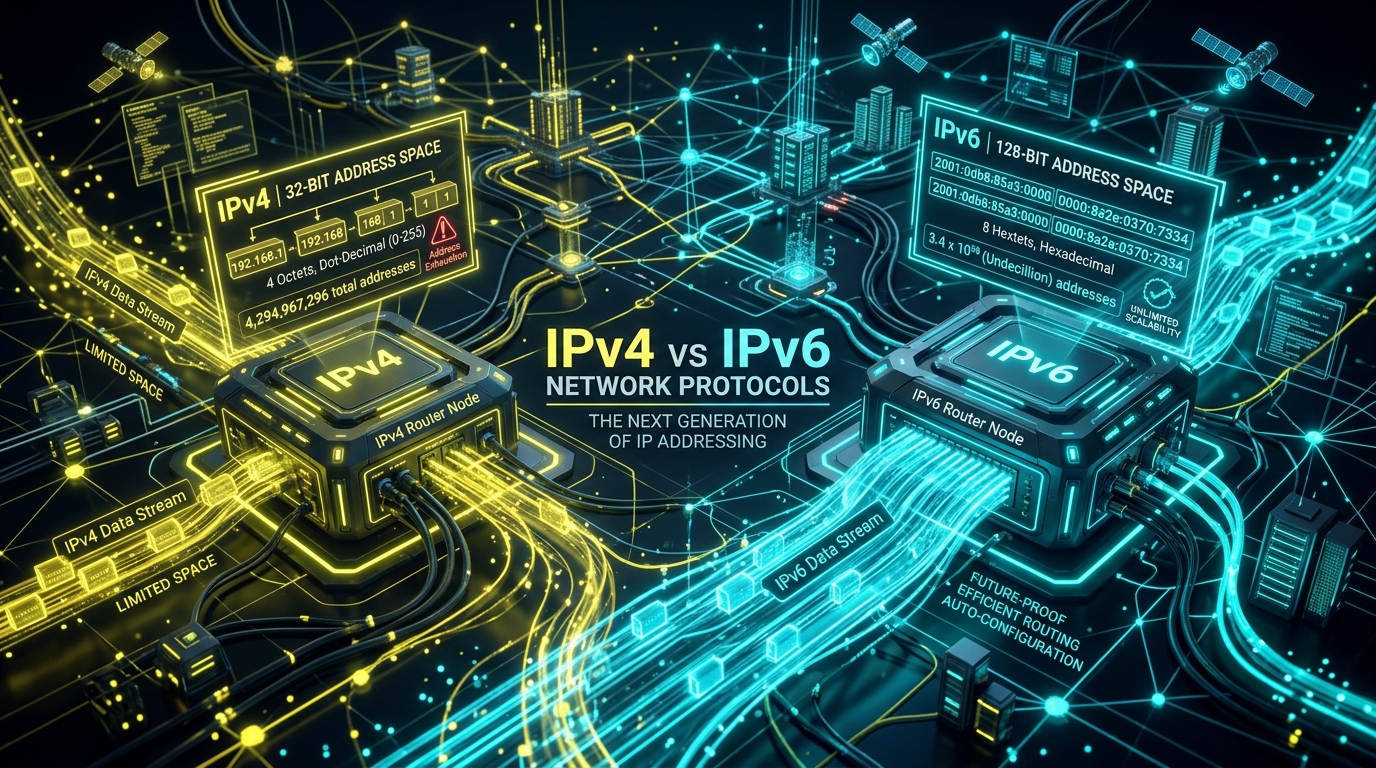
What is the fundamental difference between IPv4 and IPv6? IPv4 uses a 32-bit address space represented as four dot-decimal octets (e.g., 194.238.16.73), yielding ~4.3 billion total IP addresses. IPv6 uses a 128-bit address space formatted as eight colon-separated hexadecimal groups (e.g., 2a02:4780:12:fc11::1), producing over 340 undecillion unique addresses. In server environments like FastPanel, both IPv4 and IPv6 addresses can point to the same physical web server in a dual-stack configuration.
IPv4 and IPv6 are two versions of the Internet Protocol (IP) used to identify devices and route network traffic across the internet and private networks. If you manage websites, servers, DNS, FastPanel, WordPress, Laravel applications, or cloud infrastructure, understanding the difference is important because you will often see both IPv4 and IPv6 addresses configured on the same server.
For example, in your FastPanel setup, you saw:
- - IPv4:
194.238.16.73 - - IPv6:
2a02:4780:12:fc11::1
Both can point to the same server, but they belong to different generations of the Internet Protocol.
1. What Is an IP Address?
An IP address is essentially a network address for a device or service. Think of it like a postal address. If you want to send a physical package to someone, you need their address. Similarly, when your browser wants to access a website, it needs an IP address to know where to send the request.
The domain name is easy for humans to remember, while the IP address is what networking equipment uses to locate the server. IPv4 and IPv6 perform this same fundamental job, but they use very different address systems.
2. What Is IPv4?
IPv4 stands for Internet Protocol version 4. It was introduced decades ago and became the dominant protocol for internet communication. An IPv4 address contains 32 bits and is normally written as four decimal numbers separated by dots.
For example: 194.238.16.73. Each section can have a value from 0 to 255 (e.g., 192.168.1.10, 8.8.8.8, or 194.238.16.73).
How many IPv4 addresses exist?
Because IPv4 uses 32 bits, the total pool is calculated as \(2^{32} = 4,294,967,296\). So there are approximately 4.3 billion possible IPv4 addresses. That sounded like an enormous number when IPv4 was designed. But the internet grew far beyond expectations.
Today we have smartphones, computers, servers, Smart TVs, IoT devices, security cameras, routers, cloud servers, virtual machines, containers, and connected industrial devices. As a result, IPv4 addresses became scarce. This is the primary reason IPv6 was developed.
3. What Is IPv6?
IPv6 stands for Internet Protocol version 6. It was designed primarily to solve the IPv4 address exhaustion problem and provide a much larger address space. IPv6 uses 128-bit addresses.
An IPv6 address looks completely different from IPv4. For example: 2a02:4780:12:fc11::1. IPv6 uses numbers 0-9, letters a-f, and colons : (e.g., 2001:0db8:85a3:0000:0000:8a2e:0370:7334).
IPv6 addresses can be shortened using rules that allow consecutive zero sections to be compressed. For example, 2001:0db8:0000:0000:0000:0000:0000:0001 becomes 2001:db8::1. That is why your FastPanel IPv6 address (2a02:4780:12:fc11::1) contains double colons ::.
4. The Biggest Difference: Address Capacity
The biggest difference between IPv4 and IPv6 is the number of available addresses:
- IPv4: \(2^{32} = 4,294,967,296\) (~4.3 Billion)
- IPv6: \(2^{128} \approx 3.4 \times 10^{38}\) (340,282,366,920,938,463,463,374,607,431,768,211,456)
In other words, IPv6 provides an almost unimaginably larger address space. This means we do not need to rely on IPv4 conservation techniques to the same degree.
5. Why IPv4 Uses NAT (Network Address Translation)
Because IPv4 addresses are limited, networks commonly use NAT, or Network Address Translation. For example, your home network might assign private IPs (192.168.1.10, 192.168.1.11) to laptops, phones, and TVs while sharing a single public IPv4 address (e.g., 203.x.x.x).
The router translates traffic between private devices and the public internet, allowing many devices to share one public IPv4 address. NAT has been extremely important in extending the life of IPv4, but it also adds operational complexity.
6. IPv6 Reduces the Need for NAT
IPv6 has such a massive address space that devices can generally have globally unique addresses without needing the same kind of address conservation. A network can assign globally routable IPv6 addresses directly to devices.
However, an important clarification is needed: IPv6 does not automatically make every device directly accessible from the internet. Firewalls are still essential. Even with IPv6, you must configure firewall rules to control which incoming connections are allowed.
7. IPv4 vs IPv6 Address Format & Comparison Matrix
| Feature | IPv4 | IPv6 |
|---|---|---|
| Protocol Version | Version 4 | Version 6 |
| Address Size | 32 bits (4 bytes) | 128 bits (16 bytes) |
| Example Address | 194.238.16.73 |
2a02:4780:12:fc11::1 |
| Total Pool | ~4.3 Billion | ~3.4 x 1038 (Undecillion) |
| Notation Format | Dot-Decimal (.) |
Hexadecimal (:) |
| NAT Reliance | Common / Mandatory | Generally Unnecessary |
| Address Exhaustion | Major Limitation | Practically Eliminated |
8. Does IPv6 Make the Internet Faster?
This is a common misconception. IPv6 is not inherently faster than IPv4. If your website loads faster over IPv6, that may be due to differences in ISP routing, network congestion, peering agreements, CDN edge configuration, DNS resolution speed, server configuration, or lower carrier NAT overhead.
IPv6 itself is not a magic speed upgrade. Similarly, switching from IPv4 to IPv6 will not automatically make your WordPress or Laravel web application faster without proper code and database optimization.
9. Does IPv6 Improve Security?
IPv6 includes several improvements to underlying protocol architecture (such as mandatory IPSec standards), but saying "IPv6 is automatically more secure than IPv4" would be misleading. Security depends on firewall rules, server configurations, application patches, authentication, TLS/HTTPS, and access controls.
One critical issue is that administrators often configure IPv4 firewall rules (UFW or iptables) but forget to configure equivalent IPv6 rules (ip6tables). For example, you might block port 22 (SSH) on IPv4 (194.238.16.73:22) but leave SSH accessible over IPv6. When enabling IPv6, IPv6 firewall rules must be audited as well.
10. IPv4 and IPv6 Can Work Together: Dual-Stack Setup
You do not have to choose one over the other. This is where dual-stack networking comes in. A server can have both IPv4 (194.238.16.73) and IPv6 (2a02:4780:12:fc11::1) active at the same time. Your server can then accept incoming connections over either protocol.
In DNS, a dual-stack domain contains both records:
- - A Record:
example.com -> 194.238.16.73(IPv4) - - AAAA Record:
example.com -> 2a02:4780:12:fc11::1(IPv6)
11. What Happens When Someone Visits Your Website?
When a visitor enters example.com, DNS returns both A (IPv4) and AAAA (IPv6) records. The visitor's device checks its local network connectivity. If IPv6 connectivity is available and preferred, the device connects via 2a02:4780:12:fc11::1. Otherwise, it falls back to 194.238.16.73. Dual-stack networking ensures zero compatibility issues.
12. What Does This Mean for Your FastPanel Server?
In your FastPanel setup showing IPv4 194.238.16.73 and IPv6 2a02:4780:12:fc11::1, your server is dual-stack ready. To enable complete IPv6 support for your website:
- 1. DNS Configuration: Add both an A record (pointing to
194.238.16.73) and an AAAA record (pointing to2a02:4780:12:fc11::1). - 2. Web Server Virtual Host: Ensure Nginx/Apache in FastPanel is configured to listen on
[::]:80and[::]:443. - 3. Firewall Rules: Verify that ports 80 (HTTP) and 443 (HTTPS) are open on both IPv4 and IPv6 firewalls.
13. What About HTTPS / SSL Certificates?
Your SSL certificate does not require a separate issue process for IPv6. SSL/TLS certificates (such as Let's Encrypt issued through FastPanel) are granted to domain names (e.g., example.com), not IP addresses. The exact same HTTPS SSL certificate covers connections whether a visitor connects over IPv4 or IPv6.
14. Which One Should You Use? (Recommendation)
For modern websites, the recommended approach is Dual Stack (using both IPv4 and IPv6). This gives IPv6-capable users an optimized IPv6 path while maintaining 100% legacy IPv4 compatibility for all global visitors.
15. Conclusion & Key Takeaways
IPv6 is not an overnight replacement that forces IPv4 to disappear immediately. The global internet operates in a transition era where both protocols coexist. Having both 194.238.16.73 and 2a02:4780:12:fc11::1 configured for your FastPanel server is standard best practice for a modern, future-proof hosting environment.
Frequently Asked Questions (FAQ)
Q1: What is the main difference between IPv4 and IPv6?
The primary difference lies in address space size. IPv4 uses a 32-bit numeric address space producing ~4.3 billion unique IP addresses, whereas IPv6 uses a 128-bit hexadecimal address space yielding over 340 undecillion unique addresses.
Q2: Why do I see both an IPv4 and an IPv6 address in FastPanel?
FastPanel shows both IPv4 and IPv6 addresses when your server is configured for dual-stack networking. Both addresses point to the exact same physical server.
Q3: Does an SSL certificate need to be separate for IPv6?
No. An SSL/TLS certificate (such as Let's Encrypt) is issued for a domain name, not an IP address. The same HTTPS SSL certificate covers connections whether a visitor connects over IPv4 or IPv6.
Q4: Are IPv4 and IPv6 compatible with each other?
No, IPv4 and IPv6 are separate protocols that cannot communicate directly without transition mechanisms like Dual-Stack networking, 6to4 tunneling, or NAT64 translation proxies.