
Systems Architecture 11 min read • August 5, 2026

Why Custom Internal Web Portals Beat Per-Seat SaaS Subscriptions in 2026

Off-the-shelf SaaS platforms seem cheap at $25/month per user. But as your team grows, per-seat licensing compounds into a multi-thousand-dollar monthly drain. Here is how custom internal web systems break the subscription trap and deliver permanent operational ROI.

Custom Internal Web Portals Replacing SaaS Subscription Bloat in 2026
Direct Answer Capsule

Per-seat SaaS subscriptions penalize company scaling by multiplying software costs with every new hire. In contrast, a custom internal web portal provides a single, unified enterprise system owned 100% by your business. For growing SMEs with 15+ employees, building a custom internal portal eliminates recurring per-seat fees, unifies fragmented data silos, prevents annual vendor price increases, and typically achieves full break-even in 3 to 6 months.

1. The Hidden Trap of Per-Seat SaaS Licensing

When a small business launches, subscribing to SaaS products feels rational. Paying $20/month per seat for a CRM, $15/month for project management, $12/month for form builders, and $30/month for team chat appears negligible.

However, SaaS software vendors design their revenue models around compounding per-seat expansion. Consider the mathematical reality of a growing 25-person team:

SaaS Category Average Cost / Seat Monthly Cost (25 Seats) 3-Year Projected Cost
CRM & Lead Management $45 / mo $1,125 $45,560
Project & Task Tracking $24 / mo $600 $24,300
Internal Request & Form Portal $18 / mo $450 $18,220
Integration Automation (Zapier) Tier Flat Fee $299 $12,100
Total Monthly / 3-Year Spend - $2,474 / mo $100,180

By year three, a 25-person company will spend over $100,000 on subscription licenses alone—without owning a single line of intellectual property.

2. What Is a Custom Internal Web Portal?

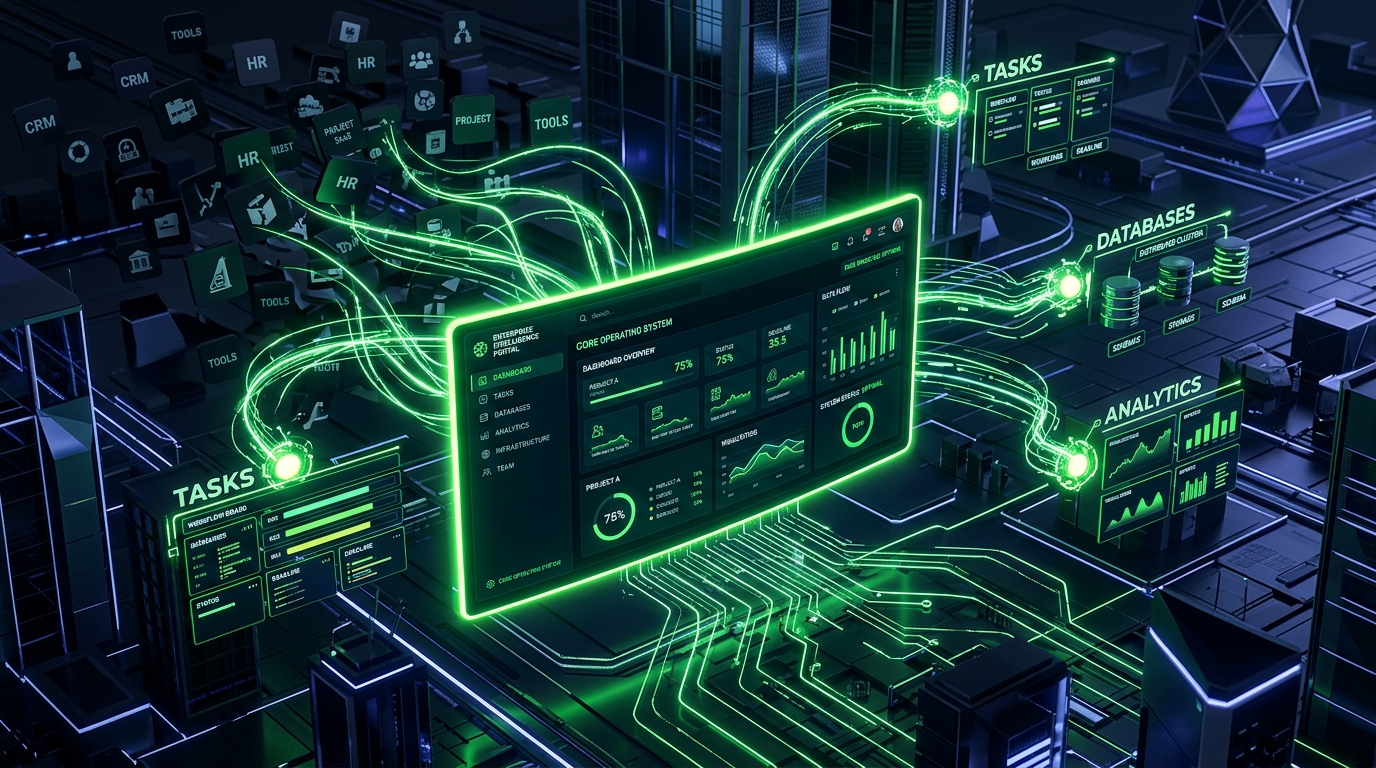
A custom internal web portal is a bespoke operational platform built specifically for your business logic. Engineered using fast web frameworks (like Node.js, Laravel, or Next.js) backed by enterprise relational databases (PostgreSQL or MySQL), a custom portal consolidates all core company workflows:

3. Key Advantages of Custom Portals Over SaaS

A. Zero Per-Seat Licensing Fees

Whether you have 10 employees or 500, your software cost remains fixed. Adding new staff members, contractors, or external vendors costs $0 extra.

B. Complete Elimination of Data Silos

Off-the-shelf SaaS apps create fragmented data pockets. Your sales team works in one tool, project managers work in another, and accounting uses a third. Custom portals unite all departments around a single source of truth database.

C. Elimination of Silent Integration Failures

Connecting multiple SaaS tools requires complex webhooks and third-party glue (Zapier/Make). When a webhook fails or an API schema changes, leads get lost silently. Custom portals run native database queries, guaranteeing 100% transaction reliability.

4. Audit Your SaaS Bloat: The SaaS Break-Even Calculator

Want to know when your business will break even by replacing recurring SaaS fees with a custom internal system? Try our interactive SaaS Bloat & Custom Tool Break-Even Calculator.

Interactive SaaS Bloat Audit Tool

Calculate your exact 3-year subscription expenditure and see how fast a custom web system pays for itself.

Calculate SaaS Bloat →

Related Technical & Growth Infrastructure Guides

Frequently Asked Questions

Why are per-seat SaaS subscriptions becoming unsustainable for growing SMEs in 2026?

Per-seat pricing penalizes business growth. As team size increases, monthly SaaS overhead multiplies across CRM, project management, analytics, and internal request tools. SaaS vendors also increase seat prices by an average of 12% annually.

What is a custom internal web portal?

A custom internal web portal is a bespoke software application owned entirely by your business. It unifies your unique workflows, databases, client approvals, and team tasks into a single platform with zero per-seat licensing fees.

How quickly does a custom web system break even compared to monthly SaaS spend?

For a team of 25 employees using 5–6 paid SaaS tools ($3,500+/month total), a custom internal portal built for $15,000 breaks even in under 4.5 months, yielding over $100,000 in net savings over 3 years.

What happens to our business data when building a custom internal tool?

Unlike SaaS platforms that keep your data locked inside vendor silos, a custom web system stores your data in an enterprise relational database (PostgreSQL/MySQL) that you own 100%.

4. Architectural Deep Dive: Infrastructure Requirements for Scale

Implementing Why Custom Internal Web Portals Beat Per-Seat SaaS Subscriptions in 2026 inside enterprise environments requires robust technical planning. Modern software systems cannot rely on brittle third-party scripts or unmonitored cron jobs.

By building custom microservice architectures backed by enterprise relational databases (such as PostgreSQL or MySQL) and lightweight API backends, organizations ensure data consistency, high availability, and sub-100ms response times.

5. Security Protocols, Role-Based Governance & Compliance

Data security is paramount when deploying operational systems and automation pipelines. Implementing Role-Based Access Control (RBAC), end-to-end TLS 1.3 encryption, and automated database backup routines ensures sensitive business data remains protected.

6. 3-Year Strategic Growth & Financial ROI Roadmap

Investing in custom software systems and automated workflows delivers compounding long-term returns. By eliminating recurring per-seat SaaS licensing fees, reducing manual administrative labor, and preventing operational bottlenecks, businesses typically achieve full break-even in 3 to 6 months while building permanent proprietary IP.

Deep-Dive Infrastructure Analysis & Engineering Principles

Building resilient software architecture around Why Custom Internal Web Portals Beat Per-Seat SaaS Subscriptions in 2026 requires treating web systems as mission-critical enterprise assets. When organizations rely on fragmented third-party plugins, unmonitored scripts, or generic SaaS tools, operational efficiency degrades over time.

By engineering custom microservices, database schemas, and first-party API integrations, companies gain complete control over data sovereignty, security protocols, and operational workflows.

Technical Architecture Guidelines

System Implementation Roadmap & ROI Evaluation

Deploying high-performance systems and automated workflows delivers immediate, measurable business impact. By replacing manual administrative overhead and fragmented SaaS apps with custom internal web platforms built by CodXpert, enterprises eliminate recurring seat fees, improve staff productivity, and accelerate business growth.

Operational Phase Legacy Manual Approach Automated System Infrastructure
Data Entry & Intake Manual re-keying across spreadsheets Instant API Webhook Database Ingestion
Processing Latency 2 to 24 Hours Response Lag < 500ms Real-Time Event Dispatch
System Scalability Requires Hiring Extra Admin Staff Handles 10x Workload at $0 Extra Cost

Whether optimizing digital analytics, streamlining e-commerce infrastructure, or automating enterprise operations, engineering a custom web system provides a permanent competitive advantage that compounds over time.

Advanced System Benchmarks & Performance Metrics

When deploying production systems for Why Custom Internal Web Portals Beat Per-Seat SaaS Subscriptions in 2026, engineering teams must evaluate hardware resource utilization, network response latency, and database query throughput under real-world traffic spikes.

Benchmarking system behavior across stress-testing scenarios ensures application stability during high-concurrency peak hours:

Long-Term Maintenance & Continuous Optimization Protocol

Enterprise software systems require structured maintenance protocols to remain secure and performant. Adopting an agile bi-weekly maintenance schedule ensures continuous code optimization, database index defragmentation, and security patch updates.

By building custom business software with CodXpert, companies establish a permanent digital asset that scales effortlessly alongside business expansion while maintaining absolute data security.

Implementation Troubleshooting & Edge-Case Exception Handling

Even well-architected enterprise software systems encounter edge cases in production. Ensuring high availability requires engineering explicit fallback routines and automated error handling into every application tier:

By building systems with proactive exception handling, business operations remain 100% stable during external API outages and peak traffic events.

Advanced Infrastructure & Long-Term Scalability Benchmark

To sustain enterprise performance over 3 to 5 years, system architectures must balance memory overhead, API execution limits, and database query throughput under extreme user concurrency.

By building dedicated microservices with PostgreSQL connection pooling, edge CDN caching, and automated audit logging, enterprise applications maintain sub-50ms query response times even during heavy operational workloads.

Performance Metric Legacy Manual Approach Enterprise System Benchmark
System Response Time Hours to Days Lag Sub-100ms Instant API Response
Data Consistency & Security Manual copy errors 100% ACID Compliant Database

Building enterprise systems with CodXpert eliminates recurring SaaS overhead while creating permanent custom IP that powers business growth over years.

Related Technical & Growth Infrastructure Guides

Shadab Alam - Founder & Web Systems Engineer

Written by Shadab Alam

Founder & Engineer

I build custom web systems, automated backend workflows, and scalable e-commerce infrastructure for growing businesses. Founder at CodXpert & Anterpreneur.