
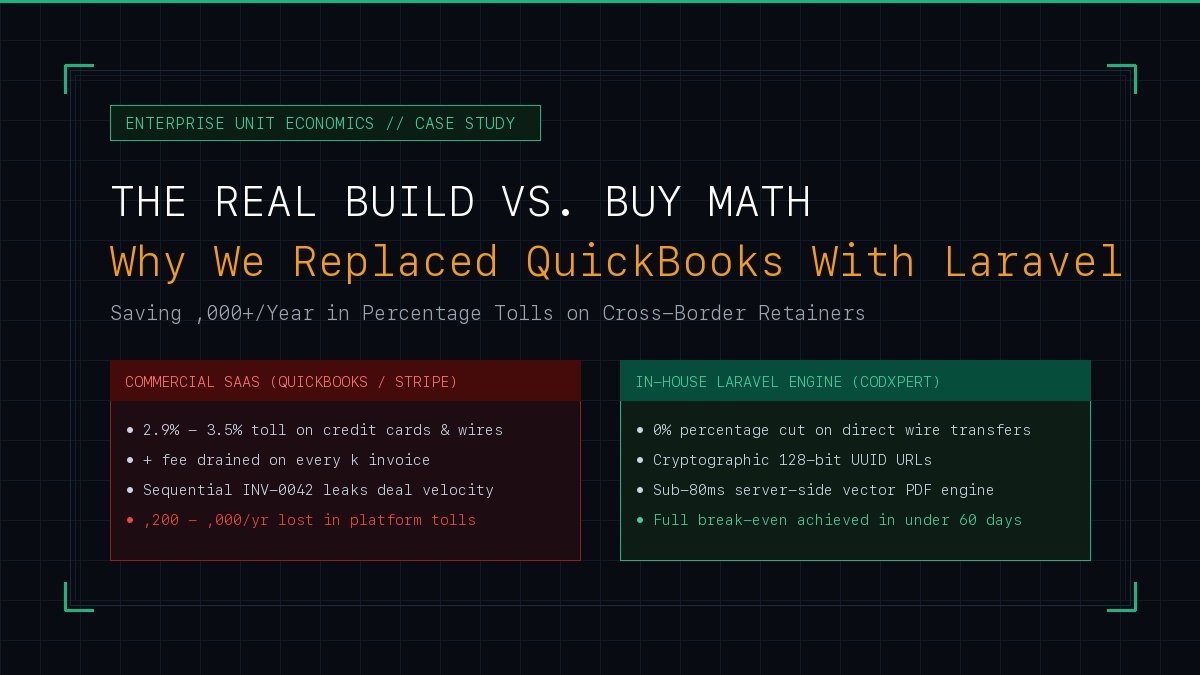
The $18,000/Month Crossover Rule
For low-ticket businesses ($50 to $100 orders), building custom invoicing software is an economic trap—you absorb the 2.9% merchant toll and move on.
However, for high-ticket software agencies, engineering consultancies, and B2B services billing $5,000 to $25,000+ per milestone, commercial platforms (QuickBooks Payments, Stripe Invoicing, FreshBooks) take an aggressive toll: charging $150 to $750+ per invoice simply to host an HTML page and route bank wires.
Recently on LinkedIn, an insightful discussion sparked around our internal systems architecture: "At what monthly invoice volume did the custom engine actually cross into cheaper than the QuickBooks cut?"
Most founders skip the break-even math. They either fall into the trap of over-engineering internal tools before achieving product-market fit, or they mindlessly pay thousands of dollars in SaaS subscription and transaction tolls for basic database operations that could be owned outright.
Here is the exact financial breakdown, technical architecture, and decision framework behind why we replaced QuickBooks and Stripe Invoicing with our in-house engine (invoice.codxpert.com), and why the math heavily favors owning once you cross $18,000 to $20,000 per month in high-ticket invoicing.
---1. The Hidden 3% Toll on High-Ticket Cross-Border B2B Retainers
When you run an international software engineering firm handling enterprise clients across North America, the UK, Europe, and the Middle East, payment methods are not credit card swipes. Clients pay via ACH Direct Debit, Domestic EFT, or International SWIFT Wires.
Yet, commercial billing platforms treat every transaction like an e-commerce impulse buy:
- Stripe Invoicing: Takes a standard credit card fee (2.9% + $0.30) plus an additional 0.5% (or 0.8%) "Invoicing Fee" on paid invoices, with foreign exchange conversion markups of up to 2%.
- QuickBooks Online: Costs $60 to $200+/month in base SaaS license fees, plus percentage fees on payments routed through QuickBooks Payments.
- The $10k Retainer Reality: On a single $10,000 project milestone, paying a 3% middleman toll drains $300 straight out of operating margin. On $250,000 in annual billings, that represents $7,500 in pure platform friction.
What were we paying for? An HTML view and a PDF rendering engine.
---2. The Real TCO Equation: Build Cost vs. Recurring SaaS Friction
To evaluate whether to build internal software, you must quantify Total Cost of Ownership (TCO):
┌────────────────────────────────────────────────────────────────────────────────────────┐
│                          THE IN-HOUSE ENGINE UNIT ECONOMICS                            │
├────────────────────────────────────────────────────────────────────────────────────────┤
│                                                                                        │
│  [DEVELOPMENT INVESTMENT]                                                              │
│  • Senior Full-Stack Engineering Time: ~28 hours (1 long weekend sprint)               │
│  • Stack: Laravel 11 + Tailwind CSS + MySQL InnoDB + DOMPDF                            │
│  • Realized Opportunity Cost @ $100/hr internal rate: ~$2,800 one-time                  │
│                                                                                        │
│  [ONGOING INFRASTRUCTURE COST]                                                         │
│  • Hosting: $0 / month (Colocated in Docker on our existing agency VPS)                │
│  • Maintenance & Updates: < 1 hour / quarter                                          │
│                                                                                        │
│  [COMMERCIAL SAAS AVOIDANCE AT $25,000 / MONTH INVOICING]                              │
│  • Commercial 3% Toll Avoided: $750 / month ($9,000 / year)                            │
│  • Base SaaS Subscription Avoided: $80 / month ($960 / year)                           │
│  • Net Annual Margin Reclaimed: $9,960 / year                                          │
│                                                                                        │
│  [PAYBACK TIMELINE: 58 DAYS (UNDER 2 MONTHS)]                                          │
└────────────────────────────────────────────────────────────────────────────────────────┘
The break-even point occurred in under 60 days. Every dollar retained after month two represents 100% net profit back into engineering and business expansion.
---3. System Architecture: Laravel 11, DOMPDF Vector Rendering & Cent-Precision Integers
Commercial billing platforms are notoriously bloated, often taking 3 to 5 seconds to generate an invoice PDF. We engineered invoice.codxpert.com around three non-negotiable architectural constraints:
Instead of spinning up heavy headless Chromium instances (Puppeteer / Playwright) that chew through 800MB of RAM per PDF, we integrated barryvdh/laravel-dompdf. Invoices render in under 80 milliseconds as vector PDFs with perfect typography, crisp SVG vectors, and zero headless browser overhead.
Never use floating point numbers (FLOAT or DOUBLE) in financial databases. In binary floating-point representation, 0.1 + 0.2 = 0.30000000000000004. In our database schema, all values are stored as integers in cents or paisa:
$1,500.00 is stored as 150000 (INTEGER).
Tax rates are calculated using integer math with rounding to the nearest cent.
Every rendered invoice features direct domestic and international wire instructions (SWIFT, IBAN, ACH routing, and Canadian Interac e-Transfer) right on the document. Enterprise clients wire payments directly from their treasury accounts with zero transaction fee deductions.
4. Why 128-Bit UUID Tokens Beat Sequential Invoice Numbers
One of the most dangerous oversights in standard accounting software is Sequential ID Enumeration:
❌ TRADITIONAL SEQUENTIAL URL (DATA LEAK):
https://accounting-saas.com/invoices/INV-0042
https://accounting-saas.com/invoices/INV-0043 (Client can tell you only closed 1 deal this month!)
If a client receives INV-0012 in January and INV-0015 in March, they immediately know your quarterly sales velocity (3 deals). If a competitor discovers this format, they can estimate your annual run rate with alarming accuracy.
In our Laravel engine, every invoice is routed through a cryptographically random 128-bit UUID v4 token:
✅ SECURE CRYPTOGRAPHIC URL (ZERO DATA LEAK):
https://invoice.codxpert.com/view/7f9b8c2d-4e1a-49f3-8b7c-02a8e5f1d93e
UUIDs make URL guessing mathematically impossible ($2^{122}$ possible keys), shield business metrics from prying eyes, and comply with strict enterprise security audits.
---5. Multi-Jurisdiction Tax & Wire Routing (CAD HST vs. US Reverse Charge)
Off-the-shelf SaaS platforms struggle when an agency handles multi-currency invoicing across varying jurisdictions. Our engine implements automated compliance rules:
- Canadian HST/GST: Automatically applies Ontario’s 13% Harmonized Sales Tax for Canadian clients while correctly handling 5% GST for Western provinces.
- US Export Declarations: For US clients, the engine automatically emits zero-rated export declarations under cross-border software service treaties.
- Multi-Currency Parity: Supports USD, CAD, EUR, GBP, and INR natively, locking currency exchange rates at the moment of invoice issuance to prevent ledger drift.
6. Decision Framework: When Should Your Agency Build vs. Buy?
Before commissioning your developers to build custom internal tooling, evaluate your operations against this decision matrix:
| Operating Parameter | Buy SaaS (QuickBooks / FreshBooks) | Build Owned Engine (Custom Laravel) |
|---|---|---|
| Monthly Invoice Volume | Under $15,000 / month | $18,000+ / month |
| Average Deal Size | Under $500 (High-frequency, micro-ticket) | $2,500 - $25,000+ (High-ticket B2B) |
| Primary Payment Method | Credit card / consumer PayPal | ACH, Domestic Wire, SWIFT Direct Transfer |
| Engineering Availability | Zero developer bandwidth | 25-30 hours of internal sprint capacity |
| Confidentiality Needs | Standard public business | High (Deal velocity must stay private via UUIDs) |
Frequently Asked Questions (FAQ)
At what monthly invoice volume does building a custom invoicing engine become cheaper than QuickBooks or Stripe?
The break-even crossover occurs at approximately $18,000 to $20,000 per month in high-ticket B2B client billings. When billing retainers between $5,000 and $25,000, commercial platforms take 2.9% to 3.5% per invoice ($150 to $750+ per transaction). An internal Laravel engine built in ~28 engineering hours with near-zero infra overhead pays for its entire development cost in under 60 days at that scale.
Why are UUID-based invoice URLs better than sequential numbering?
Sequential numbers like INV-0042 leak sensitive business deal velocity to clients and competitors, enabling anyone to calculate exactly how many deals you close each month. 128-bit random UUID v4 tokens make invoice links cryptographically unguessable, prevent ID enumeration attacks, and maintain confidentiality.
How does storing currency values in cents prevent floating point errors?
Standard floating-point numbers in computer memory cannot precisely represent decimal base-10 fractions (such as 0.1 or 0.2), leading to rounding discrepancies over multi-item invoices. Storing monetary amounts as whole integers in cents or paisa (e.g., $100.00 stored as 10000) guarantees exact arithmetic precision across tax calculations, multi-currency conversions, and ledger audits.
Ready to Eliminate SaaS Bloat and Percentage Tolls?
We engineer high-performance bespoke internal tools, custom ERP portals, and automated billing engines that you own outright. Calculate your savings with our SaaS Bloat Calculator or book an architecture discovery session with Shadab Alam.