
Custom software development services comprise the end-to-end architectural engineering, custom programming, database modeling, and deployment of bespoke web platforms, internal operations portals, and API middlewares engineered exclusively for an organization's specific operational workflows. Unlike commercial Off-the-Shelf SaaS (which charges escalating per-seat monthly licensing fees, imposes rigid feature constraints, and stores proprietary data in multi-tenant shared silos), custom software engineering transfers 100% intellectual property ownership to the client, delivers zero recurring seat-license tax, enables sub-second edge response times, and yields a predictable 3-year Total Cost of Ownership (TCO) break-even within 3 to 6 months of production rollout.
TL;DR: The Build vs. Buy Equation in 2026
For the past decade, enterprise IT orthodoxy demanded that businesses "buy, never build." Companies were advised to license third-party SaaS applications for every micro-department: HubSpot for CRM, Jira for issue tracking, BambooHR for attendance, Monday.com for project boards, and Zapier to clumsily duct-tape the silos together.
By 2026, this strategy has completely collapsed under its own weight. Scaling mid-market companies and fast-growing agencies are now hemorrhaging $80,000 to $250,000 annually on per-user subscription fees for software where their teams utilize less than 15% of the licensed features. Worse, company data remains locked in walled vendor gardens, while employees waste hours every shift manually copying fields between incompatible tabs.
Custom software development services exist to terminate this SaaS seat tax permanently. By engineering owned internal systems, organizations regain operational velocity, protect their margins, and transform bespoke operational workflows into durable competitive moats.
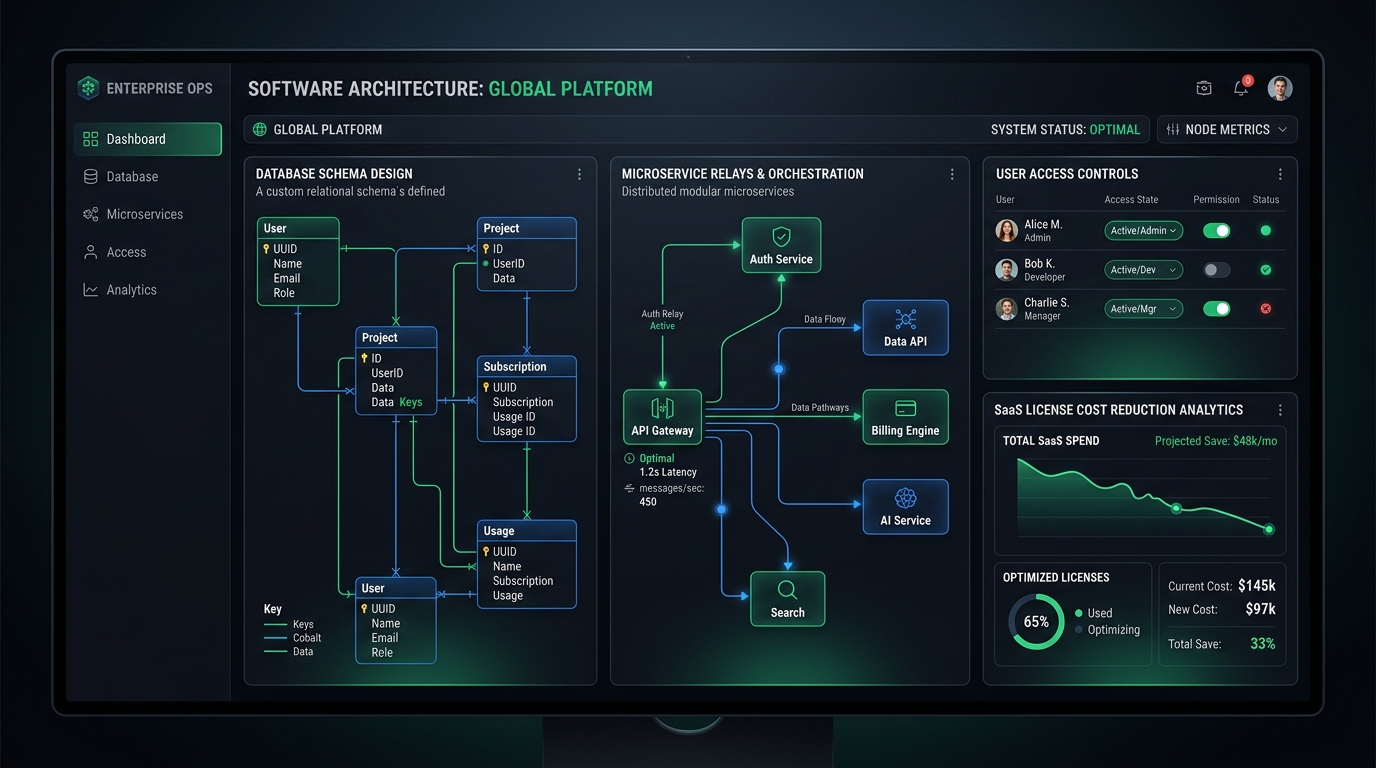
What Are Custom Software Development Services in the Modern Stack?
Modern custom software engineering is fundamentally distinct from legacy agency development. In 2026, a production-grade software agency does not spend eighteen months writing boilerplate CRUD code from scratch. We leverage modern web frameworks (Astro, Laravel, Next.js, FastAPI), enterprise open-source database engines (PostgreSQL, Redis, ClickHouse), and containerized microservice deployments (Docker, Kubernetes) to deliver enterprise-grade systems in 4 to 8 weeks.
Custom software development services encompass four critical technical areas:
- Internal Operations Portals & Custom ERPs: Unified control planes that replace disjointed third-party SaaS seats with tailored dashboards mirroring your exact company hierarchy, shift rules, and approval workflows.
- High-Concurrency Transaction Engines: High-throughput backend architectures capable of processing millions of records, orders, or applicant submissions with zero lag and ACID transaction guarantees.
- Bidirectional API Integration Gateways: Robust webhook listeners and queue dispatchers that connect legacy mainframes, payment processors (Stripe, Razorpay), logistics carriers, and real-time communication networks (WhatsApp Business, Slack).
- Proprietary AI & Automated Telemetry Pipelines: Ingesting unstructured business data and routing it through intelligent multi-model LLMs without leaking confidential trade secrets to public training clouds, as detailed in our guide on artificial intelligence automation agency architecture.
The Hidden Tax of Commercial SaaS: Seat Creep & Margin Erosion
Commercial SaaS companies operate on a business model designed for Wall Street expansion: net revenue retention (NRR). They incentivize sales reps to push tier upgrades, gate essential security features (such as SAML SSO or audit logs) behind $50/user enterprise markups, and aggressively penalize headcount growth.
When an agency or service business scales from 15 to 60 employees:
- Linear Cost Penalty: Adding a team member costs an additional $450/month across their individual software seat licenses, creating an artificial drag on hiring margins.
- Workflow Friction: Staff must adapt their daily routines to the rigid data schemas dictated by commercial vendors, rather than having software conform to their proprietary business methodology.
- Fragile Sync Relays: Relying on external automation platforms to sync records between disconnected platforms frequently results in silent webhook drops, sync collisions, and unmonitored data corruption.
As explored in our technical teardown on stopping SaaS subscriptions with custom internal portals, building bespoke internal software converts these recurring operational expenses into an appreciating capital asset on your corporate balance sheet.
The 6-Factor Build vs. Buy Architectural Matrix
Not every business function warrants custom software development. Commodity utilities—such as transactional email delivery (Amazon SES/Postmark) or raw cloud server compute (Hetzner/AWS)—should almost always be rented. However, when a workflow touches your core customer value proposition, operational margins, or proprietary client data, buying commercial SaaS is an architectural anti-pattern.
Here is how enterprise engineering leaders evaluate the build-versus-buy decision:
| Evaluation Dimension | Commercial Off-the-Shelf SaaS | Bespoke Custom Software (CodXpert) |
|---|---|---|
| Cost Trajectory Over 3 Years | Escalates annually with 8%–15% vendor price hikes + headcount penalties | Fixed one-time build investment; near-zero marginal cost per additional user |
| Data Sovereignty & Privacy | Stored on shared multi-tenant databases with third-party tracking cookies | 100% Private PostgreSQL database hosted on your designated VPC |
| Feature Adaptability | Locked to vendor roadmap; requests languish in public backlog voting | Engineered directly around your exact workflows and competitive edge |
| API Rate Limits & Latency | Heavily throttled (e.g. 10 req/sec); latency averages 450ms–1,200ms | Direct database queries with Redis memory caching (< 15ms response) |
| Intellectual Property Value | Rented software ($0 equity value upon company acquisition or sale) | 100% Owned IP that directly increases enterprise company valuation |
| Security & Audit Controls | Enterprise SSO and audit logs gated behind expensive premium tiers | Granular RBAC, cryptographic logging, and immutable audit trails included |
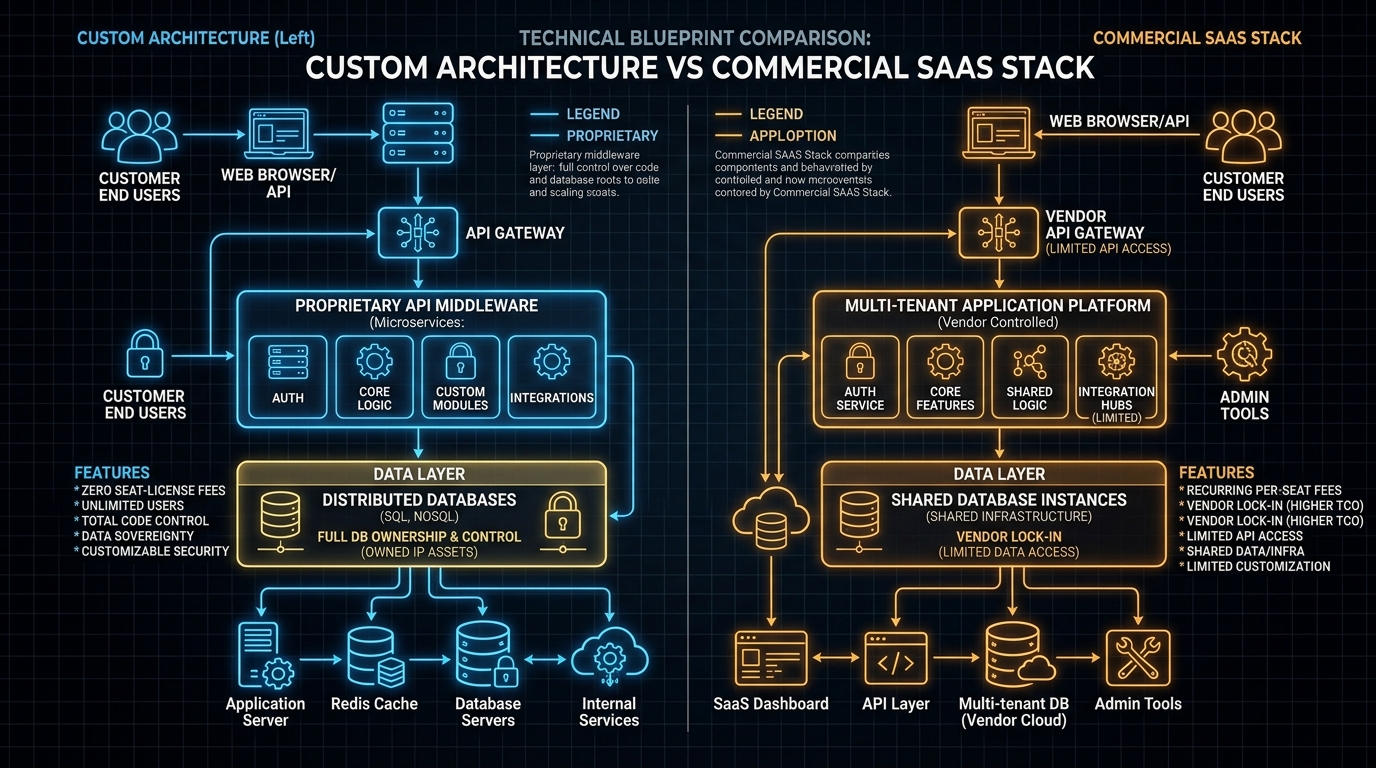
The 4 Pillars of Production Custom Software Engineering
When our engineering team at CodXpert constructs a custom system for a scaling business, we follow an architectural doctrine designed for zero maintenance overhead, maximum data security, and high developer velocity.
Pillar 1: Complete Relational Database & State Ownership (PostgreSQL)
Your database is the foundation of your business equity. When you rely on SaaS tools, your customer data is scattered across five separate proprietary schemas. If you ever attempt to export your historical records, you receive an incomplete CSV archive with lost relational integrity.
In our custom software architectures, we engineer a single, normalized PostgreSQL database with strict foreign-key constraints, comprehensive ACID transaction guarantees, and automated daily point-in-time recovery (PITR). Whether your platform handles 500 orders or 5,000,000 transactions, your state remains intact, indexed, and fully under your legal ownership.
Pillar 2: Decoupled API Middleware & Asynchronous Queues
Traditional off-the-shelf software buckles when traffic surges during flash sales or shift handovers. Custom systems utilize decoupled asynchronous architectures.
We position fast in-memory message brokers (Redis Streams, BullMQ, or RabbitMQ) between web interfaces and backend processors. If a client submits an intake request, or an external payment webhook triggers, the request is acknowledged within 45 milliseconds. Heavy background computations—such as PDF invoice rendering, automated shift reconciliation, or external notification dispatches—execute asynchronously in worker threads without freezing the user interface.
Pillar 3: Granular Role-Based Access Control (RBAC) & Audit Trails
Commercial tools force binary permission schemes: either a team member is an "Admin" with access to all financial data, or a "Viewer" who cannot edit anything.
Custom software engineering allows precision Role-Based Access Control (RBAC). A warehouse supervisor can view inventory manifests and dispatch drivers without ever seeing client invoice margins or company payroll. Every mutation—who edited an invoice, when a status was toggled, from which IP address—is stamped into an immutable audit table for total operational accountability.
Pillar 4: First-Party Telemetry & Zero Vendor Lock-In
Commercial SaaS tools are laden with third-party tracking scripts that degrade page performance, leak visitor data to ad exchanges, and trigger ad-blocker errors.
As detailed in our architectural guide on custom internal portals vs SaaS architecture, custom platforms run completely clean. Telemetry is collected first-party on your private servers, ensuring sub-second rendering speeds, zero browser tracking warnings, and full compliance with international privacy mandates (GDPR, CCPA, and India's DPDP Act).
Financial Modeling: 3-Year TCO & Break-Even Analysis
Let us evaluate the cold, hard financial math. Consider a growing digital agency or logistics firm with 35 full-time employees evaluating whether to renew their commercial SaaS stack or invest in a custom internal portal.
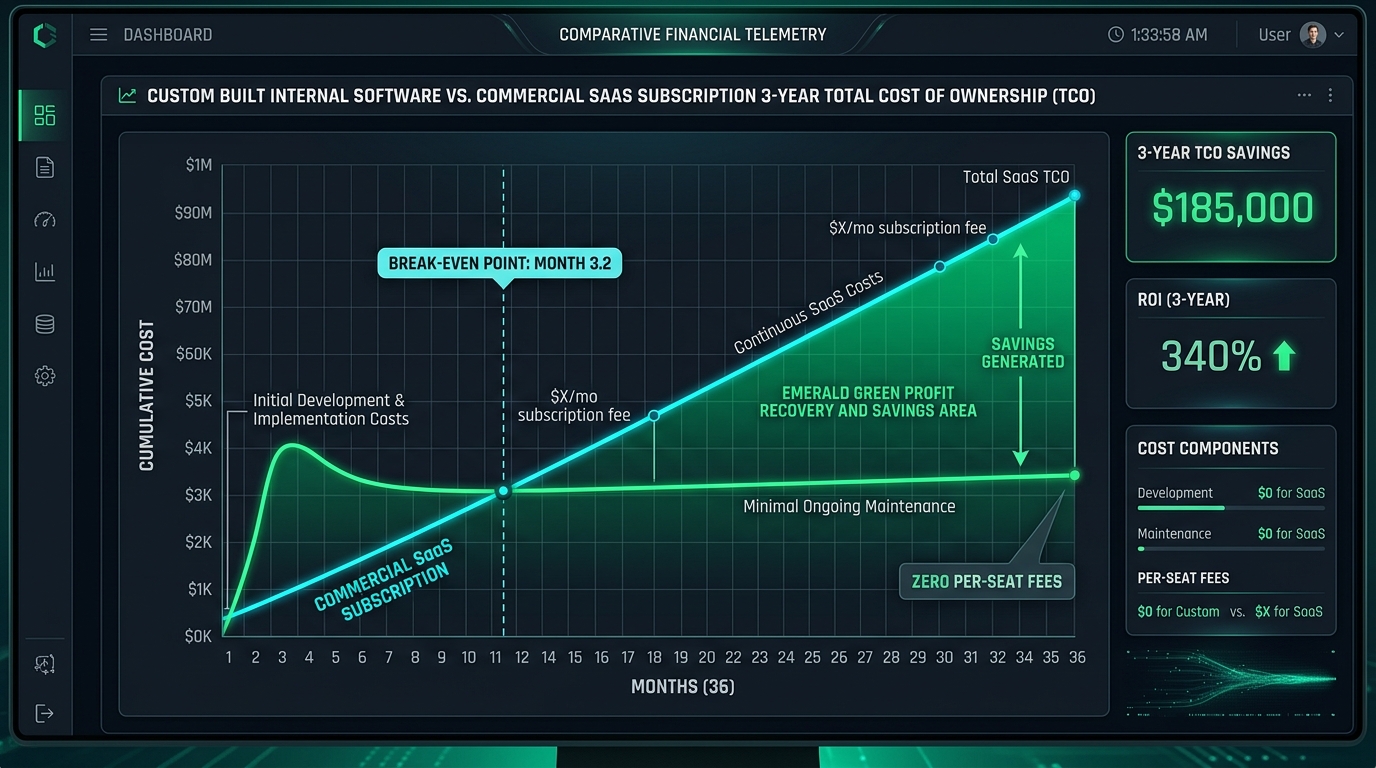
Scenario A: Commercial SaaS Tool Stack (35 Users):
- CRM & Pipeline Management (HubSpot Pro): $1,500 / month
- Project & Task Management (Monday/Asana Enterprise): $1,050 / month
- Time Tracking & Attendance (Harvest/BambooHR): $420 / month
- Custom Dashboard & Reporting (Datadog/Geckoboard): $380 / month
- Workflow Automation & Webhook Relays (Zapier Company): $799 / month
- Total Monthly Expenditure: $4,149 / month ($49,788 / year)
- 3-Year Projected SaaS Spend (factoring 10% price increases): $164,800
Scenario B: Bespoke Custom Software System (CodXpert Build):
- One-time Engineering Build & Architecture (Complete IP Transfer): $18,000
- Dedicated Cloud Hosting (Hetzner Dedicated Server with daily NVMe backups): $85 / month ($1,020 / year)
- Optional Quarterly Security & Maintenance Retainer: $350 / month ($4,200 / year)
- Total Year 1 Cost: $23,220
- Total 3-Year Custom Spend: $33,660
- Net 3-Year Cash Saved: +$131,140
The break-even point occurs at exactly month 4.3. From that moment forward, the company saves over $3,500 every single month in cash that directly drops to bottom-line net profit. You can model your own team's exact numbers using our interactive SaaS Bloat Audit Calculator.
Ready to Replace Bloated SaaS Subscriptions with an Owned System?
Stop letting third-party software licensing tax your operational margins. At CodXpert, we design and build bespoke high-concurrency web platforms, internal portals, and database engines tailored to your specific workflows.
Production Teardown: How YouthHireLink Scaled Without SaaS Bloat
To demonstrate the real-world performance of custom software development services, examine our architectural engineering of YouthHireLink (youthhirelink.ca), a specialized employment and job-matching ecosystem built for the Canadian labor market.
The Architectural Challenge: Commercial job-board software charged escalating monthly licensing fees, limited resume parsing concurrency, and lacked real-time automated fraud detection. Attempting to stitch together multiple SaaS subscriptions would have cost over $2,800/month while introducing severe latency bottlenecks during peak hiring seasons.
The Custom Solution Engineered:
- Dual-Guard Authentication: Tailored role isolation separating job seekers, employers, and government compliance auditors into decoupled security perimeters.
- Asynchronous SMTP & Notification Queues: High-throughput email dispatchers handling thousands of applicant confirmations without blocking web server worker threads.
- Automated Employer Verification Pipeline: Real-time cross-referencing of Canadian corporate registration numbers to prevent phantom job postings and employment scams.
The Outcome: YouthHireLink achieved 100% automated test coverage, sub-200ms page delivery, and zero recurring third-party software licensing fees. Read our full case breakdown in the YouthHireLink Case Study.
How to Select a Custom Software Engineering Partner
When interviewing development agencies for custom software projects, look beyond portfolio screenshots and assess their systems engineering rigor:
-
"Do we retain 100% intellectual property and code ownership upon milestone delivery?"
Never sign an agreement where the agency retains copyright or leases the software back to you. The contract must stipulate complete, unencumbered transfer of git repositories, deployment scripts, and database assets. -
"What is your automated testing and CI/CD deployment strategy?"
A professional engineering partner maintains automated test suites (unit, integration, and end-to-end) with continuous integration pipelines. Code should never be pushed to production via manual FTP. -
"How do you handle database migrations and zero-downtime deployments?"
Demand to know how schema changes are applied. Legitimate software architects use reversible database migration frameworks with blue-green or rolling container deployments to ensure zero service disruption. -
"Can your team audit our existing manual operations before writing code?"
As emphasized in our field guide on the real cost of bloated software, great developers do not blindly code features. They audit your operational friction, eliminate redundant steps, and design lean systems that accelerate real business velocity.
Technical Code Blueprint: Zero-Leakage Tenant Scoping in Custom Systems
One of the most profound advantages of custom software engineering over commercial multi-tenant SaaS is eliminating cross-tenant data leaks. In commercial SaaS platforms, all customers share the exact same underlying database cluster. A single missing WHERE company_id = ? clause in a vendor release can expose your client financial data or customer phone numbers to another company.
In our custom architectures at CodXpert, we enforce tenant data isolation at the ORM and database connection level using PostgreSQL Row-Level Security (RLS) and cryptographic tenant scoping:
import { Pool, PoolClient } from "pg";

// 1. Production Context-Scoped PostgreSQL Connection Manager
export class ScopedDatabaseClient {
  private pool: Pool;

  constructor(connectionString: string) {
    this.pool = new Pool({
      connectionString,
      max: 20,
      idleTimeoutMillis: 30000,
      ssl: { rejectUnauthorized: true }
    });
  }

  // Enforces Row-Level Security (RLS) dynamically per request context
  async executeScopedQuery<T>(
    tenantId: string,
    queryText: string,
    params: any[] = []
  ): Promise<T[]> {
    const client: PoolClient = await this.pool.connect();
    try {
      await client.query("BEGIN;");

      // Inject verified session tenant into transaction context
      await client.query("SET LOCAL app.current_tenant_id = $1;", [tenantId]);

      const result = await client.query(queryText, params);
      await client.query("COMMIT;");
      return result.rows;
    } catch (error) {
      await client.query("ROLLBACK;");
      console.error("[CRITICAL DB ERROR] Scoped transaction aborted:", error);
      throw error;
    } finally {
      client.release();
    }
  }
}

// 2. Verified Transaction Handler with Immutable Telemetry
export async function processInternalPayoutRecord(
  db: ScopedDatabaseClient,
  companyId: string,
  payoutData: { recipientId: string; amountUsd: number; invoiceRef: string }
) {
  const query = `
    INSERT INTO internal_payout_ledger (recipient_id, amount_usd, invoice_reference, created_at)
    VALUES ($1, $2, $3, NOW())
    RETURNING id, transaction_hash;
  `;
  return await db.executeScopedQuery(companyId, query, [
    payoutData.recipientId,
    payoutData.amountUsd,
    payoutData.invoiceRef
  ]);
}
Data Security & Compliance: Why Multi-Tenant SaaS Fails Modern Audits
In 2026, enterprise regulatory compliance is no longer optional. With the rigorous enforcement of Europe’s GDPR, the California Consumer Privacy Act (CCPA), and India’s Digital Personal Data Protection (DPDP) Act, handing your proprietary client data to a dozen separate cloud startups creates an unmanageable surface area of liability.
Every additional SaaS vendor you onboard requires vendor risk assessment, Data Processing Agreements (DPAs), and third-party security audits. If any of those vendors suffers a credential breach, your organization is legally accountable for the customer notification fallout.
As explored in our analysis of off-the-shelf SaaS vs custom dashboards, custom software engineering completely confines your data perimeter. The database sits in your dedicated VPC. Backups are encrypted with private KMS keys that only your leadership controls. When your enterprise clients demand proof of data isolation, you present clean, single-tenant architectural verification instead of relying on a vendor marketing sheet.
Frequently Asked Questions About Custom Software Development
What are custom software development services?
Custom software development services encompass the design, engineering, and deployment of bespoke web platforms, private databases, and internal operation portals built specifically for your organization. Unlike commercial off-the-shelf software with recurring user seat fees, custom systems are 100% owned by your company with zero ongoing license costs.
How much does custom software development cost?
Targeted internal admin portals and automated workflow engines typically range from $12,000 to $35,000 for complete production deployment. Because custom systems eliminate thousands of dollars in monthly SaaS subscriptions and administrative payroll drag, most businesses break even within 3 to 6 months.
How long does it take to build a custom internal portal?
Using modern web architectures, containerized microservices, and rapid engineering frameworks, production-ready custom software portals are typically built and deployed in 4 to 8 weeks.
Who owns the code and intellectual property?
At CodXpert, our clients retain 100% full ownership of all source code, git repositories, database schemas, and intellectual property upon milestone completion. You are never locked into proprietary vendor platforms.