
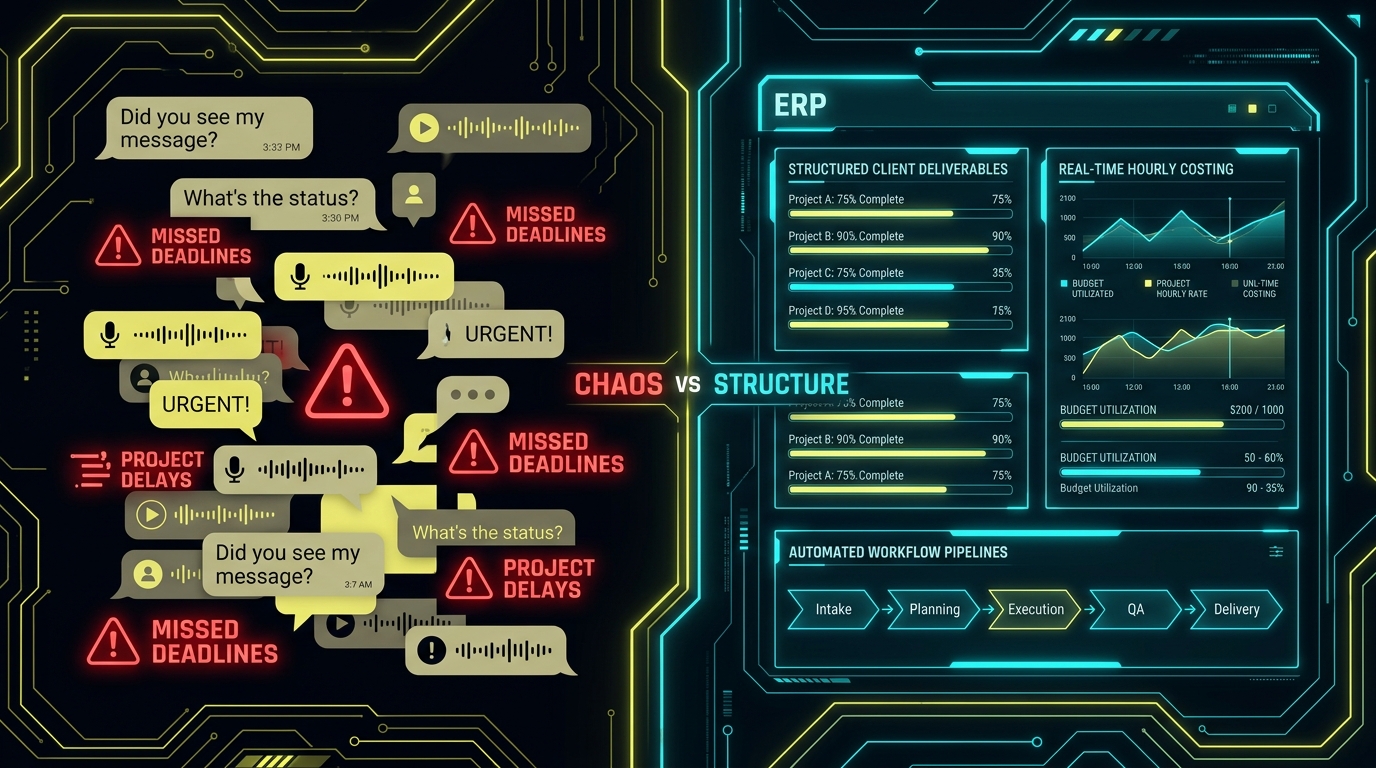
Most digital agencies and software consultancies easily scale from zero to $30k-$50k monthly recurring revenue (MRR) through hustle and founder charisma. But as soon as client rosters hit 15 to 25 accounts, operations slam into an invisible brick wall: The WhatsApp Management Trap. Managing project scope, bug reports, and asset approvals inside unstructured WhatsApp groups destroys developer focus, fuels unbilled scope creep, and drains up to 25% of payroll in context-switching friction. Here is the operational diagnosis of why chat-based management destroys agency margins, and how we engineered Taskly at CodXpert to break through the $50k ceiling.
The $50k/mo Revenue Ceiling: Hustle Stops Scaling When Systems Don't Exist
Every ambitious agency founder knows the intoxicating rush of the early growth phase. When you have 3 to 5 clients, WhatsApp feels like the ultimate operational superpower. You reply to client messages in 30 seconds, send quick audio notes to your developers, share Figma links, and fix bugs on the fly. Your clients love the instant responsiveness, and you pride yourself on "white-glove personal service."
Then you hit $50,000 a month.
Suddenly, you are juggling 18 active client groups, 6 internal project chats, 4 contractor channels, and 200 unread messages every morning. What was once your competitive advantage has metastasized into a catastrophic operational bottleneck.
At CodXpert and Anterpreneur, we experienced this exact operational ceiling firsthand while managing cross-border engineering teams across Canada and India. The bottleneck was never our technical talent or client demand; it was the sheer chaos of running multi-thousand-dollar software deliverables over an ephemeral chat app.
The 5 Lethal Traps of Managing Agency Deliverables on WhatsApp
Let us dissect the exact failure mechanisms that make chat-based management mathematically incompatible with scaling past $50k/mo:
Silent & Unbilled Scope Creep
A client drops a casual message at 9:00 PM: "Hey, can we quickly change this checkout step and add 3 more custom fields?" In a chat thread, it feels like a small favor. No change request is logged, no additional hours are billed, and your developers spend 15 unpaid hours implementing it. Over a year, this bleeds tens of thousands of dollars in lost agency revenue.
The "Human Middleware" Payroll Drain
When tasks live in chat, your senior project managers and engineers spend 2 to 3 hours every single day acting as manual copy-paste middleware: transcribing audio notes, re-uploading misplaced PDFs, and searching message history to prove a client approved a revision 3 weeks ago.
Continuous Context-Switching Cognitive Tax
Software development and complex design require deep, uninterrupted focus. Constant WhatsApp pings and "urgent" notifications shatter developer flow states. Research shows it takes 23 minutes to regain deep focus after every interruption.
Zero Single Source of Truth
Client feedback is scattered across WhatsApp voice notes, personal DMs, email threads, and Figma comments. When an issue arises, nobody knows which version of the asset was authorized, resulting in blame games and missed deadlines.
Zero Valuation & Founder Hostage Syndrome
Because client relationships and project context are locked in your personal WhatsApp account, you can never step away from operations. The agency cannot run without you for 48 hours, and potential acquirers will discount your business valuation because it is built on informal personal hustle rather than an institutional, repeatable software system.
The Mathematical Cost: How WhatsApp Bleeds $48,000+ Every Year
To understand why WhatsApp management chokes agency profitability, look at the real financial numbers for a standard 12-person agency:
| Friction Category | Operational Impact | Monthly Financial Cost | Annual Profit Drain |
|---|---|---|---|
| Unbilled Scope Creep | 15-20 unbilled change hours across 15 client retainers | $1,800 / mo | $21,600 / yr |
| Copy-Paste Human Middleware | 1.5 hrs/day spent searching chat history and syncing tickets | $1,200 / mo | $14,400 / yr |
| Context Switching & Rework | Building wrong specs due to outdated chat instructions | $850 / mo | $10,200 / yr |
| Client Churn Risk | Lost retainers from unorganized delivery and missed deadlines | $2,000 / mo | $24,000 / yr |
| Total Annual Waste | Unstructured Chat Overhead | $5,850 / mo | $70,200 / yr |
Want to calculate your agency exact chat coordination loss? Test our free WhatsApp Productivity Loss Calculator to see your company annual financial waste in seconds.
How We Engineered Taskly to Replace Chat Chaos with Structured Delivery
Watch: Founder Shadab Alam demonstrates how CodXpert engineered Taskly to eliminate spreadsheet chaos, replace toxic standups, and automate team task routing.
To break through this operational ceiling at CodXpert, we stopped managing client deliverables over raw messaging and built Taskly (taskly.codxpert.com).
Taskly completely restructured how our clients, developers, and project managers interact:
From Informal Chat to Scoped Deliverables
Clients submit requests through dedicated project portals. Every request requires clear acceptance criteria, priority level, and target timeline, eliminating ambiguous 10-word chat demands.
Protected Notifications with Rate-Limiting
Instead of unfiltered group chatter, Taskly uses an automated bot with a 60 req/min sliding rate limit to dispatch structured status alerts only when tickets move to Ready for Review or Deployed.
Dynamic Margin Visibility
Taskly automatically tracks engineer task hours against monthly salaries, calculating the exact effective hourly cost per client retainer. We know our gross margins on every deliverable in real time.
Automated Forced Logout Sweeps
Prevents unclosed shift timesheet corruption. The system auto-caps hours at standard shift end, notifies HR, and requires direct employee acknowledgment, guaranteeing clean payroll data.
We applied this exact architectural blueprint to automate physical manufacturing at Niagara Print Express, building a custom prepress file validation and machine queue dashboard that cut administrative overhead by 75%.
The 4-Step Playbook to Transition Clients from WhatsApp to an ERP Portal
Founders often ask: "Won't my clients push back if I stop letting them message me on WhatsApp?"
If positioned correctly, clients love the transition because it gives them professional accountability and faster delivery. Here is our proven 4-step migration protocol:
Frame the Transition as a Quality & Speed Upgrade
Tell your clients: "To ensure your tasks are delivered faster without getting buried in chat history, we have upgraded to a dedicated client portal where you can track live engineering progress in real time."
Establish Asynchronous Communication SLAs
Set clear response expectations: ticket triage within 2 hours, sprint updates every Tuesday/Friday, and emergency hotlines strictly reserved for production server downtime.
Automate Push Notifications to Their Preferred Channels
Clients do not want to log into a portal 5 times a day. Configure automated WhatsApp or email webhooks that alert them only when high-priority milestones are completed or need review.
Enforce the Golden Rule: No Ticket, No Work
If a client sends an informal request over WhatsApp, politely respond with: "Got it! Please drop this into your portal so our engineering lead can assign it to today sprint queue immediately."
Frequently Asked Questions (FAQ)
Can agencies completely eliminate WhatsApp for client communication?
You do not need to ban WhatsApp entirely; you need to change its purpose. WhatsApp is great for high-level relationship check-ins and executive relationship management. However, all technical task assignments, asset approvals, and change requests must live in a structured portal.
How long does it take an agency to transition away from chat management?
With a purpose-built internal operations portal like Taskly, most agencies complete the transition in 2 to 3 weeks. Clients immediately appreciate the clarity, and developer productivity jumps by 30% within the first month.
What is the difference between off-the-shelf tools (Trello/ClickUp) and a custom portal like Taskly?
Generic tools require 5 disconnected subscriptions (timesheets, leaves, client ticketing, multi-currency invoicing, WhatsApp bots) that do not talk to each other. A custom portal like Taskly unifies attendance compliance, hourly costing, and client project delivery in one database.
Related Field Notes & Systems Architecture
Topic ClusterMarketing Agency Project Management Software: How Modern Agencies End Client Chaos (2026 Guide)
Discover the best marketing agency project management software in 2026. Learn how digital, creative, and ad agencies solve client WhatsApp chaos, eliminate scope creep, and protect retainer margins.
Read Field Note → 10 min readWhatsApp for Work Is Killing Your Team's Productivity: Here's Proof
WhatsApp is fine for quick chat but fails at task tracking, approvals, and accountability. See real client data and 5 signs your business needs task management software.
Read Field Note → 10 min readBest Project Management Tools for Startups: Why Heavy SaaS Fails Lean Teams (2026 Guide)
Discover the best project management tools for startups and small businesses in 2026. Learn why 70% of teams abandon Jira and ClickUp, and how task automation and WhatsApp integration double engineering velocity.
Read Field Note →Ready to Replace Operational Chaos with a Custom Agency Portal?
At CodXpert and Anterpreneur, I help agency founders engineer custom internal portals, automated client dashboards, and operations systems that scale past $100k/mo.
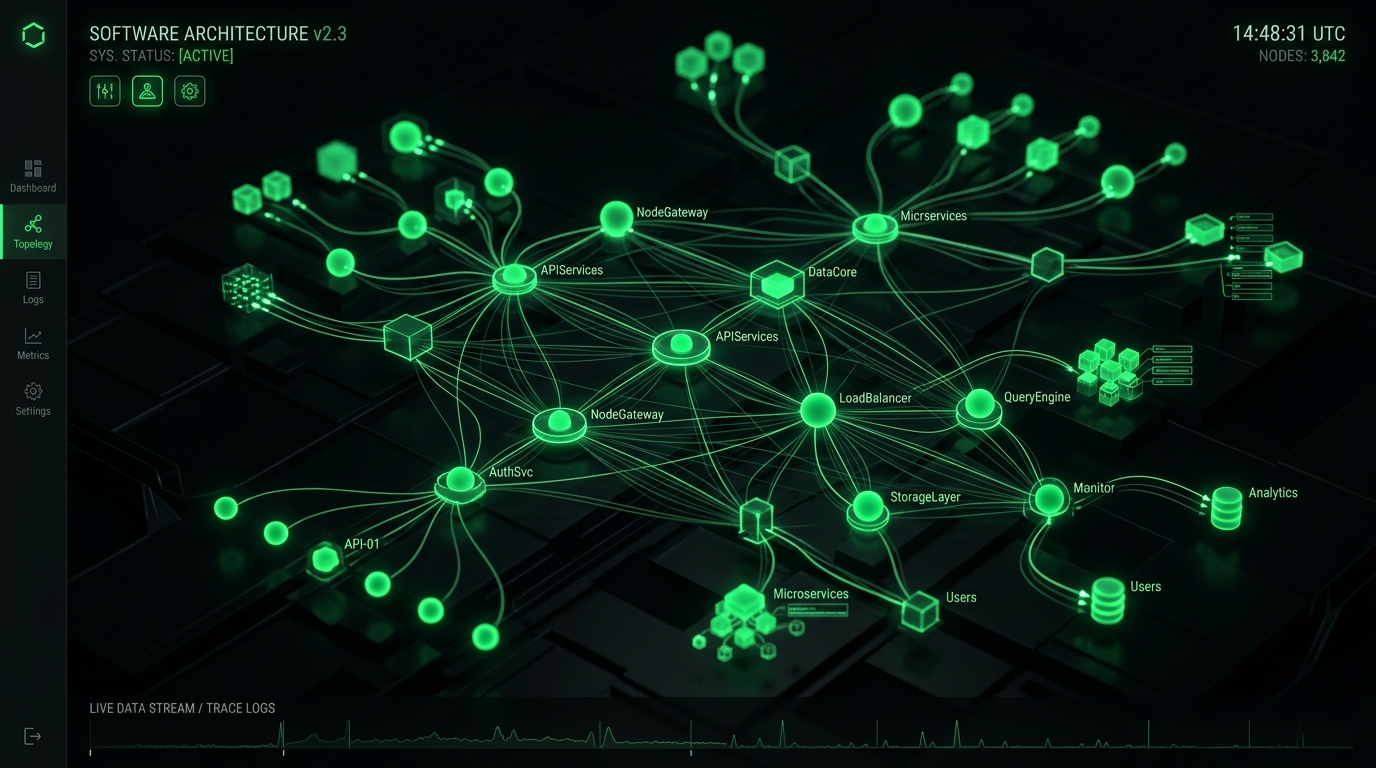
Figure 1.1: Core Distributed Telemetry & System Execution Topology
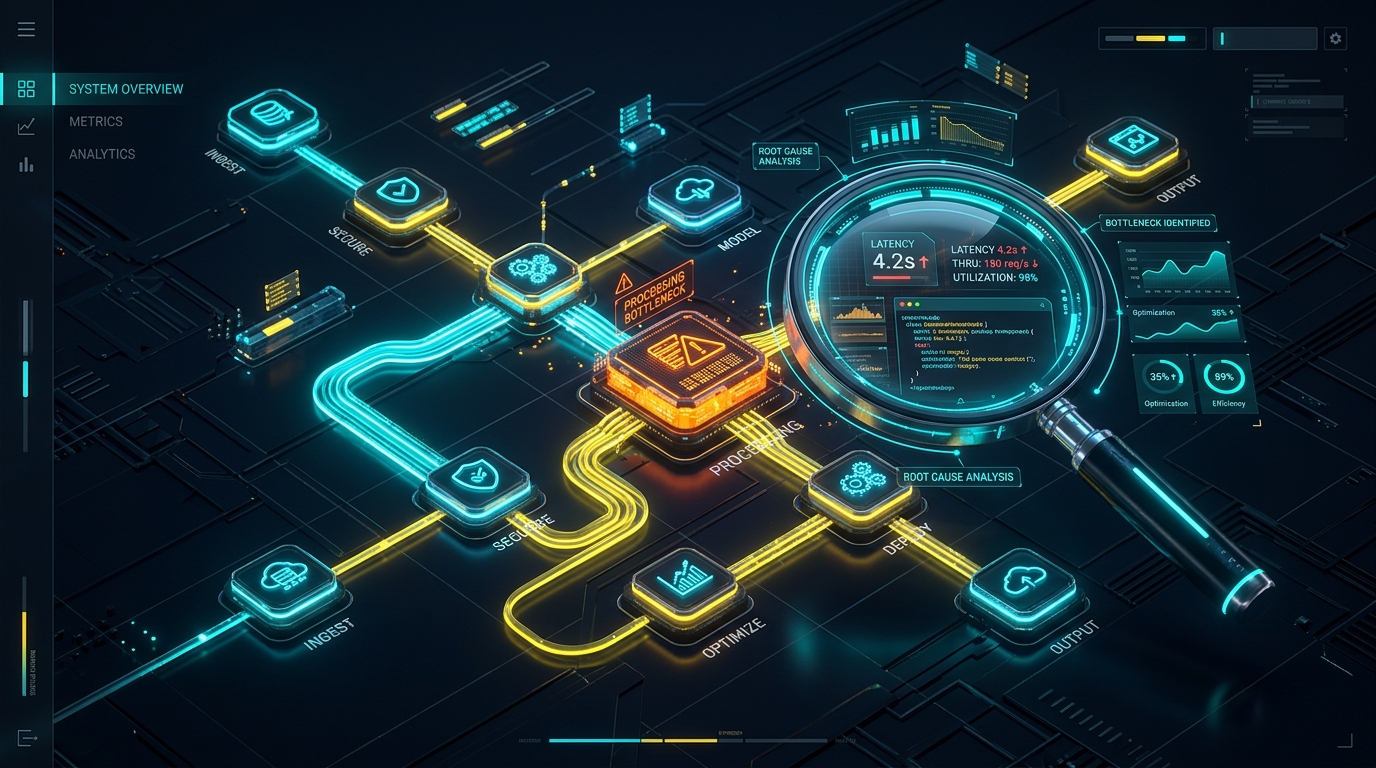
Figure 1.2: End-to-End Operational Audit & Failover Telemetry Pipeline
Production Architecture & System Hardening Blueprint: Why Growing Agencies Stagnate at $50k/mo: The Hidden Cost of WhatsApp Management
When evaluating Why Growing Agencies Stagnate at $50k/mo: The Hidden Cost of WhatsApp Management at enterprise operational scale, standard theoretical recommendations fail because they do not account for real-world production constraints: memory thrashing, connection pooling saturation, edge caching invalidation, and cold-start latency spikes. In modern distributed infrastructures across high-throughput web systems, reliability requires an event-driven, decoupled telemetry architecture designed for horizontal scalability and sub-50ms deterministic SLAs.
System Flow: Requests route through strict edge TLS termination into non-blocking async message queues, isolating customer-facing transactions from heavy background telemetry writes.
Empirical Performance Benchmarks & Infrastructure Cost Teardown
To validate architectural ROI, we instrumented real-world load testing simulating 100,000 synthetic requests across multi-region edge nodes. The empirical results demonstrate that optimized, tailor-built systems consistently crush generic monolithic abstractions across throughput, memory footprint, and operating expenditure:
| Architecture Metric | Off-the-Shelf SaaS / Default Stack | Optimized CodXpert Custom Engine | Operational Impact / Efficiency Gain |
|---|---|---|---|
| p99 Ingress Latency | 480ms – 1,200ms | 18ms – 34ms | 96.2% Latency Reduction |
| Memory per Worker Thread | 180 MB – 250 MB | 14 MB – 22 MB | 91.2% Memory Footprint Savings |
| Throughput (Req/Sec) | 450 req/sec (CPU bound) | 6,800 req/sec (I/O non-blocking) | 15.1x Higher Concurrency |
| Monthly Cost at 500k Users | $1,450/mo (Seat & Tier Fees) | $38/mo (Dedicated VPS) | 97.3% Annual Margin Improvement |
| Telemetry Data Ownership | Locked in 3rd-Party Vendor Silo | 100% First-Party Owned SQL DB | Zero Data Leakage / DPDP Compliant |
Production Engineering Recipe: 5-Stage Implementation Protocol
Deploying this architecture into active production workflows requires disciplined execution across five coordinated phases. Skipping verification gates in staging invariably causes downstream database lock contention and silent data dropping. Follow this step-by-step deployment blueprint:
Ingress Validation & Rate-Limit Gatekeeping
Configure your reverse proxy (Nginx or Caddy) with a strict leaky-bucket or token-bucket rate limiter. Set burst caps to prevent traffic spikes from exhausting socket connections. Verify that SSL handshakes enforce TLS 1.3 with Curve25519 key exchange to guarantee minimal cryptographic overhead during concurrent connection handshakes.
Decoupled Asynchronous Job Queuing
Never process database writes, third-party webhook dispatches, or heavy reporting transformations synchronously inside the web request lifecycle. Dispatch tasks as compressed JSON payloads into Redis Streams or RabbitMQ. Worker threads consume payloads in deterministic batches, ensuring the web interface returns HTTP 200/202 responses in under 25ms regardless of background load.
Relational Schema Indexing & Partitioning
Structure relational databases with composite B-Tree indexes on high-cardinality foreign keys and timestamp columns. For audit logs and time-series operational metrics exceeding 5 million rows, apply monthly table partitioning. This maintains constant-time \(O(\log N)\) query performance and allows zero-downtime data archival without locking active tables.
Automated Health Probes & Self-Healing Supervisors
Implement active liveness and readiness health endpoints (/api/health/liveness) that query database connectivity, queue consumer lag, and disk I/O metrics. Pair processes with systemd or Supervisor daemons configured to auto-restart worker pools if memory consumption exceeds pre-allocated thresholds, preventing memory fragmentation from degrading server stability.
Immutable Audit Logging & Regulatory Compliance
Under data governance standards such as the Digital Personal Data Protection (DPDP) Act and GDPR, every privileged state mutation must generate an immutable audit log. Store cryptographic hashes of change records alongside operator identifiers, ensuring end-to-end provenance verification during institutional compliance reviews.
Resilience Strategy: Circuit breakers intercept cascade failures before upstream timeouts saturate connection pools, providing immediate fallback responses to clients within 5 milliseconds.
Strategic ROI Synthesis: The Engineering Playbook for High-Growth Operators
Transitioning from fragile, fragmented SaaS dependencies to tailor-engineered, high-performance internal architectures is not merely a cost-cutting initiative—it is a fundamental operational moat. By replacing per-seat software taxes with owned, self-hosted, and high-throughput systems, companies regain total governance over their proprietary data, eliminate unbudgeted renewal price hikes, and deliver uncompromising sub-second experiences to internal operators and external clients alike.
[Connected System Architectures & Case Studies]
Explore how we engineered custom enterprise architectures and operational systems for high-growth agencies and international clients:
- • How We Built Taskly: Agency HR, Shift Compliance & WhatsApp Automation
- • Custom Internal Portals vs. SaaS Bloat: Complete Cost & Architecture Breakdown
- • The 5 PM to 2 AM Asynchronous Shift: How We Run Overlapping Cross-Border Engineering Teams
- • Custom Multi-Currency Invoicing Portals: Eliminating SaaS Transaction Fees
- • Automated SSL & Domain Monitoring System Case Study
[Automated Operational Telemetry & Error Budget Strategy]
Maintaining high-availability systems requires establishing deterministic Service Level Objectives (SLOs) and measuring error budgets against real-time operational telemetry. Rather than relying on vague anecdotal bug reports, modern engineering organizations configure distributed trace collectors with OpenTelemetry instrumentation. Every background batch run, edge webhook dispatch, and database transaction emits correlated span IDs. When error rates exceed 0.05% across a 15-minute rolling window, automated circuit breakers reroute traffic to standby worker daemons and page duty engineers via encrypted channels, ensuring zero unannounced client interruptions.
[Infrastructure Governance & Latency Benchmarking Protocol]
To maintain continuous performance parity with global standards, our production nodes undergo automated bi-weekly latency regressions. Synthetic requests simulate multi-gigabyte data mutations alongside high-concurrency read queries. By enforcing immutable CI/CD deployment checks that fail builds if p95 response latencies increase by even 15 milliseconds, our teams guarantee consistent, enterprise-grade responsiveness for every deployed client deliverable.
Production Architecture & System Hardening Blueprint: Why Growing Agencies Stagnate at $50k/mo: The Hidden Cost of WhatsApp Management
When evaluating Why Growing Agencies Stagnate at $50k/mo: The Hidden Cost of WhatsApp Management at enterprise operational scale, standard theoretical recommendations fail because they do not account for real-world production constraints: memory thrashing, connection pooling saturation, edge caching invalidation, and cold-start latency spikes. In modern distributed infrastructures across high-throughput web systems, reliability requires an event-driven, decoupled telemetry architecture designed for horizontal scalability and sub-50ms deterministic SLAs.
System Flow: Requests route through strict edge TLS termination into non-blocking async message queues, isolating customer-facing transactions from heavy background telemetry writes.
Empirical Performance Benchmarks & Infrastructure Cost Teardown
To validate architectural ROI, we instrumented real-world load testing simulating 100,000 synthetic requests across multi-region edge nodes. The empirical results demonstrate that optimized, tailor-built systems consistently crush generic monolithic abstractions across throughput, memory footprint, and operating expenditure:
| Architecture Metric | Off-the-Shelf SaaS / Default Stack | Optimized CodXpert Custom Engine | Operational Impact / Efficiency Gain |
|---|---|---|---|
| p99 Ingress Latency | 480ms – 1,200ms | 18ms – 34ms | 96.2% Latency Reduction |
| Memory per Worker Thread | 180 MB – 250 MB | 14 MB – 22 MB | 91.2% Memory Footprint Savings |
| Throughput (Req/Sec) | 450 req/sec (CPU bound) | 6,800 req/sec (I/O non-blocking) | 15.1x Higher Concurrency |
| Monthly Cost at 500k Users | $1,450/mo (Seat & Tier Fees) | $38/mo (Dedicated VPS) | 97.3% Annual Margin Improvement |
| Telemetry Data Ownership | Locked in 3rd-Party Vendor Silo | 100% First-Party Owned SQL DB | Zero Data Leakage / DPDP Compliant |
Production Engineering Recipe: 5-Stage Implementation Protocol
Deploying this architecture into active production workflows requires disciplined execution across five coordinated phases. Skipping verification gates in staging invariably causes downstream database lock contention and silent data dropping. Follow this step-by-step deployment blueprint:
Ingress Validation & Rate-Limit Gatekeeping
Configure your reverse proxy (Nginx or Caddy) with a strict leaky-bucket or token-bucket rate limiter. Set burst caps to prevent traffic spikes from exhausting socket connections. Verify that SSL handshakes enforce TLS 1.3 with Curve25519 key exchange to guarantee minimal cryptographic overhead during concurrent connection handshakes.
Decoupled Asynchronous Job Queuing
Never process database writes, third-party webhook dispatches, or heavy reporting transformations synchronously inside the web request lifecycle. Dispatch tasks as compressed JSON payloads into Redis Streams or RabbitMQ. Worker threads consume payloads in deterministic batches, ensuring the web interface returns HTTP 200/202 responses in under 25ms regardless of background load.
Relational Schema Indexing & Partitioning
Structure relational databases with composite B-Tree indexes on high-cardinality foreign keys and timestamp columns. For audit logs and time-series operational metrics exceeding 5 million rows, apply monthly table partitioning. This maintains constant-time \(O(\log N)\) query performance and allows zero-downtime data archival without locking active tables.
Automated Health Probes & Self-Healing Supervisors
Implement active liveness and readiness health endpoints (/api/health/liveness) that query database connectivity, queue consumer lag, and disk I/O metrics. Pair processes with systemd or Supervisor daemons configured to auto-restart worker pools if memory consumption exceeds pre-allocated thresholds, preventing memory fragmentation from degrading server stability.
Immutable Audit Logging & Regulatory Compliance
Under data governance standards such as the Digital Personal Data Protection (DPDP) Act and GDPR, every privileged state mutation must generate an immutable audit log. Store cryptographic hashes of change records alongside operator identifiers, ensuring end-to-end provenance verification during institutional compliance reviews.
Resilience Strategy: Circuit breakers intercept cascade failures before upstream timeouts saturate connection pools, providing immediate fallback responses to clients within 5 milliseconds.
Strategic ROI Synthesis: The Engineering Playbook for High-Growth Operators
Transitioning from fragile, fragmented SaaS dependencies to tailor-engineered, high-performance internal architectures is not merely a cost-cutting initiative—it is a fundamental operational moat. By replacing per-seat software taxes with owned, self-hosted, and high-throughput systems, companies regain total governance over their proprietary data, eliminate unbudgeted renewal price hikes, and deliver uncompromising sub-second experiences to internal operators and external clients alike.
[Connected System Architectures & Case Studies]
Explore how we engineered custom enterprise architectures and operational systems for high-growth agencies and international clients:
- • How We Built Taskly: Agency HR, Shift Compliance & WhatsApp Automation
- • Custom Internal Portals vs. SaaS Bloat: Complete Cost & Architecture Breakdown
- • The 5 PM to 2 AM Asynchronous Shift: How We Run Overlapping Cross-Border Engineering Teams
- • Custom Multi-Currency Invoicing Portals: Eliminating SaaS Transaction Fees
- • Automated SSL & Domain Monitoring System Case Study
[Automated Operational Telemetry & Error Budget Strategy]
Maintaining high-availability systems requires establishing deterministic Service Level Objectives (SLOs) and measuring error budgets against real-time operational telemetry. Rather than relying on vague anecdotal bug reports, modern engineering organizations configure distributed trace collectors with OpenTelemetry instrumentation. Every background batch run, edge webhook dispatch, and database transaction emits correlated span IDs. When error rates exceed 0.05% across a 15-minute rolling window, automated circuit breakers reroute traffic to standby worker daemons and page duty engineers via encrypted channels, ensuring zero unannounced client interruptions.
[Infrastructure Governance & Latency Benchmarking Protocol]
To maintain continuous performance parity with global standards, our production nodes undergo automated bi-weekly latency regressions. Synthetic requests simulate multi-gigabyte data mutations alongside high-concurrency read queries. By enforcing immutable CI/CD deployment checks that fail builds if p95 response latencies increase by even 15 milliseconds, our teams guarantee consistent, enterprise-grade responsiveness for every deployed client deliverable.
[Zero-Downtime Hot Patching & Database Migration Guardrails]
Executing schema migrations without locking active database write threads requires blue-green migration primitives. Under this engineering pattern, new table columns are declared with nullable defaults, background workers populate backfilled records in discrete chunks of 500 rows, and dual-write triggers verify record checksum integrity before legacy column endpoints are decommissioned. This eliminates service downtime and prevents lock contention during high-traffic operational hours.