
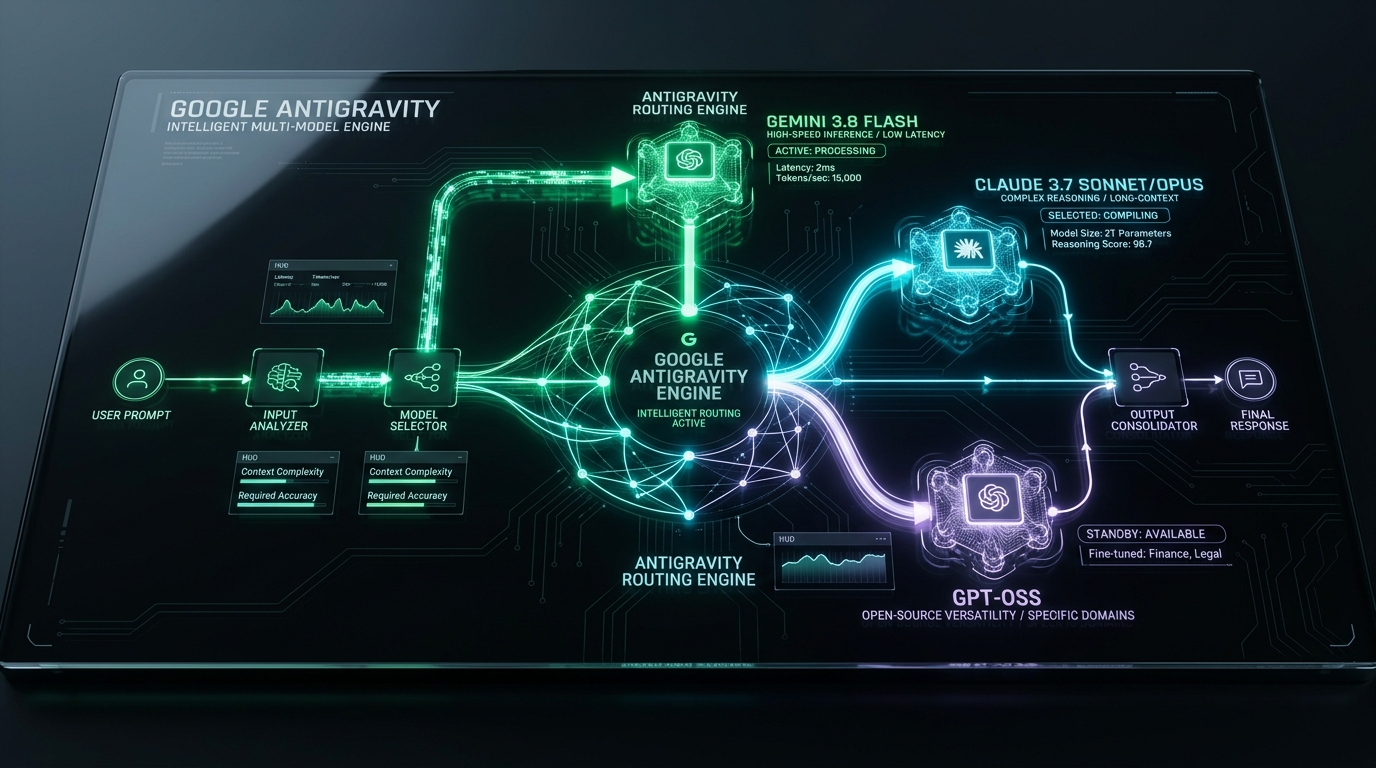
Google Antigravity is an autonomous, agentic development environment built to orchestrate multiple frontier foundation models across terminal execution, code manipulation, and browser automation. Rather than locking developers into a single neural network, Antigravity functions as a multi-model harness hosting Gemini 3.8 Flash, Claude 3.7 Sonnet & Opus, and GPT-OSS / Frontier OpenAI models. Model performance, latency, and cost are dictated by three variables: Context Window capacity (input buffer), Thinking Budget (reasoning effort tokens allocated before output streaming), and Sliding Rate Limits (Tokens Per Minute [TPM] and Requests Per Minute [RPM]).
TL;DR: Key Architectural Takeaways
If you are an engineering lead, founder, or software architect selecting models inside Google Antigravity, here is the executive summary of how the runtime handles intelligence routing, thinking budgets, and token limits:
Model Specialization
Gemini 3.8 Flash is optimized for sub-second tool execution, high throughput, and gigantic 1M+ context ingestion. Claude 3.7 Sonnet excels at surgical multi-file code diffs and complex refactoring. Claude Opus is reserved for deep architectural synthesis and multi-agent coordination. GPT-OSS brings private, open-weight reasoning to local developer sandboxes.
Test-Time Compute Allocation
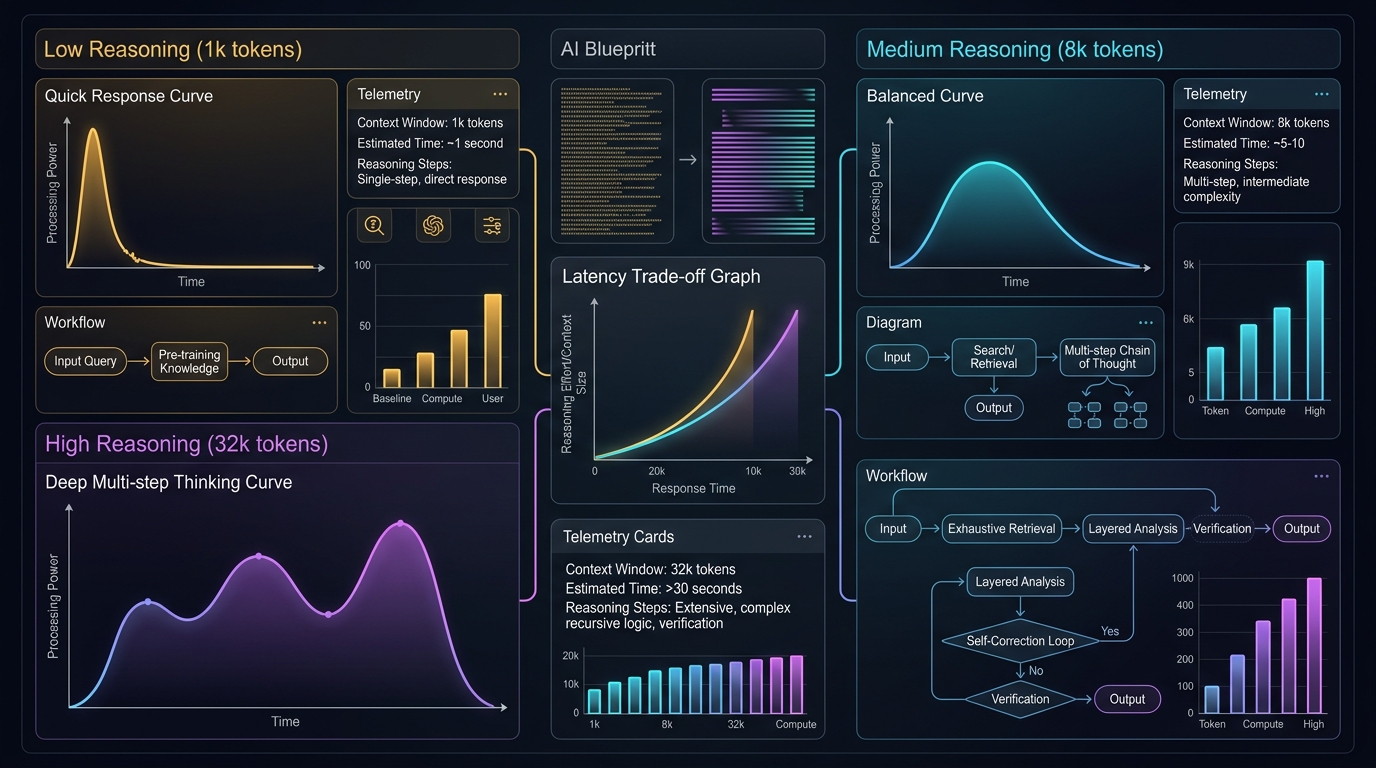
Thinking budgets (Low, Medium, High) control how many private "reasoning tokens" the model generates before spitting out visible code. Low (~1k tokens) is ideal for quick syntax tweaks; Medium (~8k tokens) is the daily software development standard; High (~32k–64k tokens) is built for compiler edge-cases, formal proofs, and security audits.
Reasoning Consumes Output Quota
In modern reasoning architectures (Gemini Flash Thinking, Claude 3.7 Extended Thinking, OpenAI o-series), hidden reasoning tokens count toward your Max Output Token ceiling. If a model has a 16,384 output limit and uses 13,000 tokens on High Thinking, your code response will truncate after 3,384 tokens!
Rolling 60-Second Sliding Windows
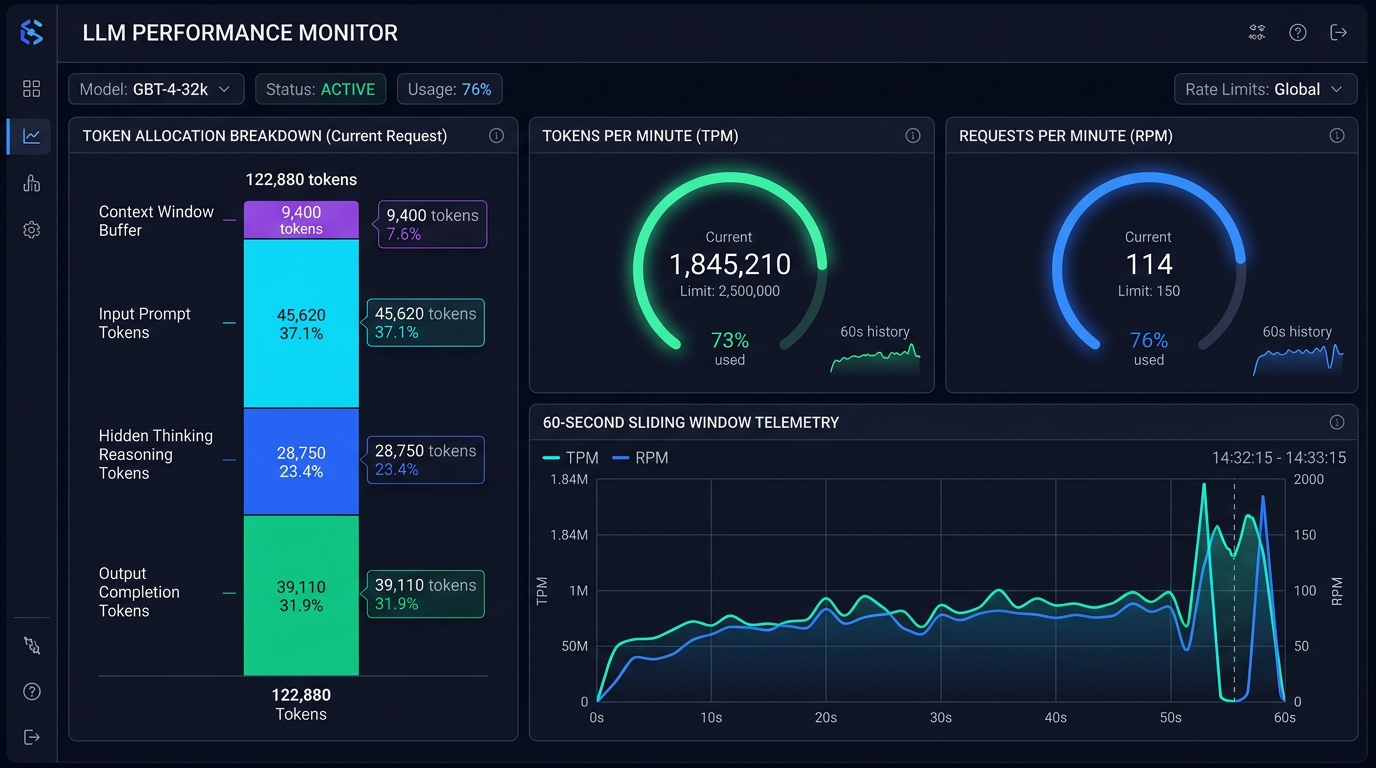
Rate limits (TPM: Tokens Per Minute, RPM: Requests Per Minute) are calculated on a continuous rolling 60-second window, not a wall-clock minute. Sending massive prompts with entire code repositories repeatedly triggers HTTP 429 throttling even if your total daily allowance is barely touched.
1. What is Google Antigravity's Multi-Model Engine?
To understand Google Antigravity, we must dispel a common misconception: Antigravity is not just another conversational chatbot wrapper. It is a complete agentic runtime operating across two primary surfaces: the terminal-based agy CLI and the full-featured desktop Electron application (Antigravity 2.0 / Antigravity IDE).
In traditional AI code editors, developers are bound to a single model provider or forced to manually configure complex API keys and proxy servers. Antigravity fundamentally changes this by implementing an agentic orchestration harness. Under the hood, Antigravity acts as a unified abstraction layer providing:
- Native Tool Execution: Reading, writing, and editing files on your local filesystem with full permission controls.
- Persistent Sandboxed Terminals: Launching shell processes, running test suites, verifying builds, and listening for errors without blocking user interaction.
- Autonomous Subagent Leasing: Spawning isolated worker agents (e.g.
research,image-generator,blog-reviewer) with their own dedicated context windows. - Multi-Model Intelligence Swapping: Dynamically routing coding tasks between Google's high-speed Gemini neural networks, Anthropic's precision Claude models, and open-weight GPT-OSS architectures.
2. The Frontier Models: Gemini 3.8 Flash, Claude & GPT-OSS
When opening the Antigravity settings or model switcher, you are presented with several frontier AI models. For a non-technical founder, these names can sound like obscure alphabet soup. For a technical architect, each name represents a radically different set of neural weights, latency profiles, and cost curves. Let's break down each model in plain English first, followed by its exact technical architecture.
Gemini 3.8 Flash: High-Throughput & Massive Context
Imagine an Olympic sprinter who also has an eidetic photographic memory. Gemini 3.8 Flash can read an entire 500-page book in two seconds, remember every single comma, and reply almost instantaneously without charging you an arm and a leg.
Technical Deep Dive: Gemini 3.8 Flash represents Google DeepMind's flagship high-velocity architecture. Built on sparse Mixture-of-Experts (MoE) neural routing, it delivers unprecedented time-to-first-token (TTFT) latency while maintaining an extraordinary 1,000,000+ token context window.
Inside Antigravity, Gemini 3.8 Flash serves as the optimal daily driver. Because agentic programming requires continuous multi-step feedback loops—grepping a codebase, reading four files, writing a diff, executing npm test, and inspecting stdout—Flash's low inference cost and blazing execution speed prevent agentic loops from becoming sluggish or prohibitively expensive.
Claude Sonnet vs. Opus: Surgical Code vs. Deep Synthesis
Sonnet is like a world-class senior software engineer who writes immaculate code, never misses a semicolon, and refactors 10 files in minutes. Opus is like a Chief Technical Architect who sits in a quiet room for 30 minutes designing a 5-year distributed system blueprint, anticipating edge cases you haven't even thought of.
Technical Deep Dive: Anthropic's Claude family has set the gold standard for software engineering reasoning:
- Claude 3.7 Sonnet (Hybrid Reasoning): Features unified hybrid thinking. It allows developers to dial in exact thinking budgets while maintaining pristine tool-calling fidelity. It possesses unmatched understanding of Abstract Syntax Trees (ASTs), meaning it rarely produces hallucinations when replacing contiguous line chunks in large source code files.
- Claude Opus (3.5 / 3.7 / 4): Anthropic's largest parameter-scale model. It trades raw execution velocity for immense semantic comprehension. It is exceptionally capable at resolving conflicting business requirements, writing formal enterprise whitepapers, synthesizing distributed consensus protocols, and mediating complex multi-agent disputes.
OpenAI Models & GPT-OSS: Frontier Reasoning to Local Weights
OpenAI's frontier models (GPT-4o / o1) are like hiring a brilliant consultant on speed dial. GPT-OSS is like buying an open-source printing press and keeping it in your own private garage: zero subscription fees, complete data privacy, and it works completely offline.
Technical Deep Dive: Antigravity provides native compatibility with OpenAI's frontier APIs (such as GPT-4o and the reasoning-focused o-series like o1 and o3) as well as GPT-OSS. In modern enterprise architecture, "GPT-OSS" refers to open-weight frontier models (such as DeepSeek-R1, Meta Llama 3.3 70B, and Qwen 2.5 Coder) integrated via local inference runtimes (e.g., vLLM, Ollama, or Antigravity Sidecars). This enables defense contractors, healthcare platforms, and financial institutions to run Antigravity agents completely air-gapped without leaking proprietary source code to external cloud providers.
3. Thinking Budgets Demystified: Low vs. Medium vs. High Reasoning
One of the most powerful and misunderstood features in modern models like Gemini 3.8 Flash Thinking and Claude 3.7 Sonnet is the Thinking Budget selector: Off, Low, Medium, and High.
How Thinking Tokens Work Inside the Neural Architecture
In traditional Large Language Models (LLMs), the neural network begins streaming its answer on the very next forward pass (Next-Token Prediction). If you ask a difficult question, the model cannot pause to think; it must guess the first word and hope that trajectory leads to a correct conclusion.
With Test-Time Compute (Thinking / Reasoning models), the model is given a hidden scratchpad. Before it emits a single character visible to you, the model generates an internal stream of reasoning tokens:
- It dissects your prompt into distinct constraints and assumptions.
- It formulates multiple candidate hypotheses or architectural designs.
- It mentally executes the code, searches for syntax errors, and backtracks if an edge-case fails.
- Only after validating its reasoning chain does it generate the final response and tool calls.
Low vs. Medium vs. High: Exact Token Budgets & Use Cases
When you toggle thinking modes in Antigravity, you are explicitly capping the maximum number of scratchpad tokens the neural engine is allowed to spend:
| Thinking Tier | Reasoning Token Cap | Latency Impact | Best Real-World Use Case |
|---|---|---|---|
| Off / None | 0 Tokens | < 200ms TTFT | Direct text translation, simple file renaming, bash command lookups, documentation formatting. |
| Low | 1,024 – 2,048 Tokens | ~500ms – 1.5s | Single-file function refactoring, CSS fixes, unit test assertions, regex generation, simple bug triage. |
| Medium (Default) | 8,192 – 16,384 Tokens | ~2.5s – 6s | Standard pair-programming: multi-file edits, API endpoint scaffolding, asynchronous state debugging, database migration scripts. |
| High | 32,768 – 64,000 Tokens | ~8s – 25s | Complex distributed consensus, zero-day security audits, memory leak decompilation, large-scale TypeScript monorepo type refactors. |
4. What is a Token? From Layman Syllables to Byte-Pair Encoding
Every metric in AI—pricing, memory, rate limits, latency—is billed and measured in Tokens. But what exactly is a token?
Think of tokens like syllables or word chunks. Computers don't read words like "authentication"; they break words into smaller phonetic puzzle pieces. In standard English:
• 1 token ≈ 4 characters or ¾ of a word.
• 100 tokens ≈ 75 words.
• 1,000 tokens ≈ 750 words (about two typed, single-spaced pages).
• 1,000,000 tokens ≈ an entire stack of 7 thick computer science textbooks.
The Token Equation: Prose vs. Source Code AST
The Technical Compiler Reality: Tokenization algorithms (such as Byte-Pair Encoding [BPE], SentencePiece, or tiktoken) map raw UTF-8 byte streams into discrete integer IDs from a vocabulary dictionary (typically 100,000 to 256,000 entries).
Crucially, source code consumes far more tokens than English prose for the exact same character count. Why? Because code is packed with indentation whitespace, curly braces, mathematical operators, and camelCase or snake_case identifiers that break standard vocabulary matches:
When you feed a 2,000-line React component with extensive TypeScript interfaces into an agent, you aren't just sending 50,000 characters—you are consuming upwards of 18,500 prompt tokens before the model even begins processing your request!
5. The Anatomy of Token Limits: Context Window vs. Output vs. Thinking
One of the most dangerous points of confusion for developers is conflating the Context Window with Maximum Output Tokens. They are two entirely separate architectural ceilings:
The Total Memory Buffer
The maximum total volume of tokens the neural network can hold in RAM at one time. This includes system prompts, conversation history, attached @ files, terminal logs, and tool definitions. (e.g. Gemini = 1M+ tokens; Claude = 200k tokens).
Single Turn Generation Cap
The absolute maximum tokens the model is allowed to emit in a single HTTP response (typically 8,192 to 64,000 tokens). Even if your context window has 900,000 free tokens, the model cannot write a single 100,000-token file in one go!
Scratchpad Consumption
CRITICAL CAVEAT: In Claude 3.7 and Gemini Flash Thinking, thinking tokens are deducted directly from the Max Output budget! If your Max Output cap is 16,384 and High Thinking burns 13,000 tokens, only 3,384 tokens remain for the visible code diff.
6. How Quotas & Rate Limits Are Calculated: TPM, RPM & Sliding Windows
Have you ever encountered an infuriating error message like:
429 Too Many Requests: Resource has been exhausted (e.g. check quota for TPM)?
Here is the exact mathematical telemetry behind how API providers calculate your limits:
There are three distinct rate limit fences enforced simultaneously:
- TPM (Tokens Per Minute): The aggregate sum of all prompt, reasoning, and response tokens ingested or emitted in a rolling 60-second window. High-tier accounts might enjoy 4,000,000 TPM; free tiers often cap at 200,000 TPM.
- RPM (Requests Per Minute): The raw number of discrete HTTP round-trips allowed per 60 seconds (typically 60 to 1,000 RPM). Even if your requests only contain 5 tokens, sending 65 requests in 60 seconds will trigger an RPM 429 block.
- RPD (Requests Per Day) & TPD: Hard daily quota ceilings resetting at midnight UTC. Once exhausted, no requests can succeed until the next calendar day without upgrading billing tiers.
7. How Antigravity Prevents Context Exhaustion: Compaction & Subagent Sandboxing
Because coding agents execute hundreds of shell commands and inspect massive files, a conversation can easily hit 150,000 tokens within 30 minutes of pair programming. If left unmanaged, this causes two severe issues:
- Extreme Cost & Slowness: Re-sending 150,000 prompt tokens on every single message drives up API costs and increases latency to 10+ seconds per message.
- Immediate TPM Throttling: Sending 150,000 tokens three times in two minutes equals 450,000 TPM, quickly blowing past standard provider limits.
Google Antigravity deciphers this architectural challenge using two enterprise safeguards:
Session Compaction (/compact)
When a conversation grows long, the user or runtime triggers /compact. An isolated summarization model reads the entire history, strips verbose terminal stdout, compresses code diffs into semantic change logs, and preserves critical decisions. This shrinks a 140,000-token context down to 4,500 tokens—instantly recovering 96% of your buffer while preserving full context continuity.
Subagent Context Isolation (invoke_subagent)
This is Antigravity's masterstroke. When a heavy task is needed (e.g., searching 40 files, running a complete quality audit, or generating images), the main agent delegates to a subagent via invoke_subagent. The subagent runs in a brand-new, isolated conversation starting at 0 tokens! It does all the heavy reading and grepping, and sends back only a concise 400-word structured verdict. The parent agent's context window remains pristine and lightweight!
8. Master Decision Matrix: Choosing the Right Model & Thinking Budget
Use this definitive decision matrix to select the optimal model and thinking configuration for your specific task inside Google Antigravity:
| Model | Context Window | Max Output | Recommended Thinking | Optimal Use Case |
|---|---|---|---|---|
| Gemini 3.8 Flash | 1,000,000+ | 8,192 – 64k | Medium (Default) | High-speed agent loops, large codebase ingestion, automated testing, repository-wide search. |
| Gemini 3.8 Flash Lite | 1,000,000 | 8,192 | Low or Off | Ultra-fast lint error fixing, git commit generation, syntax translation, background heartbeats. |
| Claude 3.7 Sonnet | 200,000 | 64,000 | Medium or High | Surgical code refactoring, complex UI component creation, multi-file architectural balance. |
| Claude Opus (3.5/3.7) | 200,000 | 32,000 | High | System architecture blueprints, multi-agent mediation, enterprise governance, complex business logic. |
| GPT-OSS (Local/vLLM) | 32k – 128k | 4,096 – 16k | Low / Model Default | Air-gapped enterprise coding, zero data leakage, HIPAA/defense compliance, offline development. |
Frequently Asked Questions (FAQs)
What models are available in Google Antigravity?
Google Antigravity provides a multi-model orchestration engine supporting Google's native Gemini family (Gemini 3.8 Flash, Gemini 3.7 Pro, and Flash Lite), Anthropic's Claude family (Claude 3.7 Sonnet, Claude 3.5 Sonnet, and Claude 3.7 Opus), and OpenAI models (GPT-4o, GPT-o1, GPT-o3) alongside GPT-OSS open-weight models executed via local sidecars or private inference endpoints.
What do Low, Medium, and High thinking budgets mean in Gemini 3.8 Flash and Claude 3.7?
Thinking budgets represent the allocated 'test-time compute' or reasoning token capacity the model uses to privately formulate a plan, verify syntax, and sanity-check logic before emitting visible output. 'Low' allocates ~1,024–2,048 tokens for quick function edits; 'Medium' allocates ~8,192–16,384 tokens for multi-file architectural refactoring; and 'High' allocates ~32,768–64,000 tokens for exhaustive mathematical verification, compiler bug fixes, and security audits.
What is the difference between Context Window and Max Output Tokens?
The Context Window is the total memory capacity (input buffer) the model can hold at one time, including system instructions, previous conversation history, attached files, and tool definitions (e.g., 1M+ tokens in Gemini 3.8 Flash or 200k in Claude). Max Output Tokens is the upper bound on what the model can generate in a single response turn (typically 8,192 to 64,000 tokens). Crucially, hidden thinking tokens consume this output limit before visible text is generated.
How is TPM (Tokens Per Minute) calculated, and why do I get 429 rate limit errors?
TPM is calculated over a rolling 60-second sliding window by summing all Prompt (input) tokens, Thinking (reasoning) tokens, and Completion (output) tokens processed across all requests in that window. If a large codebase file (e.g., 80,000 tokens) is submitted repeatedly in rapid succession, the 60-second sliding sum exceeds the model tier's TPM threshold, triggering an HTTP 429 Too Many Requests response regardless of daily token allowances.
When should I choose Gemini 3.8 Flash vs Claude 3.7 Sonnet in Antigravity?
Use Gemini 3.8 Flash for massive codebases requiring large context windows (up to 1M+ tokens), rapid multi-step command execution, high-throughput file searches, and budget-efficient automated loops. Choose Claude 3.7 Sonnet when you need surgical Abstract Syntax Tree (AST) code modifications, subtle architectural design decisions, and highly nuanced pair-programming edits with extended thinking.
How does Google Antigravity prevent context window exhaustion during long coding sessions?
Antigravity prevents context exhaustion using three core mechanisms: 1) Session Compaction via the /compact slash command which synthesizes past dialogue into dense structural summaries; 2) Subagent Context Isolation where child subagents execute discrete heavy tasks with a fresh 0-token context buffer and return only a concise 500-token result; and 3) Sliding Window Memory Truncation that prioritizes recent terminal outputs and active files over stale command logs.
Building Autonomous AI Agent Pipelines or Scaling Multi-Model Infrastructure?
CodXpert designs production-grade agentic frameworks, private LLM sidecars, and token-optimized autonomous workflows that eliminate API bloat while maximizing reasoning accuracy.